Many people support Ron Paul’s domestic plans, but they balk when they listen to what he has to say about foreign policy. It does not help that many of Ron Paul’s supporters are in fact pacifists who talk about how he is the “peace” candidate, and unfortunately this often gets a knee-jerk reaction from hawks. If it’s pro-peace, then it must be against a strong and powerful United States, they think.
I’m a Ron Paul supporter, and I am not a pacifist. I am not “pro-peace”. I believe that war is an inevitable part of the life of any nation, that nations rise and fall by the sword, and that those who cannot fight are doomed to be ruled by others. But I haven’t heard anything from Ron Paul against war. What he has been suggesting is that we follow the constitutional provisions concerning the way war is to be conducted. What I find shocking is that so many “conservatives” are happy to disregard the constitution, when it comes to war.
1. What does the United States Constitution Say About War?
Here is Article 8 of the United States constitution. Not all of it is about war, but I will bold the part that is:
Section. 8.
The Congress shall have Power To lay and collect Taxes, Duties, Imposts and Excises, to pay the Debts and provide for the common Defence and general Welfare of the United States; but all Duties, Imposts and Excises shall be uniform throughout the United States;
To borrow Money on the credit of the United States;
To regulate Commerce with foreign Nations, and among the several States, and with the Indian Tribes;
To establish an uniform Rule of Naturalization, and uniform Laws on the subject of Bankruptcies throughout the United States;
To coin Money, regulate the Value thereof, and of foreign Coin, and fix the Standard of Weights and Measures;
To provide for the Punishment of counterfeiting the Securities and current Coin of the United States;
To establish Post Offices and post Roads;
To promote the Progress of Science and useful Arts, by securing for limited Times to Authors and Inventors the exclusive Right to their respective Writings and Discoveries;
To constitute Tribunals inferior to the supreme Court;
To define and punish Piracies and Felonies committed on the high Seas, and Offences against the Law of Nations;
To declare War, grant Letters of Marque and Reprisal, and make Rules concerning Captures on Land and Water;
To raise and support Armies, but no Appropriation of Money to that Use shall be for a longer Term than two Years;
To provide and maintain a Navy;
To make Rules for the Government and Regulation of the land and naval Forces;
To provide for calling forth the Militia to execute the Laws of the Union, suppress Insurrections and repel Invasions;
To provide for organizing, arming, and disciplining, the Militia, and for governing such Part of them as may be employed in the Service of the United States, reserving to the States respectively, the Appointment of the Officers, and the Authority of training the Militia according to the discipline prescribed by Congress;
To exercise exclusive Legislation in all Cases whatsoever, over such District (not exceeding ten Miles square) as may, by Cession of particular States, and the Acceptance of Congress, become the Seat of the Government of the United States, and to exercise like Authority over all Places purchased by the Consent of the Legislature of the State in which the Same shall be, for the Erection of Forts, Magazines, Arsenals, dock-Yards, and other needful Buildings;–And
To make all Laws which shall be necessary and proper for carrying into Execution the foregoing Powers, and all other Powers vested by this Constitution in the Government of the United States, or in any Department or Officer thereof.
Here is a link to where I got these words:
http://www.archives.gov/exhibits/charters/constitution_transcript.html
This is an official transcription of the actual constitution of the United States of America, and it appears on the official government site. Any parts of the original constitution that have since been repealed are hyperlinked on the official site.
You’re probably thinking that the parts I marked in bold are no longer valid. That the United States Congress no longer has the power to declare war, to grant letters of marque and reprisal, or that the Congress now is allowed to provide for a standing army for a period of longer than two years. Or that we’re not supposed to call up the militia in case we’re invaded.
Surprise! Not one of these provisions has ever been repealed. They are still the law of the land, and the official government site will back me up on this.
Going to war with another nation requires a declaration of war. It is Congress, and not the President, that has the authority to declare war. In the case of a war, Congress does have the right to raise an army, temporarily, for a period of no more than two years. On the other hand, Congress has the right to provide for a permanent navy. Navies are generally smaller than armies and are less expensive to maintain.
A declaration of war is not the only way provided by the constitution for Congress to deal with hostile forces, groups or individuals. Letters of marque and reprisal can authorize a private person or persons to act on behalf of the United States to take care of a small, though pesky problem.
It doesn’t take an entire army to go find some terrorist leader and take him out, if that is what you find expedient. It does not take an entire army to free hostages from the clutches of kidnappers. You can just authorize enterprising individuals to do it at their own expense or for a small reward. You don’t have to empty the entire national treasury to do it — and you certainly don’t have to go into debt.
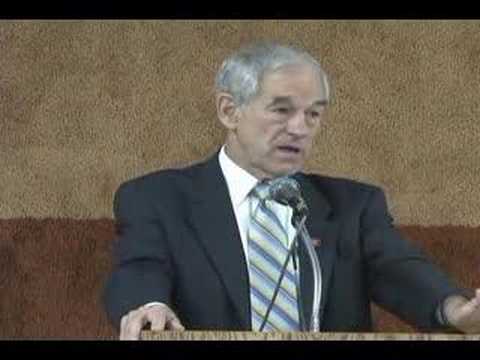
2. It is not an isolationist stance to refuse to fund other countries’ defense
Ron Paul has been accused of isolationism. This is not true. He favors open trade with other nations, and he does not want to isolate the United States from other countries. What he does not favor is unequal relations with other countries whereby we give them money and then tell them what to do. He doesn’t favor it, because it backfires every single time.
Take, for instance, the current arrangements with Israel. American money has been used to weaken Israel. American money has been used to pressure Israel to return lands that were rightfully conquered when Israel was attacked by neighboring countries. American influence in the Middle East is not good for Israel, and it’s not good for the United States, either! It would be in America’s best interest to walk away from Israel and let Israel do what is in its own best interest.

Should we turn a blind eye to atrocities committed abroad? No. But not every problem is everybody’s problem. Let’s use common sense and let the people who understand the situation take care of it.
By all means, if an American citizen is hurt or his property or holdings in a foreign land are plundered, allow him to defend himself! Allow him to raise his own army and fight his own battles. If we are concerned about oil fields being nationalized, let the people who have the most at stake stand up for their rights at their own expense. The constitution allows it. (We just need to repeal a few Federal laws that were passed forbidding people from exercising these rights — and I think Ron Paul will support that.) The point is that not every fight is a public fight and not every army is a public army. There are people who are born to be warriors and who long for battle, and they should be encouraged. But not at the public expense.
It’s one thing to go and conquer another nation, to demand tribute, even to pillage and loot, and it is quite another thing to set yourself up as the policeman who will keep everybody from fighting. The one is doable, though perhaps frowned upon. The other is impossible and no earthly good comes from trying.
3. The Ron Paul policy is the only practical policy
I’ve been told that Ron Paul has some beautiful ideas and ideals, but they are not practical. In fact, it’s quite the other way around. Ron Paul’s policy is the only practical solution for both the deficit problem and the war problem.
The government doesn’t do much of anything all that well, which is why the founding fathers limited its scope and powers. Whatever the job that needs to be done, whether it be educating a child, healing a sick person or fighting abroad on behalf of American citizens, it can be accomplished much better and at a fraction of the price by private individuals who are motivated by their own self-interest.
This is both justice and pragmatism, and Ron Paul is the only one who is offering this solution.










 When Thanksgiving Day comes around, there’s lots of work to do before the big feast. But who wants to wait until late afternoon to eat anything? Should the non-cooks starve while the cooking experts in the family put all their efforts into masterpieces that will take hours and hours to come to fruition?