
Analysis for Legal Researchers and Practitioners
The recent U.S. Department of Commerce Bureau of Industry and Security (BIS) directive restricting Anthropic’s access to its most advanced AI models—Claude Fable 5 and Claude Mythos 5—for foreign nationals (including those inside the United States) raises profound constitutional questions. This action, issued under the Export Administration Regulations (EAR) and the Export Control Reform Act of 2018 (ECRA), effectively prohibits the “export” or deemed export of these models.
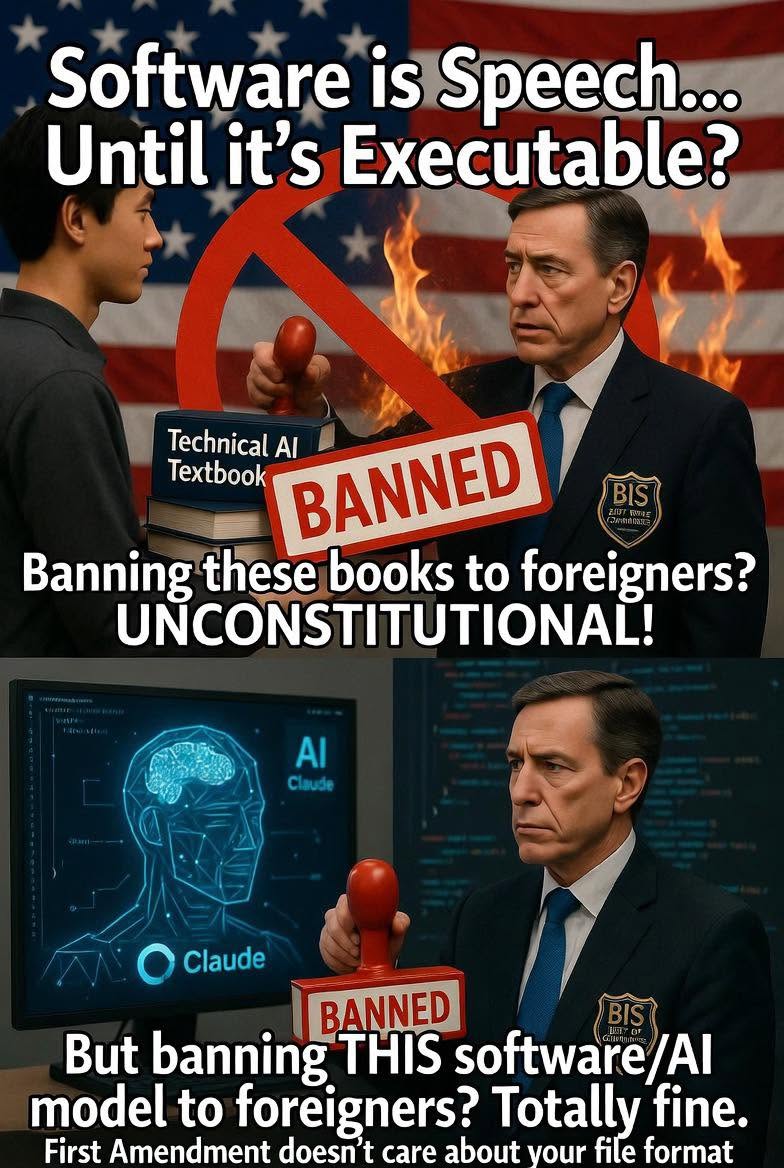
Such restrictions are functionally equivalent to a government order banning the sale or distribution of certain books—technical treatises, scientific papers, or instructional texts—to foreign nationals. Both software (including AI model weights and associated code) and books are vehicles for conveying ideas, algorithms, mathematical formulations, and knowledge. U.S. courts have long recognized computer code as protected speech under the First Amendment. Treating advanced software differently from printed books lacks a coherent doctrinal or logical basis and risks unconstitutional prior restraints on scientific expression.
This article outlines the argument in brief-like form, citing key precedents, for use by attorneys challenging similar measures.
I. Software and Books Are Both Expressive Speech
Courts have consistently held that source code is protected speech because it communicates ideas among programmers, much like mathematical equations, recipes, or musical notation.
• In Bernstein v. United States (9th Cir. 1999), the court struck down export controls on encryption source code as an unconstitutional prior restraint. The regulations required prepublication licensing, vested boundless discretion in officials, and lacked procedural safeguards. Encryption source code was deemed expressive: “a precise and rigorous expression of complex scientific ideas.”
• Junger v. Daley (6th Cir. 2000) reinforced this: source code is “an expressive means for the exchange of information and ideas about computer programming.”
• Universal City Studios v. Corley (2d Cir. 2001) affirmed that code does not lose protection merely because it is written in a specialized language or has functional effects when executed.
Executables and model weights receive analogous treatment. While less human-readable, they remain a form of expression in a specialized language. A novel in binary would still be speech; the same logic applies to compiled code or trained AI parameters, which encode learned knowledge and algorithms. Regulating distribution based on functionality does not strip First Amendment coverage—courts apply scrutiny (often intermediate for expressive conduct under United States v. O’Brien) but protect the expressive component.
Books containing the same ideas (e.g., a technical manual describing an algorithm or AI architecture) would receive unequivocal protection. Exporting or selling such a book to a foreign national requires no license in most cases. The medium—digital executable versus printed text—should not dictate constitutional outcomes. As the Bernstein court noted, the government cannot control the spread of ideas simply because they are expressed in code rather than prose.
II. The Equivalence to a Book Ban
Imagine a BIS directive prohibiting the sale of a groundbreaking cryptography textbook or scientific paper on AI training techniques to any foreign national. Such an order would be swiftly invalidated as content-based censorship or a prior restraint.
The Anthropic directive operates identically:
• It restricts access to models embodying complex ideas about intelligence, reasoning, and computation.
• “Deemed exports” to foreign nationals in the U.S. mirror banning a foreign student from purchasing a book in an American bookstore.
• Global disablement (as Anthropic implemented for compliance) chills domestic speech and innovation, much like a publisher self-censoring book distribution.
National security justifications do not grant carte blanche. Bernstein involved encryption—a clear dual-use technology with military applications—yet the court prioritized speech protections. AI models, while powerful, are tools for research, education, and commerce, akin to advanced textbooks. Broad, discretionary licensing regimes for such “technology” risk the same constitutional defects: vagueness, overbreadth, and chilling effects.
Recent analyses note that AI model weights may raise distinct questions (more functional than readable source code), but papers, architectures, and descriptive materials remain strongly protected. The government cannot evade scrutiny by targeting the “executable” form alone.
III. Legal Standards and Potential Challenges
Here are the applicable legal standards:
• Prior Restraint Doctrine: Licensing schemes for publication/distribution trigger strict scrutiny. They must include narrow tailoring, definite standards, and prompt judicial review (Freedman v. Maryland standards, applied in Bernstein).
• Content-Neutral vs. Content-Based: If targeting functionality, intermediate scrutiny applies—but the government bears the burden. Chilling scientific progress (as in cryptography) weighs against the restriction.
• Declaratory/Injunctive Relief: Plaintiffs like Anthropic (which has pursued related litigation) can seek declarations under the APA and First Amendment, plus injunctions. Arbitrary/capricious review under 5 U.S.C. § 706 provides additional avenues.
Attorneys should argue that AI export controls on models constitute the modern equivalent of book bans, retarding open science without sufficient tailoring.
Conclusion
Banning sales of advanced software or AI models to foreign nationals is, in essence, an attempt to ban the international dissemination of certain ideas encoded in digital form. This cannot be reconciled with precedents treating code as speech, nor with the fundamental principle that the First Amendment protects the marketplace of ideas regardless of medium. Courts should subject these restrictions to rigorous review, recognizing the book/software equivalence to safeguard innovation and expression.
Recommended Citations for Briefs: Bernstein v. U.S. Dep’t of Justice, 176 F.3d 1132 (9th Cir. 1999); Junger v. Daley, 209 F.3d 481 (6th Cir. 2000); ECRA (50 U.S.C. §§ 4801 et seq.); EAR (15 C.F.R. Parts 730-774). Consult primary sources and update with post-2026 developments.

