The Problem of Genre
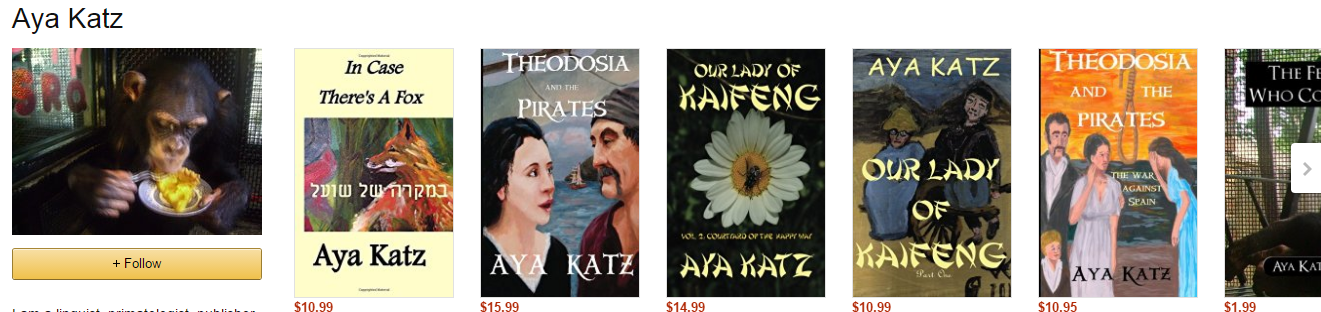
Books I have published — Buy them on Amazon
I was not quite seventeen years old when I wrote the first chapter of The Few Who Count. I was twenty-three by the time it was finished. It was my first novel. I sent out a query letter to just about every major publisher listed in the 1983 Writer’s Market. Not a single one replied with anything but a form letter. Attempts to interest an agent in the manuscript were likewise unsuccessful. Two years later, I self-published
- DAW – Penguin Group (USA)
DAW – Penguin Group (USA).
What was more troubling to me at the time than not being able to publish the book was the bizarre reactions it got from people who tried to read it. For instance, my grandmother thought it was a great mystery, “just like Agatha Christie!” Was it a mystery? Well, maybe. I mean, there were certain mysterious elements, but it wasn’t anything like an Agatha Christie. It wasn’t a whodunit. We knew who did it long in advance. The story was about something else.
A friend of mine who enjoyed the novel asked me whether I had tried submitting to DAW books. “Don’t they publish science fiction only?” I asked.
“Well, isn’t this science fiction?” she replied.
It wasn’t set in outer space or on a different planet.There were no bug-eyed monsters or aliens involved. There were no scientific theories of any sort featured in the plot. It was set on earth in the present . The characters were all human. Nobody had any supernatural powers. The technology was current. I couldn’t imagine why she thought it was science fiction.
“Because it reads that way,” she said. Her answer was matter-of-fact and filled with certainty.
That got me to thinking. What exactly is genre, and why was the genre of my novel such a puzzlement to ordinary readers?
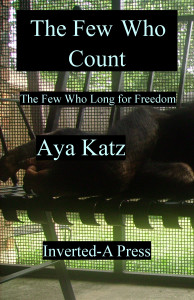
The Few Who Count — Kindle Edition Buy it on Amazon
- Factsheet Five Review: The Few Who Count
Review of a novel: THE FEW WHO COUNT
Eventually, I got one review of the book that showed the reader knew what sort of book it was supposed to be. I include a link to a copy of Mike Gunderloy’s review here. I was thrilled with this review , even though it wasn’t that positive a take on my novel, just because it showed that it is possible to read the novel and understand what kind of information it was intended to convey. It was a novel of ideas. All my writing is like that. The problem is that, somehow, most readers find this difficult to make out. They are looking for genre clues to let them know what kind of book they are reading, and the clues they expect are not there.
I didn’t mind so much that my characters were deemed to be as unrealistic as those in an Ayn Rand novel, because Ayn Rand is one of my favorite novelists, and I like her characters. Not John Galt. He’s not my cup of tea. But people like Francisco D’Anconia and Dagny Taggart are the sorts of characters I enjoy reading about. I was less thrilled with the accusation of elitism, and I vowed that next time there would be plenty of “ordinary people” in my novels. For every well educated person who sits around reading Shelley and sneering at the masses, there would be a dozen regular people who don’t read poetry, people who spend their lives working for a living, and who eat, drink and make merry, getting DWIs and going on probation for drug use, for whom divorces and fighting for custody of kids is a normal part of life, just like the clients in my law practice. I would give them a voice and let that voice be heard.
I’ll admit that The Few Who Count was an early effort, and if I were to try to re-publish it now, I would probably smooth off some of the rougher edges in the prose. But rather than do that, I wrote another novel. And wouldn’t you know it, people had trouble figuring out what that one was about, too!
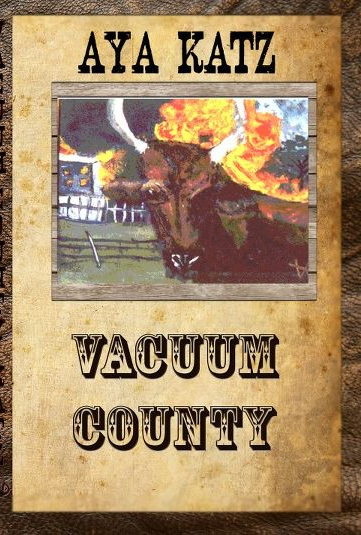
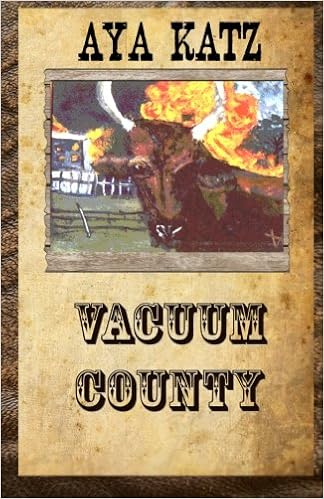
Vacuum County — Buy it on Amazon!
I began writing Vacuum County in 1989 and finished in 1993, right after the Mt. Carmel massacre.Vacuum County is not a straight third person narrative, the way The Few Who Count had been. My second novel is composed of a patchwork of documents, written from multiple points of view, but held together by a single, overarching plot. While I was writing it, I found an agent in Dallas who seemed interested. Evan Fogelman told me that my writing was literary; it was an exercise in “polyphony”. He said Vacuum Countywas like the works of Thomas Pynchon.
I didn’t think my writing was literary, and I had never heard of Thomas Pynchon. To me, literary was like Philip Roth or Saul Bellow, all existential angst and main characters with poor self-esteem.
Vacuum County is set in rural Texas in the 1970s, but it features characters straight out of the Old Testament, not to speak of dealing with ancient mysteries involving early conquerors of the Iberian peninsula, as well as later conquistadors of the Americas. The hero of the story is a local rancher, reluctant to get involved in politics. We are introduced into the action by a young woman who is dragged into county politics by the sexual harassment of the local sheriff. It was perhaps a cheap trick, but it got us into the thick of the action in a scant amount of time with a minimal need for explanations.
By the time I started writing Vacuum County, I had had my own law practice for nearly seven years, had dabbled in local politics myself, and I was a seasoned veteran ofBlake’s Seven fan fiction. I knew all about genre. I knew how to use a Mary Sue to vie for the reader’s sympathy, and I knew how to mix characters from one epic in with characters from another. (In fanfic, that’s called a “cross-over”.) In the parlance of the fan writer, my ingenue, Verity Lackland, was a “Mary Sue”.
The device of introducing the reader to the locals through a naive, socially inept ingenue is not that unusual. It’s a time-honored tradition. However, for some reason, it totally threw some of the literary agents who read the book.
By the time I had finished writing Vacuum County, Evan Fogelman had lost interest in polyphony and said he would only consider the book if I re-wrote it as a straight narrative. I couldn’t do that. The multiple narrators were too integral to the story, so I got a writer I knew to recommend me to her agent. I think that agent must have specialized in romance novels. She sent my manuscript to a reader, who thought my main character (the ingenue) was very appealing. “Just get rid of all the politics and murder and mayhem!” Well, the politics, murder and mayhem were the story.
At the time, I thought that perhaps that agent was simply not right for me, and that her assessment might have been a fluke. However, I have since received the same suggestion from a published author with a very good reputation.
So I’m willing to submit that it is not a fluke. I have a problem with genre. I don’t give readers the right signals, so their expectations are dashed. Nine people out of ten will not be able to read this book without the cliff notes.
However, the book is not objectively unreadable. It has a tight plot, with an integrated theme. The writing is good. The characters are real. There’s an emotional pay-off. It’s just not what most people expect when they start reading it. Many people, if they don’t get what they expect to get, will stop reading the moment their expectations are not met. This is true of most, but not all. When I was in grad school, I met one person, totally unrelated to me and without any personal connection, who read the book and understood every single nuance.
The problem is that it is hard to market a book for an audience that small.
What is genre, anyway? It comes from the French word meaning “kind”. When people ask about the genre of a book, they want to know what kind of a book it is. Unfortunately, they won’t be satisified with the answer: “A very good book.”
Genre isn’t just about the setting of a novel. It isn’t enough for a book to be set in the wild west in order to qualify it as a western. It’s not enough for it to be centered around the search for the perpetrator of a crime in order to qualify as a whodunit. It’s not enough for it to be set in outer space in order to make it science fiction.
Conversely, even if a book doesn’t have the expected setting or plot device, it can feel like one of the genres listed above, if “it reads that way.”
Even when a book is set in our time and does not defy any natural laws, it might seem like science fiction if the characters are not like the ones who occupy the average mainstream novel.This is because readers identify genre by the way a book makes them feel, not its setting or plot.

Our Lady of Kaifeng: Courtyard of the Happy Way Buy it on Amazon!
Romantic versus Naturalist Fiction
Mainstream fiction is often quite depressing. It presents problems, but not solutions. It describes the mundane and avoids the sublime. Just as metrical poetry has been relegated to country and western song lyrics and Hallmark cards, an integrated plot and theme with an uplifting resolution is something we expect to find in a “genre” novel — not real literature.
At the time when I first discovered my problem with genre, I was very much influenced by Ayn Rand’s Romantic Manifesto. I was aware that my fiction was romantic, and that Saul Bellow and Philip Roth and their ilk were writing a different kind. Naturalist fiction is supposed to describe people the way they really are, as opposed to idealizations of people. Somehow, when that gets translated onto the page, it turns out that “real people” are riddled with neurosis. While that accurately describes some people, it isn’t true of everyone, and the naturalist school has somehow devolved into the school of psychological pathology.
I was perfectly willing to accept a “conspiracy theory” explanation for what was going on in the literary market at the time. The explanation went something like this: “Degenerate intellectuals have taken over academia and the literary press. Romantic fiction, where heroes grapple with moral and ethical issues while dealing with real life problems, is not permitted except in genres like science fiction, fantasy, westerns and detective novels. Since everybody knows those genres aren’t serious, this relegates the romantic outlook on life to the fringes.”
Do I still believe that it’s all a conspiracy? No, not exactly. After all, ordinary people are the ones who buy books. They have a say in the marketplace. If genre distinctions weren’t meaningful to them, publishers and agents would not be so fixated on genre, either.
Focusing on the Incidentals Rather than the Content
When I began teaching writing at Tamsui Oxford University College in Taiwan, my eyes were opened to a new perspective on genre. By this time I had a Ph.D. in linguistics, and I was teaching linguistics courses as well as creative writing to college students.
One day, when the students were expected to turn in a short story assignment, I was surprised to see a girl in my class hand me a one paragraph summary of the life of Evita Peron that looked as if it had been copied straight out of the encyclopedia. I had only to glance at it briefly before I remarked: “That’s not a short story!”
The girl was very confused and there began a long consultation in Chinese with her classmates. One of them translated for me: “But it is short. And it is a story. So why isn’t it a short story?”
I began to describe the structural requirments of a short story. I also mentioned that a short story is a form of fiction.
“Then it is because Eva Peron was real that it’s not a short story?” my student asked.
“No,” I said. “You could have written a short story about Eva Peron. A short story about Eva Peron would be fiction. But this is non-fiction.”
Not only was the girl confused by this explanation, I could see that her classmates were puzzled as well.
One of them asked: “But if it is real, then how can it be fiction?”
What a very good question! We often learn from our students.
I saw that there were some genre assumptions that I had taken for granted as well, without ever having had to define them.The difference between a short story about a real person and a non-fiction account of that person’s life is often a matter of including or omitting details. Whether the details are actually true or not is almost of secondary importance.
One of the ways a history book is different from a historical novel is that the history book is written in a dry, pedantic style and omits what the protagonist had for breakfast or how he felt when mounting an attack on the enemy. A historical novel, on the other hand is meant to include such details, whether they are true or not.
It then happens that if we read an account of how Eva Peron had scrambled eggs for breakfast and the breeze from the open window whipped at her hair while she wondered what dress to wear that day, we figure it must be fiction. If we read a terse account of public events with lots of dates and numbers, we surmise that it must be non-fiction. It’s a genre thing. The truth has nothing to do with it.The numbers could be completely made up. The important thing is how it feels.
In the same way, and for the same reasons, readers have come to associate certain ways of telling a story with a particular genre, so that you don’t get to start a tale with an inexperienced young college girl and a lecherous sheriff, and have your readers prepared to read a serious story about the relationship between the governed and the government, or the individual’s struggle against the strictures of society. Or, perhaps, you don’t get to try this ploy until after you are an established writer.
So when I write my third novel, I plan to let the reader know right away what kind of novel it is. I will put in enough details so that the entire plot of the novel is completely foreshadowed in the first sentence. Hopefully, that will do the trick. If not, I could just print “A Novel of Ideas” right under the title. You can never make the genre of your work too obvious.

Our Lady of Kaifeng, Part One: The first sentence foreshadows the whole story. Buy it on Amazon!
The Fox and the Hedgehog
The Hedgehog and the Fox
Last night, I was pondering how to finish this hub, when I picked up a paperback that I inherited from my grandfather’s library. It was by Isaiah Berlin, an Oxford scholar, and the title was The Hedgehog and the Fox: An Essay on Tolstoy’s View of History. It came out in May of 1957 and the cover price was 35 cents. The title comes from a fragment by the Greek poet Archilochus: “The fox knows many things, but the hedgehog knows one big thing.”
Berlin uses this to classify thinkers and writers — and human beings in general. Hedgehogs “relate everything to a single central vision, in terms of which they understand and think and feel — a single, universal, organizing principle in terms of which alone all that they are and say has significance.” Foxes, on the other hand, “pursue many ends, often unrelated and even contradictory, connected, if at all, only in some de facto way.”
Table of Hedgehogs and Foxes

Shakespeare was a fox. His writing was a brilliant mirror on the world. Yet, after we read one of his plays, we don’t have any idea what Shakespeare thought about anything. He had no particular vision on life, beyond being able to see the details clearly. Because Shakespeare was a fox, he had no trouble with genre. His tragedies were tragedies, his comedies were comedies, and his historical dramas were … “histories”. They’re even labeled that way on the title page. A fox tells tales whose content is in their unfolding; a hedgehog tells the same story over and over again, using different material to illustrate the same point. Dostoevsky is an example of a hedgehog. So was Ayn Rand.
Isaiah Berlin concluded that Tolstoy was a fox trying desperately to disguise himself as a hedgehog.
Why would someone feel the need to disguise himself as something he isn’t? After all, Shakespeare is a writer acknowledged by all as a master of his craft, and he was a fox. Nobody thinks any the less of him for that. In fact, Shakespeare is universally acclaimed the world over.
Here, I think, is the answer. Every era has its literary preferences. In the 19th century, everyone wanted to have a unifying vision. Not everybody did, of course. Foxes and hedgehogs are born, not made. Emily Bronte was a hedgehog. Jane Austen was a fox. Charles Dickens was a fox, too. Victor Hugo was a hedgehog.
Tolstoy was a fox desperately trying to disguise himself as a hedgehog. I have a similar problem. I live in an era of foxes. But I am not a fox. I’m a hedgehog. When I wroteVacuum County, I was trying to pass myself off as a fox. Nobody was fooled.
So the moral of the story is: “To thine own self be true.” Written by a true fox.
(c) 2008 Aya Katz
Comments 33 comments

Jerilee Wei 3 years ago from United StatesLevel 2 Commenter
Very interesting, as always!

Aya Katz 3 years ago from The OzarksHub Author
Thanks, Jerilee!
anonymous 3 years ago
Jane Austen was a fox? She may have written about a lot of foxy ladies but can you point out two of her novels, that are, like, different from one another?
Nets 3 years ago
Dickens was a fox. All his novels were about the exploitation of the hapless poor by the rich and their responsible bankers. You sure could never know where he came down on anything. Why even in the Child’s History, he can scarcely go two pages without telling us which obscure British historical figures were wicked.
Hugo was a hedgehog. All his novels are attempts to get across a single underlying idea. What is it again? Let me think. The role of modern sewage systems in draining away the wealth of France? Merde. Valjean seems much less like a fox than Javert and for whom is Hugo rooting? Or can you tell? And don’t get me started on that hunchback fellow.
Are you sure you’re not confusing the categories of hedgehog and fox with the categories of writers that you like and don’t?
Aya Katz 3 years ago from The OzarksHub Author
Anonymous, thanks for the comment. It did occur to me that all of Austen’s novels are about women trying to find a husband. However, they are not all the same woman. Northanger Abbey is very different from the others with a quite different heroine. Persuasion may seem similar to Pride and Prejudice, but it’s really not the same.
I know that a feminist message is something that modern readers tack on to her writing, but I don’t think she was really a feminist. Her novels were about how individuals navigate the social landscape, and they essentially mirrored the situation as it was. Some of her characters were lampoons of real people, and they resemble Shakespeare’s comic characters. There was no exhortation for anyone to do anything about it.
Aya Katz 3 years ago from The OzarksHub Author
Nets, thanks for the comment.
I could very well be confusing the categories of fox and hedghog with “realism” versus “romanticism”, and this occured to me, too. However, I think they are not exactly the same, even in my idiosyncratic interpretation of them.
First of all, I don’t dislike Shakespeare. Julius Caesar is one of my favorite plays. I really do admire his writing, although not every part of it. Secondly, while I used to marvel that anyone could read Jane Austen, I have since developed a taste for her. Her writing is informed by a deep understanding of social skills. Until I developed a few social skills of my own, I wasn’t able to appreciate it.
About Dickens: yes, he’s a very intrusive narrator who can’t hide his bourgeois English bias. His opinions pop up everywhere. But does that have anything to do with the genius of his writing? Do we go away from a Dickens novel with the urge to become less wicked? I don’t think so. Fagin and Sykes are fascinating because they seem real. If anything, it makes us want to explore that part of ourselves more! It’s the helpless waifs in his novels, people like Oliver Twist, who pale in comparison.
I know, Dickens is supposed to be famous for fighting against child labor. But I don’t think the strength of his writing was in its value as propaganda. The real strength of his writing was in the way he portrayed and exaggerated the idiosyncracies of individual people.
Now, about Hugo and the sewer system — isn’t that just like Heinlein who gives you a lecture on stellar navigation in the middle of a classic like Podkayne of Mars? Any good editor would simply have cut those parts out as extraneous to the story. What these writers do well is to describe heroism — and make us want to go out and be heroes, too!
Nets 3 years ago
Hugo does not want us to be like Javert, although he may accidentally get us to do so. He also wants us to be more like Marius and less like the students on the barricades. Heroes?
I don’t like Dickens. So his writing doesn’t work on me to get me to be less wicked. But take the Christmas Carol, for instance. It seems to have a lot of fans for some reason. Don’t they like it because its exhortation to keep Christmas all the year has appealed to them. (Doesn’t this explain what just happened to the U.S. banking system? Scrooge checked people’s credit carefully.)
Nets 3 years ago
One more thing. When you admire Dickens for the exagerrated idiosyncracies of his characters rather than his message which is common between The Christmas Carol, Great Expectations, and Oliver Twist, how different is that from your agent saying that the girl is good but you should get rid of the local politics and mayhem. Perhaps you’re a fox and just don’t know it!
Aya Katz 3 years ago from The OzarksHub Author
Nets, it’s hard to keep our politics and religion separate from our literary assessment of a writer. But it should be possible, in theory.
I don’t know exactly what accounts for the broad popular appeal of A Christmas Carol, but it’s got to be more than fiscal policy. Otherwise, why wouldn’t we see Marx’s Das Kapital enacted on TV every Christmas? Whatever the appeal of the Dickens classic, it’s very similar to what makes people like Frank Capra’s “It’s a Wonderful Life.” I suspect it’s not about bank foreclosures so much as about the individual’s place in the community. People would like to think that if they were in trouble, other people they know would care enough to help them out. (Not the government.)
Anyway, dividing writers into foxes and hedgehogs isn’t directly related to the quality of their writing. Shakespeare and Dickens are both foxes, but Shakespeare is by far the better writer. I think even Dickens fans would agree.
Both Shakespeare and Dickens were actors. Dickens used to give performances and the ladies would swoon. He often played murderous villains. I think he was a character actor.
Perhaps if we used an analogy from acting, we might be able to see the difference between hedgehogs and foxes. Gary Cooper and Clint Eastwood are hedgehogs. They play the same character over and over again, no matter what movie they’re in. Lawrence Olivier was a fox. Meryl Streep is a fox. Julia Roberts and Meg Ryan are hedgehogs.
It’s not that Lawrence Olivier was a better actor than Gary Cooper. It’s that he was a different kind of actor. Meryl Streep is a universally acknowledged acting genius who can play many, many different roles. However, could she stand in for Julia Roberts?
It’s not a question of better or worse. It’s just different.
Aya Katz 3 years ago from The OzarksHub Author
Nets, I’ll admit that it’s quite possible for a writer not to be sufficiently introspective to know exactly what kind of writer he is. I may not be objective enough about myself. It could be that this hub smacks of arrogance, and I just need to improve my writing, period.
However, when reviewing the work of others, I do have a pretty clear idea of how to find out which part is extraneous. Take Podkayne of Mars, for example. Separate out the sections that are clearly lectures (whether on interstellar navigation, high-tech reproduction or how to change a diaper in zero G.) Leave the story intact. See which one is longer. You will end up with two different types of text. Each is a worthwhile type of writing; they just don’t belong together. I think you can do the same for Hugo and sewers.
In Dickens’ case, there is less to cut out. You could argue that the social stuff is organic to his writing. I agree. Nut Dickens’ social commentary wasn’t so much a call to change the system. He described how lost an upper class person was when he was forced to live in the lower class world. It was culture clash. In the end, most of his waifs were restored to upper (or middle class) lifestyle to which they had been born. The cocknies stayed cockney.
An example of a writer who didn’t understand his own message is Milton. He wrote Paradise Lost to exp,ain the ways of God to man, but anyone who reads the poem ends up identifying with Satan.
It’s not the explicit message that determines what a piece of writing is about. It’s the overall effect of the writing.
Nets 3 years ago
The agent would say that the interaction between Oliver Twist and the Artful Dodger was good, he should just take out all the pesky social commentary.
Charles Dickens wasn’t a science fiction writer in the mold of George Bernard Shaw. But he did want to change the system. He was just using a literary device. The upper class person was a Mary Sue entering the lower class world. At the end of the story, he became upper class again. But the idea was to get the upper class readers to understand the lower classes with the idea that they would implement social justice. The Christmas Carol is more literal. We see Scrooge change at the end. Both are trying to get across the same message, and Dickens thinks he is a hedgehog. Unfortunately for him, you disagree.
We don’t see constant reenactments of Das Kapital on television? You could have fooled me.
About Milton, that is a classical interpretation. Contrariwise, Fish in “Surprised by Sin” argues that Milton knew exactly what he was doing and his story would not have made sense without Satan being appealling.
Aya Katz 3 years ago from The OzarksHub Author
Nets,
I’m not familiar with “Surprised by Sin”. Can you provide a link?
Aya Katz 3 years ago from The OzarksHub Author
Nets, about VC: what the agent told me to do would be equivalent to telling Dickens that the relationship between Oliver Twist and the Artful Dodger was great, but he should cut out Fagin and Sykes. There would be no relationship between Oliver Twist and the Artful Dodger if not for Fagin and Sykes.
Nets 3 years ago
Aya Katz 3 years ago from The OzarksHub Author
Nets,
Thanks for the link. I’ll let you know what I think after I’ve read it.
Aya Katz 3 years ago from The OzarksHub Author
Oh, so it’s Stanley Fish! I was expecting Leslie Fish.
A de-constructionist reading, I see.
By the same logic, Dickens might have made his villains more attractive than his heroes just to make us feel guilty for identifying with villains. But somehow, I doubt it.
Or maybe Sienkiewicz made Petronius seem like more of a hero than his Christians, because he wanted readers to realize they were pagan at heart and repent? If so, I don’t think it worked.
Nets 3 years ago
Sorry I wasn’t clear.
Milton was explaining the ways of God to man. God works in mysterious ways.
Aya Katz 3 years ago from The OzarksHub Author
Okay…
So, how does this apply to Isaiah Berlin’s argument that Tolstoy was a fox trying to be a hedgehog?
Aya Katz 3 years ago from The OzarksHub Author
If we go back to Isaiah Berlin’s essay on Tolstoy, we see that his use of the terms “fox” and “hedgehog” has nothing to do with either the setting of a novel or its explicitly stated theme. Tolstoy did have a “theory of everything” and he was hoping that “War and Peace” would illustrate his points about history and the individual. Berlin’s essay suggests that the theory was bogus and that the real power of Tolstoy’s writing had nothing to do with it.
The terms “hedgehog” and “fox”, as used by Berlin, meant “visionary” versus “clear-sighted descriptivist.” Berlin thought Tolstoy was a great writer because he could see the significant differences between and among individuals — just as Shakespeare could. What Tolstoy didn’t have, although he longed to have this, was a unifying vision.
Writers like Ayn Rand get blasted for exactly the opposite. They have a grand sweeping vision, but not a lot of psychological insight into individual people.
This dichotomy, like all dichotomies, overgeneralizes. Perhaps everyone will disagree with some of my classifications. Maybe I’m wrong about where Dickens or Jane Austen fit in. That’s because classifying all writers into two different types has its limitations. However, it can be a useful exercise, if we take into account what those limitations are.
It’s like that joke about binary that I saw posted somewhere. There are 10 kinds of people: those who like counting in binary and those who don’t!

Bob Ewing 3 years ago from New BrunswickLevel 1 Commenter
I am on the verge of writing my first novel and I found reaidng yoru hub helpful, why? It says to me go ahead and write. thanks.

Shadesbreath 3 years ago from CaliforniaLevel 5 Commenter
You came to the right conclusion in the end. You just have to write. You can’t write your novel for publication, for the market, or based on what people say or critics write. I mean, you can if you want, lay yourself out a little formula for some genre and let ‘er rip. But if you truly love to write, you just need to sit down and do it.
Some of your issues with literature and genre are addressed deeply and I think very truthfuly in John Gardner’s “On Moral Fiction,” and he does get into the trap that modern romantic writers can feel trapped in.
Anyway, just write. You too Bob, just do it, man. Write it. Write it for you, not for anyone else. F- the publishers, F- the critics, F- the agents. Writing is a way of life, it’s art. It’s not hoop jumping for some a-hole somewhere else.
Aya Katz 3 years ago from The OzarksHub Author
Bob Ewing, Shadesbreath, thanks for your encouraging comments. They mean a lot!
I will try to look up John Gardner’s “On Moral Fiction.”

Jerry G2 3 years ago from Cedar Rapids, IA
Great topic! As an undergrad I remember my favorite professor telling me I would get a lot of attention because I had an interesting, unique writing style, but I would have to be stubborn to publish because it was too unique to be boxed into a genre. So I know your struggle 🙂 Great hub, and thanks for sharing!

SweetiePie 3 years ago from Southern California, USALevel 6 Commenter
Very dedicated to have started writing at a young age. At least you went for your dreams instead of just talking about it as many of us do :). I like novels that cannot be compartimentalized into genres also, and many times a novel that is listed by one genre is not exactly this. It is good you remained true to yourself and provided a detailed summary of the book for those who will read it. I actually like to read books without always reading the summary first, I usually wait until twenty pages in to do that. This way I am able to get a feel for the book without prejudging the book by its cover.
Aya Katz 3 years ago from The OzarksHub Author
Jerry G2, Sweetie Pie, thanks for your comments. Jerry, I see you actually have a writing job. That’s great!
Sweetie Pie, I like to be surprised by a book when I read it, too. I usually skip the summary. I also like to figure out for myself what the book is actually saying, regardless of what the author’s take on it is. But … not everybody feels that way.

Trsmd 3 years ago from India
“But if it is real, then how can it be fiction?”..
very good quote..from the classmate..
Aya Katz 3 years ago from The OzarksHub Author
Trsmd, thanks for the comment!
Yes. That is a very good question from the student’s perspective. We often give one defintion for fiction (or some other literary term) , when instinctively we are operating based on a completely different understanding of what we mean. The new term “creative non-ficiton” has recently sprung up, perhaps in order to deal with the fuzzy line between truth and fiction.

satomko 2 years ago from Macon, GALevel 1 Commenter
Excellent hub with some really good analysis.
Aya Katz 2 years ago from The OzarksHub Author
Satomko, thanks!

Ladybythelake55 2 years ago from I was Born in Bethesda, Maryland and I live in Chicago,IL
genre is everything. Some publishers wil tell you the only genre they want and others will not you are taking a wild guess in trying to fingure out what genre they want. There are a lot of self publishers out there and I would be careful. I am working with one of them but my novel has a long way to go. Karissa
Aya Katz 2 years ago from The OzarksHub Author
Ladybythelake55, thanks for your comment. It’s true. A lot of established publishers swear by genre as a way of defining the market for a novel. Others will ask you bluntly what is your demographic. I would not consider a company that helps people get published a “self-publisher.” I reserve that label for those of us who publish our own works. I am considering marketing my second novel through CreateSpace. What company are you working with? What I look for is someone who will take a percentage of the take but does not expect payment from me up front. That way I know they are not just a vanity press.
Aya Katz 5 months ago from The OzarksHub Author
For those of you who are still following this hub, here is a new book trailer that I have put together for “Vacuum County.” After you see the video, please let me know what genre it sounded as if the book belonged in, if all you knew was what is in the trailer: