This gallery contains 21 photos.
When we cannot travel, it’s good to live in a beautiful place. Continue reading
This gallery contains 21 photos.
When we cannot travel, it’s good to live in a beautiful place. Continue reading

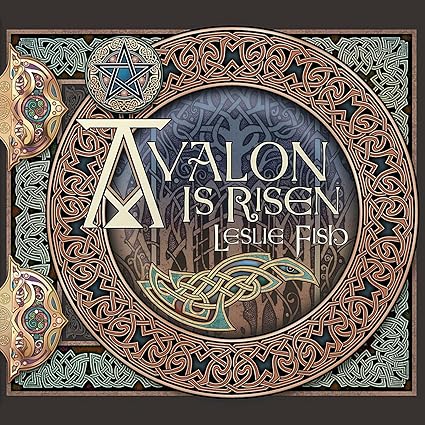
Cover of “Avalon is Risen” Album produced by Prometheus music
Produced by Kristoph Klover, performed by Leslie Fish and published by Prometheus Music, Avalon is Risen is the filk album we have all been waiting for. The music is celtic and folkish, but with that special touch that only Leslie Fish adds. If you are not a Fish aficionado yet, you will be, after listening to these songs.
A Leslie Fish album is not something you listen to once and then put away. It is an experience to savor, to hear over and over again, until the music sinks into your soul and your spirits rise.
Some of the songs are funny. Some are serious. But all are full of magic and meaning. Leslie Fish composed the music to nearly all the songs, with some exceptions. She wrote the lyrics to most, and those whose lyrics are not her own come from the pens of Isaac Bonewits, Rudyard Kipling, Robert Browning, Poul Anderson, Gordon Dickson (music!), Don Simpson and Christa Landon.
Additional credits run as follows: Margaret Davis: backing vocals; Shira Kammen: vielle; Kristoph Klover: backing vocals, djembe, electric bass & percussion; Nada Lewis: accordion; Kevin White: backing vocals; Rob Wilson: bodhran.
If you buy the physical CD, you will receive with it a beautifully illustrated booklet with all the lyrics and an introduction by Diana Paxson.
But there is another, much less expensive way to to purchase the album. You can get all the songs as an mp3 download, or you can also download each song separately as a single. Just to give a few highlights, I will describe for you some of the individual songs.
The lyrics to “Avalon is Risen” are by Isaac Bonewits. He is the author of Real Magic, a seminal work on modern sorcery.
The song he wrote begins like this:
Hail the day so long expected, when the Gates are opened wide.
Magicks, old and new collected, have restored the ancient pride.
Throughout Faerie’s wide dominion hear the trumpets swoop and soar.
Avalon is risen, is risen, is risen.
Avalon is risen, to fall no more.
“The Sun is Also a Warrior” by Leslie Fish acknowledges that while war is to be avoided when possible, there are things much worse than war, and that is why wars will never cease.
Of course, battle madness, while helpful in the fray, must be controlled. That is the subject addressed by “The Berserker”:
Oh, do not seek to know what lies
Behind these mild and patient eyes,
For I have seen the demon’s powers –
And even let the monster run –
In certain unforgotten hours.
The fire that sleeps within the blood
Can waken to a burning flood
That sweeps away whatever moved
Before the wordless killer’s eye.
Oh, do not cry to see it proved!
“The God’s Aren’t Crazy” is a fun song by Leslie, more playful than serious, about how inexplicable events may be laid down to the gods’ inebriation:
Look out your window and what do you spy?
Rain falling out of a sunshiny sky.
It’s changing to hailstones that weigh half a ton,
With seven live frogs hopping out of each one.
It’s not the Last Judgment; stop wailing of Sin.
It’s only the gods at wine tasting again.
So drink, drink, to Charlie Fort’s memory –
Marvelous doings, and marvelous sights.
Drink, drink, we may as well join them.
The gods are not crazy; they’re higher than kites.
One of my favorites is “Lucifer”, with lyrics by Don Simpson based on a poem by Browning.
Taste of the fruit of the tree that is knowledge,
Of good and of evil, and all the world’s lore.
A creature’s thought must exceed what it’s taught,
Or who is Heaven for?
So come here and learn to become as the gods are,
For I’ve got a wonderful secret to tell:
A creature’s reach should exceed its grasp.
What else is Heaven or Hell?
Other notable songs include the “The Ballad of Three Kings” with lyrics by Poul Anderson and music by Gordon Dickson (!), which I used to hear sung not very well at my local filksing, but which is beautifully performed by Leslie, and Chickasaw Mountain, Leslie’s song about the deals musicians make with fame.
They’re good, and Bow and I have listened to them all. The only one he objects to is “Jack the Slob” which somehow seems to suggest that a female chimpanzee is unattractive. Bow and I know better than that. But on the plus side, the instrumentals on that song are great!
If you like folk music, magic, science fiction or even just metrical poetry, you will like
Avalon is Risen. Buy the album, if you can afford to. If you can’t, buy the mp3 download– or at least, your favorite song. Even if you’ve heard these songs before, you have never heard them like this!
(c) 2012 Aya Katz
In a perfect world, the lunar calendar and the solar calendar would be in synch. The cycles of the moon and the revolution of the earth around the sun would work together to create a single unified calendar by which we could mark all events. The fact that this is not the case is just one indication that the formation of our solar system was a random event, rather than a result of intelligent design. The mismatch in calendars, however, has spawned lots of mathematical calculations and has given philosophers and theologians much food for thought.
Early man went by the lunar calendar, because on a daily basis, and week by week, this calendar works best, but users of a lunar calendar were forced to make corrections, so that there would not be slippage from year to year for the major seasons, which are solar events. Because each culture made these corrections differently, there are several well known lunar calendars, the most famous of which are the Chinese Lunar Calendar and the Hebrew Lunar Calendar.
The calendar that most of the world goes by today is a solar calendar invented by the Romans, known as the Gregorian Calendar.
In order to see the variations in how the different calendars treat lunar events and solar events, let’s talk about the harvest moon, an annual occurrence that happens in the fall.
The harvest moon is the full moon that occurs “closest to the autumnal equinox”, according to the wikipedia. As such, this is an event that is defined both by the solar cycle and the lunar cycle. If the lunar and the solar calendars were totally in synch, then this event would occur on the same day of the year, no matter which calendar we were using.
This year, 2012, the Harvest Moon falls on September 29-30, according to earthsky.org. The “Harvest Moon” is so called, because in the days before artificial lights, farmers found that it was easiest to bring in the crops during the harvest moon, as there is no long dark period between sunset and moonrise during the full moon closest to the autumnal equinox.
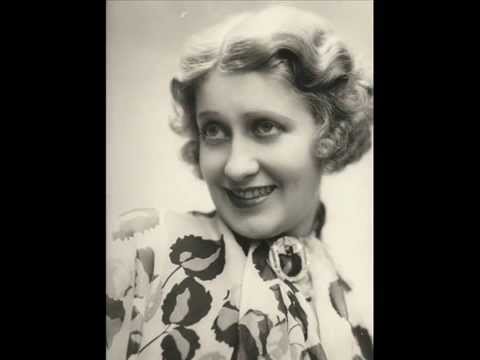
The most famous song about the Harvest Moon is “Shine On Harvest Moon”
By Nora Bayes and Jack Norworth (1903).
Now, because the Gregorian calendar is a solar calendar, the Harvest moon in the Northern Hemisphere occurs in either September or October, but never on the same day, from year to year. On the other hand, when you use a lunar calendar, then the full moon always occurs on the 15th day of the month. Every four years the Harvest Moon occurs in October in the Northern Hemisphere according to the Gregorian Calendar. Quite a bit more rarely, the autumnal equinox and the Harvest Moon coincide, occurring during the same night. When this happens, it is called a Super Harvest Moon.
There are two lunar holidays I know of celebrated around the time of the harvest moon, each in a different lunar calendar and according to a different cultural tradition.

Mid-Autumn Festival Celebration in Beijing
Image Source: Wikipedia
The Chinese Mid-Autumn Festival ( 中秋節) celebrates an ancient legend involving the moon, and it falls on the 15th day of the eighth month of the Chinese Lunar Calendar. Because the lunar calendar and the Gregorian Calendar are not in synch, this is a different day in either September or October, by the western calendar, each year. Notice that it’s called Mid-Autumn Festival, implying that it celebrates the Autmnal Equinox, but it is not defined that way: it is defined by the full moon, so only on a Super Harvest Moon will Mid-Autumn Festival actually occur during the Autumnal Equinox. This year, 2012, Mid-Autumn Festival will occur on September the 30th. However, in 2013, it will fall on September 19, in 2014, on September 8, in 2015, on September 27, in 2016, on September 15, and in 2017 on October 4.
The holiday of Sukkoth, in Hebrew, סֻכּוֹת, is a celebration defined in the Old Testament, and it falls on the 15th day of the seventh month of the Hebrew calendar. During this holiday, people build huts in their yards and gather harvested fruit. It is a seven day event, but the first day falls on the full moon. This year, 2012, that is officially set as October 1st, according to the Wikipedia. But if you really understand how Hebrew holidays work, then you know that the holiday starts on the eve of the day before, and that this year that’s on the eve of September 30th: ערב סכות erev Sukkoth.
So… do Mid-Autumn Festival and Sukkoth occur on the same day? It’s very, very close. From a celestial event perspective, are these two holidays not really the same? And aren’t they supposed to occur during the Harvest Moon? What do you think? Do Mid-Autumn Festival and Sukkoth start on the same day of the lunar calendar? Do you think they celebrate different things? Or are they two slightly different cultures’ way of observing the same celestial event and the same season of harvest?
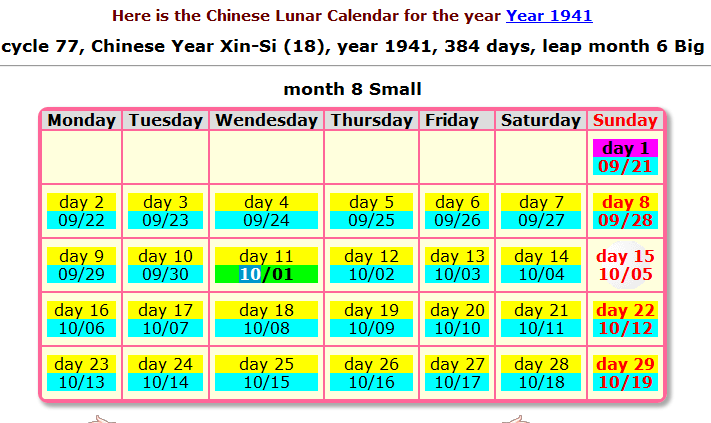
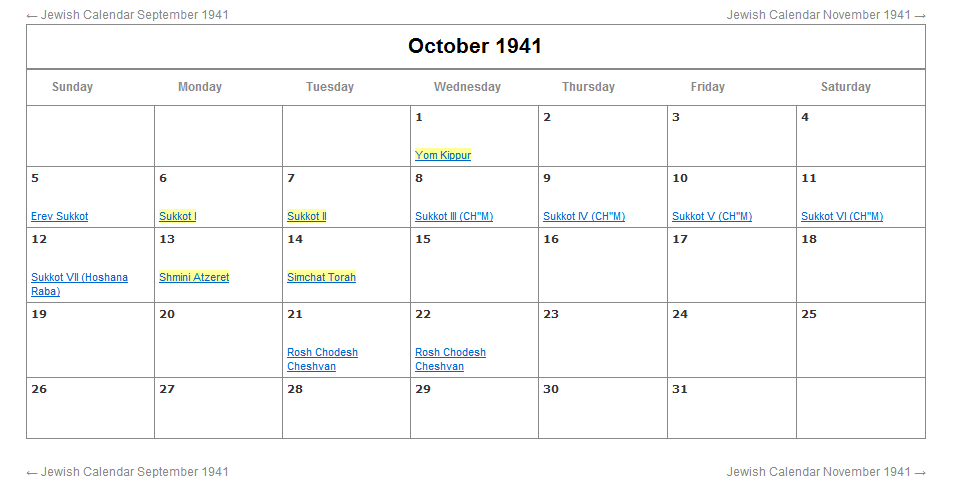
When I lived in Taiwan, and I witnessed some of the Mid-Autumn Festival celebrations, many things about the festivities did remind me of Sukkoth in Israel. I used this experience in writing my novel Our Lady of Kaifeng, which is set in China in 1941. When I was researching the story, I found out that in 1941, Mid-Autumn Festival and Sukkoth both fell on the same day of the Gregorian calendar: October 5th.
In Chapter 6, “Harvest Moon”, of Our Lady of Kaifeng, Marah Fallowfield is taken by Father Horvath to celebrate Sukkoth with the the Kaifeng Jews, but the ceremonies they conduct are not all that different from those being held by Chinese people throughout the city. When Marah realizes that the two holidays, Sukkoth and Mid-Autumn Festival, fall on the same day, she wonders why that is. Ted Sesame suggests that it might be because there is only one god. But Marah thinks it’s because there is only one moon. What do you think?
This year, whether you are celebrating the harvest moon, Mid-Autumn Festival, or Sukkoth, don’t forget to look up at the beautiful big, bright moon on the evening of September 29th and 3oth!

Our Lady of Kaifeng — Part One — Order Here

Our Lady of Kaifenv — Part Two — Order here
Related Links
http://eyeonlifemag.com/eye-on-writing/book-review-our-lady-of-kaifeng-by-aya-katz
http://sweetiepie.hubpages.com/hub/Book-Review-Our-Lady-of-Kaifeng
http://www.examiner.com/article/aya-katz-and-the-artwork-from-the-novel-our-lady-of-kaifeng
If you are searching for property in Tenerife the Tenerife Property Video Blog will make it much easier for you to find what you are looking for. Tenerife Property Video Blog provides access to some of the best properties for sale in Tenerife with its searchable database and video blogs.
Articles are published on a very regular basis to give would-be buyers the sort of information they require. Site owner and property specialist John Parkes also provides the latest Tenerife news of real estate on the island, and the Tenerife Property Video Blog enables you to easily browse for what you are looking for. You can search the listings for apartments, villas, houses, and land too, that is for sale in the south of Tenerife. The Tenerife Property Finder allows you to make your search on a map of the island.
How the Tenerife Property Video Blog works:
Besides publishing up-to-date news of properties and an easy to use search database, Tenerife Property Video Blog shows the apartments, villas, houses and land that is for sale in Tenerife with a click-able map. It is very simple to use because all you have to do is to click on an area to see a close up of the town or village you are interested in. When you do this you will be taken to a map of that location with a link shown for every part of the area that currently has property for sale. The Tenerife Property Video Blog makes searching for apartments for sale in Tenerife really easy.
Videos are featured of selected properties too, and in this way you can have an excellent visual guide to look at to help you decide if this could be the sort of place you are looking for.
Tenerife Property Video Blog also invites property owners who have properties for sale to list them on the site. There is a List Your Property section displayed on the website below.
Tenerife Property Video Blog links
• The Tenerife Property Video Blog – Property For Sale Tenerife
The Tenerife property Video Blog gives you access to the best properties for sale in Tenerife using it’s searchable database and video blogs. Articles are regularly published to give would be buyers information they need. http://www.propertyforsaleintenerife.com/
• YouTube – PropertyTenerife’s Channel http://www.youtube.com/user/PropertyTenerife
YouTube site for PropertyTenerife
Tenerife Property Video Blog contact details
Tenerife Property Video Blog, 65 Calle Verode, Charco Del Valle, Los Menores, 38677, Santa Cruz de Tenerife.
To contact Tenerife Property Video Blog the e-mail address is info@propertyforsaleintenerife.com
or phone:(0034) 678761491 or (0034) 666907255
Copyright © 2012 Steve Andrews. All Rights Reserved.
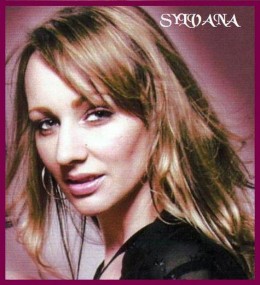
Let me introduce you to Sylvana White
I had the pleasure of an exclusive interview with Canadian singer Sylvana White.
Please introduce yourself to my readers.
Hi my name is Sylvana White! I was born in Montreal, Canada and raised in a musical environment as my parents and other family members were singers and musicians. Ever since I can remember, music has always been my greatest passion.
The Sylvana White interview:
What started you wanting to be involved in the music business?
I realized at an early age that singing and performing were part of me and doing it is where I feel home and at my place. As a singer/songwriter it permits me to express my feelings since I think, that using lyrics and music are a good way to communicate and get messages out there. When I perform a song, whether it is an original or a cover or even someone else’s lyrics, I do it with my heart and soul, as my gesture and expression will make you travel in different little stories. In other words, I literally live the song and am like this in the studio or on a stage simply because I like to keep it real. My favourite expression is KISS ( Keep It Simple & Silly).
How would you describe the sort of songs you perform?
The sort of songs that I perform are a mix of Pop/Rock and Blues since I like to mix different genre and have a versatile sound and voice. I like to be different but it’s not always easy and had my moments where I thought maybe I should fit in the mould …
What would you say are some of the most memorable moments in your career so far?
I’ve had good support from fans, friends and family and they’ve always made sure that I would remember how special I am and that it is more than OK to see out of the box. I remember the first time I performed my third single back when I was with Infini-T, I happened to look more at a particular person in the audience and I did not know her but I felt her sadness at some point and performed the song like it was written for her. She came to see me after the show and told me that because of what I did, it gave her hope she would appreciate life and continue to believe and fight for what she wanted. This girl wanted to kill herself that night and the last thing she wanted to do was to see her favourite singer before she went. You see sometimes it does not take much to help someone and it does not cost anything. My best reward was to see her smile and that she is a very happy person today! Music is the medicine of the mind!
What other acts do you admire the most?
I will not give any names, because there are too many, but I can tell you that what I admire in an artist is their hard work, devotion to their fans, their honesty, originality, true talent and most of all a positive attitude.
What do you have planned for the future?
I just kind of described myself here but it is how I see things too and what I want to continue doing for the future, as I want to travel and sing all over the world and to be able to get as close as possible to my FANS because us, artists, we exist because of them, so don’t they deserve to see us for real and not just on TV, in magazines etc? I see myself performing and singing for as long as I can!!
Anything else you would like to add?
Thank you and hope to see you all very soon!!
Copyright © 2012 Steve Andrews. All Rights Reserved.
Sylvana White link:
SYLVANA WHITE Music, Lyrics, Songs, and Videos by SYLVANA WHITE at Reverb Nation: http://www.reverbnation.com/sylvanawhite

Books I have published — Buy them on Amazon
I was not quite seventeen years old when I wrote the first chapter of The Few Who Count. I was twenty-three by the time it was finished. It was my first novel. I sent out a query letter to just about every major publisher listed in the 1983 Writer’s Market. Not a single one replied with anything but a form letter. Attempts to interest an agent in the manuscript were likewise unsuccessful. Two years later, I self-publishedThe Few Who Count. My local library would not catalog or shelve the free copy I provided, even though it did have an ISBN number. If you look for it online today, you will find that it exists, but is not available, rather like a Jeffersonian version of God.
What was more troubling to me at the time than not being able to publish the book was the bizarre reactions it got from people who tried to read it. For instance, my grandmother thought it was a great mystery, “just like Agatha Christie!” Was it a mystery? Well, maybe. I mean, there were certain mysterious elements, but it wasn’t anything like an Agatha Christie. It wasn’t a whodunit. We knew who did it long in advance. The story was about something else.
A friend of mine who enjoyed the novel asked me whether I had tried submitting to DAW books. “Don’t they publish science fiction only?” I asked.
“Well, isn’t this science fiction?” she replied.
It wasn’t set in outer space or on a different planet.There were no bug-eyed monsters or aliens involved. There were no scientific theories of any sort featured in the plot. It was set on earth in the present . The characters were all human. Nobody had any supernatural powers. The technology was current. I couldn’t imagine why she thought it was science fiction.
“Because it reads that way,” she said. Her answer was matter-of-fact and filled with certainty.
That got me to thinking. What exactly is genre, and why was the genre of my novel such a puzzlement to ordinary readers?

The Few Who Count — Kindle Edition Buy it on Amazon
Eventually, I got one review of the book that showed the reader knew what sort of book it was supposed to be. I include a link to a copy of Mike Gunderloy’s review here. I was thrilled with this review , even though it wasn’t that positive a take on my novel, just because it showed that it is possible to read the novel and understand what kind of information it was intended to convey. It was a novel of ideas. All my writing is like that. The problem is that, somehow, most readers find this difficult to make out. They are looking for genre clues to let them know what kind of book they are reading, and the clues they expect are not there.
I didn’t mind so much that my characters were deemed to be as unrealistic as those in an Ayn Rand novel, because Ayn Rand is one of my favorite novelists, and I like her characters. Not John Galt. He’s not my cup of tea. But people like Francisco D’Anconia and Dagny Taggart are the sorts of characters I enjoy reading about. I was less thrilled with the accusation of elitism, and I vowed that next time there would be plenty of “ordinary people” in my novels. For every well educated person who sits around reading Shelley and sneering at the masses, there would be a dozen regular people who don’t read poetry, people who spend their lives working for a living, and who eat, drink and make merry, getting DWIs and going on probation for drug use, for whom divorces and fighting for custody of kids is a normal part of life, just like the clients in my law practice. I would give them a voice and let that voice be heard.
I’ll admit that The Few Who Count was an early effort, and if I were to try to re-publish it now, I would probably smooth off some of the rougher edges in the prose. But rather than do that, I wrote another novel. And wouldn’t you know it, people had trouble figuring out what that one was about, too!

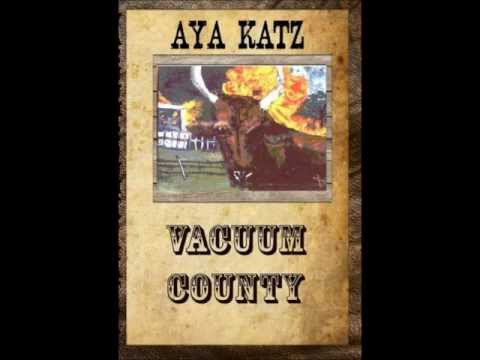
Vacuum County — Buy it on Amazon!
I began writing Vacuum County in 1989 and finished in 1993, right after the Mt. Carmel massacre.Vacuum County is not a straight third person narrative, the way The Few Who Count had been. My second novel is composed of a patchwork of documents, written from multiple points of view, but held together by a single, overarching plot. While I was writing it, I found an agent in Dallas who seemed interested. Evan Fogelman told me that my writing was literary; it was an exercise in “polyphony”. He said Vacuum Countywas like the works of Thomas Pynchon.
I didn’t think my writing was literary, and I had never heard of Thomas Pynchon. To me, literary was like Philip Roth or Saul Bellow, all existential angst and main characters with poor self-esteem.
Vacuum County is set in rural Texas in the 1970s, but it features characters straight out of the Old Testament, not to speak of dealing with ancient mysteries involving early conquerors of the Iberian peninsula, as well as later conquistadors of the Americas. The hero of the story is a local rancher, reluctant to get involved in politics. We are introduced into the action by a young woman who is dragged into county politics by the sexual harassment of the local sheriff. It was perhaps a cheap trick, but it got us into the thick of the action in a scant amount of time with a minimal need for explanations.
By the time I started writing Vacuum County, I had had my own law practice for nearly seven years, had dabbled in local politics myself, and I was a seasoned veteran ofBlake’s Seven fan fiction. I knew all about genre. I knew how to use a Mary Sue to vie for the reader’s sympathy, and I knew how to mix characters from one epic in with characters from another. (In fanfic, that’s called a “cross-over”.) In the parlance of the fan writer, my ingenue, Verity Lackland, was a “Mary Sue”.
The device of introducing the reader to the locals through a naive, socially inept ingenue is not that unusual. It’s a time-honored tradition. However, for some reason, it totally threw some of the literary agents who read the book.
By the time I had finished writing Vacuum County, Evan Fogelman had lost interest in polyphony and said he would only consider the book if I re-wrote it as a straight narrative. I couldn’t do that. The multiple narrators were too integral to the story, so I got a writer I knew to recommend me to her agent. I think that agent must have specialized in romance novels. She sent my manuscript to a reader, who thought my main character (the ingenue) was very appealing. “Just get rid of all the politics and murder and mayhem!” Well, the politics, murder and mayhem were the story.
At the time, I thought that perhaps that agent was simply not right for me, and that her assessment might have been a fluke. However, I have since received the same suggestion from a published author with a very good reputation.
So I’m willing to submit that it is not a fluke. I have a problem with genre. I don’t give readers the right signals, so their expectations are dashed. Nine people out of ten will not be able to read this book without the cliff notes.
However, the book is not objectively unreadable. It has a tight plot, with an integrated theme. The writing is good. The characters are real. There’s an emotional pay-off. It’s just not what most people expect when they start reading it. Many people, if they don’t get what they expect to get, will stop reading the moment their expectations are not met. This is true of most, but not all. When I was in grad school, I met one person, totally unrelated to me and without any personal connection, who read the book and understood every single nuance.
The problem is that it is hard to market a book for an audience that small.
What is genre, anyway? It comes from the French word meaning “kind”. When people ask about the genre of a book, they want to know what kind of a book it is. Unfortunately, they won’t be satisified with the answer: “A very good book.”
Genre isn’t just about the setting of a novel. It isn’t enough for a book to be set in the wild west in order to qualify it as a western. It’s not enough for it to be centered around the search for the perpetrator of a crime in order to qualify as a whodunit. It’s not enough for it to be set in outer space in order to make it science fiction.
Conversely, even if a book doesn’t have the expected setting or plot device, it can feel like one of the genres listed above, if “it reads that way.”
Even when a book is set in our time and does not defy any natural laws, it might seem like science fiction if the characters are not like the ones who occupy the average mainstream novel.This is because readers identify genre by the way a book makes them feel, not its setting or plot.

Our Lady of Kaifeng: Courtyard of the Happy Way Buy it on Amazon!
Mainstream fiction is often quite depressing. It presents problems, but not solutions. It describes the mundane and avoids the sublime. Just as metrical poetry has been relegated to country and western song lyrics and Hallmark cards, an integrated plot and theme with an uplifting resolution is something we expect to find in a “genre” novel — not real literature.
At the time when I first discovered my problem with genre, I was very much influenced by Ayn Rand’s Romantic Manifesto. I was aware that my fiction was romantic, and that Saul Bellow and Philip Roth and their ilk were writing a different kind. Naturalist fiction is supposed to describe people the way they really are, as opposed to idealizations of people. Somehow, when that gets translated onto the page, it turns out that “real people” are riddled with neurosis. While that accurately describes some people, it isn’t true of everyone, and the naturalist school has somehow devolved into the school of psychological pathology.
I was perfectly willing to accept a “conspiracy theory” explanation for what was going on in the literary market at the time. The explanation went something like this: “Degenerate intellectuals have taken over academia and the literary press. Romantic fiction, where heroes grapple with moral and ethical issues while dealing with real life problems, is not permitted except in genres like science fiction, fantasy, westerns and detective novels. Since everybody knows those genres aren’t serious, this relegates the romantic outlook on life to the fringes.”
Do I still believe that it’s all a conspiracy? No, not exactly. After all, ordinary people are the ones who buy books. They have a say in the marketplace. If genre distinctions weren’t meaningful to them, publishers and agents would not be so fixated on genre, either.
When I began teaching writing at Tamsui Oxford University College in Taiwan, my eyes were opened to a new perspective on genre. By this time I had a Ph.D. in linguistics, and I was teaching linguistics courses as well as creative writing to college students.
One day, when the students were expected to turn in a short story assignment, I was surprised to see a girl in my class hand me a one paragraph summary of the life of Evita Peron that looked as if it had been copied straight out of the encyclopedia. I had only to glance at it briefly before I remarked: “That’s not a short story!”
The girl was very confused and there began a long consultation in Chinese with her classmates. One of them translated for me: “But it is short. And it is a story. So why isn’t it a short story?”
I began to describe the structural requirments of a short story. I also mentioned that a short story is a form of fiction.
“Then it is because Eva Peron was real that it’s not a short story?” my student asked.
“No,” I said. “You could have written a short story about Eva Peron. A short story about Eva Peron would be fiction. But this is non-fiction.”
Not only was the girl confused by this explanation, I could see that her classmates were puzzled as well.
One of them asked: “But if it is real, then how can it be fiction?”
What a very good question! We often learn from our students.
I saw that there were some genre assumptions that I had taken for granted as well, without ever having had to define them.The difference between a short story about a real person and a non-fiction account of that person’s life is often a matter of including or omitting details. Whether the details are actually true or not is almost of secondary importance.
One of the ways a history book is different from a historical novel is that the history book is written in a dry, pedantic style and omits what the protagonist had for breakfast or how he felt when mounting an attack on the enemy. A historical novel, on the other hand is meant to include such details, whether they are true or not.
It then happens that if we read an account of how Eva Peron had scrambled eggs for breakfast and the breeze from the open window whipped at her hair while she wondered what dress to wear that day, we figure it must be fiction. If we read a terse account of public events with lots of dates and numbers, we surmise that it must be non-fiction. It’s a genre thing. The truth has nothing to do with it.The numbers could be completely made up. The important thing is how it feels.
In the same way, and for the same reasons, readers have come to associate certain ways of telling a story with a particular genre, so that you don’t get to start a tale with an inexperienced young college girl and a lecherous sheriff, and have your readers prepared to read a serious story about the relationship between the governed and the government, or the individual’s struggle against the strictures of society. Or, perhaps, you don’t get to try this ploy until after you are an established writer.
So when I write my third novel, I plan to let the reader know right away what kind of novel it is. I will put in enough details so that the entire plot of the novel is completely foreshadowed in the first sentence. Hopefully, that will do the trick. If not, I could just print “A Novel of Ideas” right under the title. You can never make the genre of your work too obvious.

Our Lady of Kaifeng, Part One: The first sentence foreshadows the whole story. Buy it on Amazon!
The Fox and the Hedgehog
Last night, I was pondering how to finish this hub, when I picked up a paperback that I inherited from my grandfather’s library. It was by Isaiah Berlin, an Oxford scholar, and the title was The Hedgehog and the Fox: An Essay on Tolstoy’s View of History. It came out in May of 1957 and the cover price was 35 cents. The title comes from a fragment by the Greek poet Archilochus: “The fox knows many things, but the hedgehog knows one big thing.”
Berlin uses this to classify thinkers and writers — and human beings in general. Hedgehogs “relate everything to a single central vision, in terms of which they understand and think and feel — a single, universal, organizing principle in terms of which alone all that they are and say has significance.” Foxes, on the other hand, “pursue many ends, often unrelated and even contradictory, connected, if at all, only in some de facto way.”

Shakespeare was a fox. His writing was a brilliant mirror on the world. Yet, after we read one of his plays, we don’t have any idea what Shakespeare thought about anything. He had no particular vision on life, beyond being able to see the details clearly. Because Shakespeare was a fox, he had no trouble with genre. His tragedies were tragedies, his comedies were comedies, and his historical dramas were … “histories”. They’re even labeled that way on the title page. A fox tells tales whose content is in their unfolding; a hedgehog tells the same story over and over again, using different material to illustrate the same point. Dostoevsky is an example of a hedgehog. So was Ayn Rand.
Isaiah Berlin concluded that Tolstoy was a fox trying desperately to disguise himself as a hedgehog.
Why would someone feel the need to disguise himself as something he isn’t? After all, Shakespeare is a writer acknowledged by all as a master of his craft, and he was a fox. Nobody thinks any the less of him for that. In fact, Shakespeare is universally acclaimed the world over.
Here, I think, is the answer. Every era has its literary preferences. In the 19th century, everyone wanted to have a unifying vision. Not everybody did, of course. Foxes and hedgehogs are born, not made. Emily Bronte was a hedgehog. Jane Austen was a fox. Charles Dickens was a fox, too. Victor Hugo was a hedgehog.
Tolstoy was a fox desperately trying to disguise himself as a hedgehog. I have a similar problem. I live in an era of foxes. But I am not a fox. I’m a hedgehog. When I wroteVacuum County, I was trying to pass myself off as a fox. Nobody was fooled.
So the moral of the story is: “To thine own self be true.” Written by a true fox.
(c) 2008 Aya Katz

Jerilee Wei 3 years ago from United StatesLevel 2 Commenter
Very interesting, as always!

Aya Katz 3 years ago from The OzarksHub Author
Thanks, Jerilee!
anonymous 3 years ago
Jane Austen was a fox? She may have written about a lot of foxy ladies but can you point out two of her novels, that are, like, different from one another?
Nets 3 years ago
Dickens was a fox. All his novels were about the exploitation of the hapless poor by the rich and their responsible bankers. You sure could never know where he came down on anything. Why even in the Child’s History, he can scarcely go two pages without telling us which obscure British historical figures were wicked.
Hugo was a hedgehog. All his novels are attempts to get across a single underlying idea. What is it again? Let me think. The role of modern sewage systems in draining away the wealth of France? Merde. Valjean seems much less like a fox than Javert and for whom is Hugo rooting? Or can you tell? And don’t get me started on that hunchback fellow.
Are you sure you’re not confusing the categories of hedgehog and fox with the categories of writers that you like and don’t?
Aya Katz 3 years ago from The OzarksHub Author
Anonymous, thanks for the comment. It did occur to me that all of Austen’s novels are about women trying to find a husband. However, they are not all the same woman. Northanger Abbey is very different from the others with a quite different heroine. Persuasion may seem similar to Pride and Prejudice, but it’s really not the same.
I know that a feminist message is something that modern readers tack on to her writing, but I don’t think she was really a feminist. Her novels were about how individuals navigate the social landscape, and they essentially mirrored the situation as it was. Some of her characters were lampoons of real people, and they resemble Shakespeare’s comic characters. There was no exhortation for anyone to do anything about it.

Aya Katz 3 years ago from The OzarksHub Author
Nets, thanks for the comment.
I could very well be confusing the categories of fox and hedghog with “realism” versus “romanticism”, and this occured to me, too. However, I think they are not exactly the same, even in my idiosyncratic interpretation of them.
First of all, I don’t dislike Shakespeare. Julius Caesar is one of my favorite plays. I really do admire his writing, although not every part of it. Secondly, while I used to marvel that anyone could read Jane Austen, I have since developed a taste for her. Her writing is informed by a deep understanding of social skills. Until I developed a few social skills of my own, I wasn’t able to appreciate it.
About Dickens: yes, he’s a very intrusive narrator who can’t hide his bourgeois English bias. His opinions pop up everywhere. But does that have anything to do with the genius of his writing? Do we go away from a Dickens novel with the urge to become less wicked? I don’t think so. Fagin and Sykes are fascinating because they seem real. If anything, it makes us want to explore that part of ourselves more! It’s the helpless waifs in his novels, people like Oliver Twist, who pale in comparison.
I know, Dickens is supposed to be famous for fighting against child labor. But I don’t think the strength of his writing was in its value as propaganda. The real strength of his writing was in the way he portrayed and exaggerated the idiosyncracies of individual people.
Now, about Hugo and the sewer system — isn’t that just like Heinlein who gives you a lecture on stellar navigation in the middle of a classic like Podkayne of Mars? Any good editor would simply have cut those parts out as extraneous to the story. What these writers do well is to describe heroism — and make us want to go out and be heroes, too!
Nets 3 years ago
Hugo does not want us to be like Javert, although he may accidentally get us to do so. He also wants us to be more like Marius and less like the students on the barricades. Heroes?
I don’t like Dickens. So his writing doesn’t work on me to get me to be less wicked. But take the Christmas Carol, for instance. It seems to have a lot of fans for some reason. Don’t they like it because its exhortation to keep Christmas all the year has appealed to them. (Doesn’t this explain what just happened to the U.S. banking system? Scrooge checked people’s credit carefully.)
Nets 3 years ago
One more thing. When you admire Dickens for the exagerrated idiosyncracies of his characters rather than his message which is common between The Christmas Carol, Great Expectations, and Oliver Twist, how different is that from your agent saying that the girl is good but you should get rid of the local politics and mayhem. Perhaps you’re a fox and just don’t know it!

Aya Katz 3 years ago from The OzarksHub Author
Nets, it’s hard to keep our politics and religion separate from our literary assessment of a writer. But it should be possible, in theory.
I don’t know exactly what accounts for the broad popular appeal of A Christmas Carol, but it’s got to be more than fiscal policy. Otherwise, why wouldn’t we see Marx’s Das Kapital enacted on TV every Christmas? Whatever the appeal of the Dickens classic, it’s very similar to what makes people like Frank Capra’s “It’s a Wonderful Life.” I suspect it’s not about bank foreclosures so much as about the individual’s place in the community. People would like to think that if they were in trouble, other people they know would care enough to help them out. (Not the government.)
Anyway, dividing writers into foxes and hedgehogs isn’t directly related to the quality of their writing. Shakespeare and Dickens are both foxes, but Shakespeare is by far the better writer. I think even Dickens fans would agree.
Both Shakespeare and Dickens were actors. Dickens used to give performances and the ladies would swoon. He often played murderous villains. I think he was a character actor.
Perhaps if we used an analogy from acting, we might be able to see the difference between hedgehogs and foxes. Gary Cooper and Clint Eastwood are hedgehogs. They play the same character over and over again, no matter what movie they’re in. Lawrence Olivier was a fox. Meryl Streep is a fox. Julia Roberts and Meg Ryan are hedgehogs.
It’s not that Lawrence Olivier was a better actor than Gary Cooper. It’s that he was a different kind of actor. Meryl Streep is a universally acknowledged acting genius who can play many, many different roles. However, could she stand in for Julia Roberts?
It’s not a question of better or worse. It’s just different.

Aya Katz 3 years ago from The OzarksHub Author
Nets, I’ll admit that it’s quite possible for a writer not to be sufficiently introspective to know exactly what kind of writer he is. I may not be objective enough about myself. It could be that this hub smacks of arrogance, and I just need to improve my writing, period.
However, when reviewing the work of others, I do have a pretty clear idea of how to find out which part is extraneous. Take Podkayne of Mars, for example. Separate out the sections that are clearly lectures (whether on interstellar navigation, high-tech reproduction or how to change a diaper in zero G.) Leave the story intact. See which one is longer. You will end up with two different types of text. Each is a worthwhile type of writing; they just don’t belong together. I think you can do the same for Hugo and sewers.
In Dickens’ case, there is less to cut out. You could argue that the social stuff is organic to his writing. I agree. Nut Dickens’ social commentary wasn’t so much a call to change the system. He described how lost an upper class person was when he was forced to live in the lower class world. It was culture clash. In the end, most of his waifs were restored to upper (or middle class) lifestyle to which they had been born. The cocknies stayed cockney.
An example of a writer who didn’t understand his own message is Milton. He wrote Paradise Lost to exp,ain the ways of God to man, but anyone who reads the poem ends up identifying with Satan.
It’s not the explicit message that determines what a piece of writing is about. It’s the overall effect of the writing.
Nets 3 years ago
The agent would say that the interaction between Oliver Twist and the Artful Dodger was good, he should just take out all the pesky social commentary.
Charles Dickens wasn’t a science fiction writer in the mold of George Bernard Shaw. But he did want to change the system. He was just using a literary device. The upper class person was a Mary Sue entering the lower class world. At the end of the story, he became upper class again. But the idea was to get the upper class readers to understand the lower classes with the idea that they would implement social justice. The Christmas Carol is more literal. We see Scrooge change at the end. Both are trying to get across the same message, and Dickens thinks he is a hedgehog. Unfortunately for him, you disagree.
We don’t see constant reenactments of Das Kapital on television? You could have fooled me.
About Milton, that is a classical interpretation. Contrariwise, Fish in “Surprised by Sin” argues that Milton knew exactly what he was doing and his story would not have made sense without Satan being appealling.

Aya Katz 3 years ago from The OzarksHub Author
Nets,
I’m not familiar with “Surprised by Sin”. Can you provide a link?

Aya Katz 3 years ago from The OzarksHub Author
Nets, about VC: what the agent told me to do would be equivalent to telling Dickens that the relationship between Oliver Twist and the Artful Dodger was great, but he should cut out Fagin and Sykes. There would be no relationship between Oliver Twist and the Artful Dodger if not for Fagin and Sykes.
Nets 3 years ago

Aya Katz 3 years ago from The OzarksHub Author
Nets,
Thanks for the link. I’ll let you know what I think after I’ve read it.

Aya Katz 3 years ago from The OzarksHub Author
Oh, so it’s Stanley Fish! I was expecting Leslie Fish.
A de-constructionist reading, I see.
By the same logic, Dickens might have made his villains more attractive than his heroes just to make us feel guilty for identifying with villains. But somehow, I doubt it.
Or maybe Sienkiewicz made Petronius seem like more of a hero than his Christians, because he wanted readers to realize they were pagan at heart and repent? If so, I don’t think it worked.
Nets 3 years ago
Sorry I wasn’t clear.
Milton was explaining the ways of God to man. God works in mysterious ways.

Aya Katz 3 years ago from The OzarksHub Author
Okay…
So, how does this apply to Isaiah Berlin’s argument that Tolstoy was a fox trying to be a hedgehog?

Aya Katz 3 years ago from The OzarksHub Author
If we go back to Isaiah Berlin’s essay on Tolstoy, we see that his use of the terms “fox” and “hedgehog” has nothing to do with either the setting of a novel or its explicitly stated theme. Tolstoy did have a “theory of everything” and he was hoping that “War and Peace” would illustrate his points about history and the individual. Berlin’s essay suggests that the theory was bogus and that the real power of Tolstoy’s writing had nothing to do with it.
The terms “hedgehog” and “fox”, as used by Berlin, meant “visionary” versus “clear-sighted descriptivist.” Berlin thought Tolstoy was a great writer because he could see the significant differences between and among individuals — just as Shakespeare could. What Tolstoy didn’t have, although he longed to have this, was a unifying vision.
Writers like Ayn Rand get blasted for exactly the opposite. They have a grand sweeping vision, but not a lot of psychological insight into individual people.
This dichotomy, like all dichotomies, overgeneralizes. Perhaps everyone will disagree with some of my classifications. Maybe I’m wrong about where Dickens or Jane Austen fit in. That’s because classifying all writers into two different types has its limitations. However, it can be a useful exercise, if we take into account what those limitations are.
It’s like that joke about binary that I saw posted somewhere. There are 10 kinds of people: those who like counting in binary and those who don’t!

Bob Ewing 3 years ago from New BrunswickLevel 1 Commenter
I am on the verge of writing my first novel and I found reaidng yoru hub helpful, why? It says to me go ahead and write. thanks.

Shadesbreath 3 years ago from CaliforniaLevel 5 Commenter
You came to the right conclusion in the end. You just have to write. You can’t write your novel for publication, for the market, or based on what people say or critics write. I mean, you can if you want, lay yourself out a little formula for some genre and let ‘er rip. But if you truly love to write, you just need to sit down and do it.
Some of your issues with literature and genre are addressed deeply and I think very truthfuly in John Gardner’s “On Moral Fiction,” and he does get into the trap that modern romantic writers can feel trapped in.
Anyway, just write. You too Bob, just do it, man. Write it. Write it for you, not for anyone else. F- the publishers, F- the critics, F- the agents. Writing is a way of life, it’s art. It’s not hoop jumping for some a-hole somewhere else.

Aya Katz 3 years ago from The OzarksHub Author
Bob Ewing, Shadesbreath, thanks for your encouraging comments. They mean a lot!
I will try to look up John Gardner’s “On Moral Fiction.”

Jerry G2 3 years ago from Cedar Rapids, IA
Great topic! As an undergrad I remember my favorite professor telling me I would get a lot of attention because I had an interesting, unique writing style, but I would have to be stubborn to publish because it was too unique to be boxed into a genre. So I know your struggle 🙂 Great hub, and thanks for sharing!

SweetiePie 3 years ago from Southern California, USALevel 6 Commenter
Very dedicated to have started writing at a young age. At least you went for your dreams instead of just talking about it as many of us do :). I like novels that cannot be compartimentalized into genres also, and many times a novel that is listed by one genre is not exactly this. It is good you remained true to yourself and provided a detailed summary of the book for those who will read it. I actually like to read books without always reading the summary first, I usually wait until twenty pages in to do that. This way I am able to get a feel for the book without prejudging the book by its cover.

Aya Katz 3 years ago from The OzarksHub Author
Jerry G2, Sweetie Pie, thanks for your comments. Jerry, I see you actually have a writing job. That’s great!
Sweetie Pie, I like to be surprised by a book when I read it, too. I usually skip the summary. I also like to figure out for myself what the book is actually saying, regardless of what the author’s take on it is. But … not everybody feels that way.

Trsmd 3 years ago from India
“But if it is real, then how can it be fiction?”..
very good quote..from the classmate..

Aya Katz 3 years ago from The OzarksHub Author
Trsmd, thanks for the comment!
Yes. That is a very good question from the student’s perspective. We often give one defintion for fiction (or some other literary term) , when instinctively we are operating based on a completely different understanding of what we mean. The new term “creative non-ficiton” has recently sprung up, perhaps in order to deal with the fuzzy line between truth and fiction.

satomko 2 years ago from Macon, GALevel 1 Commenter
Excellent hub with some really good analysis.

Aya Katz 2 years ago from The OzarksHub Author
Satomko, thanks!

Ladybythelake55 2 years ago from I was Born in Bethesda, Maryland and I live in Chicago,IL
genre is everything. Some publishers wil tell you the only genre they want and others will not you are taking a wild guess in trying to fingure out what genre they want. There are a lot of self publishers out there and I would be careful. I am working with one of them but my novel has a long way to go. Karissa

Aya Katz 2 years ago from The OzarksHub Author
Ladybythelake55, thanks for your comment. It’s true. A lot of established publishers swear by genre as a way of defining the market for a novel. Others will ask you bluntly what is your demographic. I would not consider a company that helps people get published a “self-publisher.” I reserve that label for those of us who publish our own works. I am considering marketing my second novel through CreateSpace. What company are you working with? What I look for is someone who will take a percentage of the take but does not expect payment from me up front. That way I know they are not just a vanity press.

Aya Katz 5 months ago from The OzarksHub Author
For those of you who are still following this hub, here is a new book trailer that I have put together for “Vacuum County.” After you see the video, please let me know what genre it sounded as if the book belonged in, if all you knew was what is in the trailer:
When Ross Poldark returns to Cornwall after fighting in the colonies for three years, he finds his father dead, the mines mortgaged, the house a shambles, the servants drunk and his beloved Elizabeth engaged to his insipid cousin Francis. Could there be any drearier homecoming?
He secures a loan to pay off his debauched father’s debt to his uncle in order to prevent the scheming Warleggan clan from taking over the two mines he has inherited: Wheal Grace and Wheal Leisure. He knows that Elizabeth can’t possibly be in love with Francis, and he learns that she is marrying his cousin in order to help her own parents out of debt. But when he offers to remove the financial incentive for the marriage, Elizabeth informs him that she will not marry him, anyway. There is something dark and unruly in his spirit and he frightens her. She wants to be safe. Francis is safe. She knows every nook and cranny of his soul.
Elizabeth does not appreciate mystery in a man. When Ross suggests to her that part of the joy in a marriage is to learn to know one another, Elizabeth replies that she will get to know her children. The man she marries must be transparent to her from the start. She wants no surprises. The choice to marry Francis is her own. She weds him of her own free will, while Ross Poldark scowls at the sea from the majestic heights of a Cornish cliff.
Ross does not accept the marriage. He will not gracefully walk away and seek his comfort elsewhere. He will pursue Elizabeth throughout her marriage to the weak but lovable Francis and later through her other marriage to the strong, but wicked Warleggan.
By now, you have probably deduced that the story I am relating to you is a bodice ripper, a romance, an unrealistic tale in which derring do and steamy love scenes take center stage, and reality, as we all know it, is left far behind.
The Poldark novels, from which the Poldark television drama derived, were a series of books by the British author Winston Graham. Set in Cornwall in the late eighteenth century, they centered on the social and psychological struggles of a lesser member of the gentry. Like many a novelist, Graham used the average reader’s sympathy for the common man, along with everyone’s aspirations to rise in social rank, in order to squarely ally us with Ross Poldark. Poldark is noble, but poor. Poldark is good natured, but intransigent. Poldark is hard working, but he is also entitled to his land by a long line of succession. It is his by right of primogeniture, but he has to fight for it and earn it all over again.
Poldark is handsome and manly and brave and strong, but for some reason the woman of his dreams is just outside his reach. He clearly deserves to have her, but any consummation of his burning desire will have to be deferred for years, and taken hungrily and under cover of darkness, with the whole world against him
The BBC did an excellent job of putting the Poldark series together. An able cast led by Robin Ellis as Poldark and introducing the splendid Welsh actress Angharad Rees as Demelza, Poldark’s lower class love interest, kept the drama going despite some rather dreary sets and more dialogue than action.
So what is the moral of the story? The next time you fall in love and are rebuffed and totally rejected, what will you do? Will you tell yourself that she doesn’t deserve you if she doesn’t leap into your arms at the first opportunity, or will you hunt her down and follow her wherever she goes, despite the fact that she has married someone else — and after that, yet another someone else. If you do the former, then you are a “laggard in love” as Sir Walter Scott would put it. If you do the latter, then you are a modern day stalker.
Society does not approve of romantic love. Society says we must settle. But everyone loves a good bodice ripper. Even the BBC!

When Bow was three years old, he could use his lexigrams to ask for what he wanted;he could understand what we told him; and he could even show real concern about our feelings, giving someone who was sad a big hug and knowing when something was said in jest and when it was serious. Yet there were several obvious problems. He seldom initiated conversations. His utterances were for the most part at the one word level, and he seemed uninterested in doing anything constructive. Give him a set of blocks to play with, and he never put two together to form a new configuration. If you built something from plastic blocks for him, he would tear it apart. He loved to tear things apart, but would not put them back together. He would open the door, but he never closed it. He used toys as projectiles, but not as outlets for imaginative play. The biggest problem of all was discipline. He was a fun-loving, fairly good-natured little boy, but he wouldn’t do what he was told when he was told, and this was becoming a serious problem, considering that he was rapidly growing stronger than I was.


When Bow was an infant, he had had free access to every part of the house. He could freely crawl and later walk wherever he wished. He had a playpen full of toys. I treated him as much as possible just like another child. He and Sword played together and shared their toys. Sometimes they had disagreements, but it was nothing that I couldn’t handle. As Bow grew older, he started to become destructive, and his free roaming became more limited.
Bow liked to ride on my back, and as long as he held tightly onto me, I knew he would not cause any trouble. In a way, every restriction on his freedom of movement was self-imposed. He trained me to carry him on my back, because as long as he was perched there, he behaved. He trained me to confine him to the sunroom when I couldn’t give him my full attention, because letting him roam freely through the house destroyed valuable objects.
He trained me to put straps that fastened in the back on his clothes, because whenever I didn’t, he would remove his dirty diapers and play with their contents. He trained me not to leave him alone with stuffed animals and other toys, because he invariably tore them apart and filled the room with the stuffing. Not only was the toy destroyed, but its internal components created a health hazard.
My goal was to give Bow as much freedom as he could handle, and as much enculturation in the human way of life as possible, because, as a linguist, I believe that total immersion is the very best way to learn language. I don’t think real language use is acquired by rote memorization. What works for humans is engagement in context. I do not believe it is any different for chimpanzees.
Besides our time in the house, we went on many outings. Bow loved the outdoors. As long as I sat down in one spot, Bow felt free to explore, staying within a tight radius of me. If I got up and indicated that we were going home, he would climb onto my back, and off we would go.
The key point, which was difficult to explain to others, was that I didn’t train Bow to do anything. I couldn’t force him to behave in any particular way if I wanted to. I interacted with him naturally, and we negotiated the rules of our relationship as we went along.

When Bow turned three, I started the internship program. The interns were college graduates who came for three months periods. They were eager to interact first hand with a chimpanzee, and they brought with them boundless energy, tremendous dedication, and many great ideas that were added to the program.
The interns were provided with room and board, but there was no salary. I was very lucky that so many people gave freely of their time and energy to Project Bow. The first intern was Samina Farooqi, and she came all the way from India to be with us! Samina was extra dedicated in that she only required one day off, but normally interns had two days off and worked eight hours a day, five days a week. When you consider that they could have been earning a real salary during that time, you can understand what a very big contribution they made!
The interns worked diligently with Bow for three hour periods, five days a week. That accounted for six of the eight hours. The other two hours were spent editing video footage, transcribing dialogues with Bow and preparing written reports.
We used an adapted form of floortime DIR, a method pioneered by Dr. Stanley Greenspan. Bow was not taught anything by rote. We played with him, paid attention to what he was interested in, and tried to engage him on his terms. All the while we were using lexigrams and talking to him in ordinary spoken language. The interns used English. I used Hebrew.

The lexigrams were words printed in the standard spelling of the languages we used. In 2005, I started arranging them in menus, based on semantic relationships. However, the menus were constantly being rearranged, so Bow could not memorize the position of the lexigram in the menu. He had to remember how each word looked. We used different fonts and colors, so Bow couldn’t rely on color or font to distinguish lexigrams.
The menus were laminated sheets at first, which we held in our hands and Bow could touch. Later we started posting them on the glass of the sunroom, so Bow could point to them, but could not destroy them. We also used menu stands for mealtime, and the fall interns of 2005 and 2006 made themselves shirts with lexigrams printed on them, for the purpose of even better engagement with Bow.
Bow could select the lexigram he wanted to use by pointing at it. There were several different pointing methods:
In the fall of 2005, our method of recording dialogues with Bow was still quite primitive. Sometimes one intern would take handwritten notes while another played with Bow. Sometimes one intern would do floortime with Bow, while the other filmed the interactions. Handwritten dialogues were later transcribed on the computer. Filmed dialogues were edited down to about three minute segments.
The weakness of this methodology was that we had no film footage of transcribed dialogues, and we had no transcript of filmed dialogue. This would not have been such a big problem, if not for one thing: none of us were able to catch everything Bow pointed at with a single viewing!
Chimpanzees have a very high metabolism. They tend to do everything fast. They can complete a social transaction in the blink of an eye, They can have a fight, sulk and reconcile faster than we can tie our shoelaces. They think faster, they process information faster, and they move faster. Bow seemed hyperactive, when viewed from the human perspective, and he had trouble slowing down to accomodate us. The irony is that he was answering our questions faster than we could notice. When we failed to register what he said, we would slow down even more, assuming he was slow. You can imagine how frustrating this must have been for him!
In the fall of 2006 we changed our method of documentation. The practice of taking handwritten notes was discontinued. Instead, every filmed dialogue was transcribed after multiple viewings of the video clip. That’s when we saw what was really happening: in real time, we didn’t notice Bow’s answers. But when we were able to slow down the video and view it over and over again, we saw that Bow had used OHP — his own hand, without assistance — to answer our questions and to try to engage us in spontaneous conversation about the current context.
Frustrated by our inattention, Bow took to using our hands (RH) in order to make sure we saw what he was saying. This was the state of affairs when in the spring of 2007 I suddenly found myself with no interns and Bow riding on my back twelve hours a day.

Sometimes I have lots of applicants for the internship. Sometimes there are none. When I have no help, the responsibility for taking care of Bow falls squarely on my shoulders. And I mean that literally! In April of 2007, there was no replacement for two departing volunteers. Bow weighed about 45 lbs, and he behaved well only when I was carrying him on my back. My own weight fell during that period from around 120 lbs to 109. This was good for my overall health, but carrying Bow’s weight was beginning to affect my joints.
Bow was no longer wearing clothes. The use of straps to keep his diapers on had to be discontinued, because he could remove them unless they were skin-tight, and this posed a health hazard to him. He was now in pull-ups, and used the potty consistently, as long as I was with him every moment of the day. But I needed to get to the grocery store and the bank and the post office, and many places are only open during business hours, when Bow is awake. Bow is not allowed into these businesses, and I could not leave him unattended in the car.
Reluctantly, I had an outdoor pen constructed, intending to use it only for absolutely necessary errands. But Bow hated the pen, and on the third time I tried to leave him there, he refused to go in. In the struggle that ensued, I injured my hand on his leash. He did not intend to hurt me. I just grabbed the leash by my left hand when I couldn’t hold onto it by the handle using the muscles power of my right hand alone. But the chain part of the leash was metal, and Bow kept pulling on the leash with his arm, and I ended up splitting open the flesh of my left index finger. When Bow saw that I was seriously injured, he stopped struggling. He let me put him in the pen so I could go to the emergency room.
Keep in mind: going into the pen was his choice. I couldn’t force him to do anything. He went in of his own free will, because he realized I was in trouble.
After I returned from the emergency room, I took Bow back out of the pen, but the realization was beginning to dawn that we could not go on this way. I couldn’t allow Bow to dictate when I could leave the house. He was a five year old little boy! No five year old could be entrusted with that much power over an entire household.
I commissioned a local contractor to convert the sunroom into two large indoor pens with corridors leading to a metal toilet room and to the outdoor pen. Bow went into the outdoor pen when the construction was still underway, and I slept outdoors in the pen with him every night, to make sure that he was warm and safe out there. Even when the indoor pens were completed, I continued to sleep in the pens with Bow for many months thereafter. I wanted him to know I was not abandoning him. We were still a family. I was still there for him. But the rules had changed.
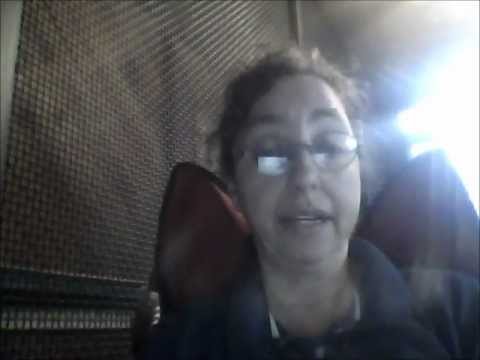
This was a very difficult time for all of us. Sword felt neglected as I spent most of the day in the pens. Bow and I spent many hours sitting huddled together, silent and glum on the concrete floor. The lack of adornments in our surroundings wasn’t a decorating choice. It was the only option, considering Bow’s behavior. I had given him lots of choices en route to the pens, and the way he exercised his right to choose had landed us in this impasse. I think both Bow and I were depressed when the summer of 2007 began. But the darkest hour is always the one before the dawn.
We began to develop daily routines. Lexigram use was on the upswing. Sword and I took meals with Bow in the pens, so we were still a family. Little by litte, our daily lives re-established themselves.
The pen system created exactly the kind of structure that Bow needed in order to thrive. And we were very lucky in June of 2007 to have a remarkable new intern join Project Bow.

Eden Michaelov is a native speaker of English who was brought up in Canada, but she is also fluent in Hebrew. Some of her family members are native speakers of Hebrew; she went to a school where Hebrew was taught; and she spent some time in Israel as a volunteer. She can speak, read and write Hebrew. This gave her a considerable advantage with Bow, who it turns out, had all this while been looking down on volunteers who did not speak Hebrew. Eden’s easy going personality was an immediate success with Bow, and her arrival was just in time to cheer Bow up about his new living arrangements.
Within a matter of weeks, with a new routine in place, Bow reached the following milestones:
1) Consistent potty behavior with both me and Eden. (He had been fairly consistent with me that spring, but he was very tricky with the interns.)
2) Using his words productively in both Hebrew and English. (For both meals and play sessions.)
3) Spontaneously using language in novel applications.
One of the problems with using lexigrams is that if a new lexigram hasn’t been introduced for an item in Bow’s working vocabulary, then even though Bow knows the word for purposes of comprehension, he cannot use it productively. In June and July of 2007 Bow began to use color words in order to ask for new foods for which a lexigram hadn’t been introduced. See below for a transcript of a session where Bow requested watermelon by using the Hebrew lexigram for “red”.

After Bow discovered that color words could be used to label foods, he began to refer to the cereal Sword and I had for breakfast in the pens as “brown”. He referred to cereal as brown, even when he didn’t want any, just to comment on what we were eating. And the next thing that happened was truly amazing: Bow told Eden that her mouth smelled of cereal! He only used two words: “Brown” and “Mouth”. But the way he used them in his exchange with Eden was the very essence of spontaneous communication.
It was a breakthrough!

Bow was not asking for cereal. He wasn’t asking for anything at all. Although he had not seen her eat, he knew that Eden had had cereal, and he was telling her this, by way of conversation. It was precisely the sort of spontaneous occurrence that characterizes human language, and that critics of ape language research claim non-humans are incapable of.
The “Brown Mouth” incident of July 17, 2007 was just the tip of the iceberg. There were many more breakthroughs that summer. But because Bow used RH, we had also opened the door to a whole series of criticisms, concerning cuing and “Clever Hans”. (See link below.)
I will stop my story here for the time being. I look forward to your input.
(c) 2008 Aya Katz

mistyhorizon2003 4 years ago from Guernsey (Channel Islands)Level 7 Commenter
This is just fascinating and I am riveted by it. What a great character, I would so love to be able to meet Bow, but far too much water between us sadly.

Aya Katz 4 years ago from The OzarksHub Author
Mistyhorizon, thanks. I think he’s pretty amazing, too. It might be possible for you to see him without crossing the water, once we get a Skype interface for Bow’s pens. I want to open a window on the world for him, even if he can’t go anywhere right now.

mistyhorizon2003 4 years ago from Guernsey (Channel Islands)Level 7 Commenter
I would love that, as he sounds so intelligent and to see him would be fabulous.

Aya Katz 4 years ago from The OzarksHub Author
Mistyhorizon, I’ll let you know when we have the kinks worked out in our communication system.
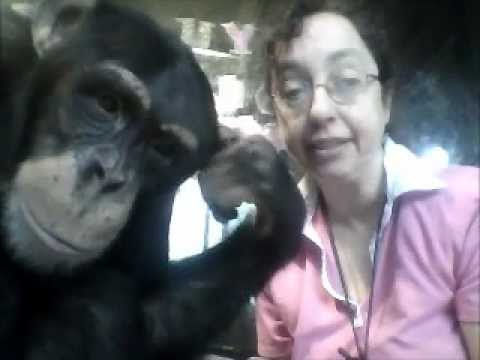
Bow is very interested in what he sees of the outer world on the computer screen.

Shadesbreath 3 years ago from CaliforniaLevel 5 Commenter
Wow, this is fantastic stuff. That “Brown Mouth” comment is so, you know, just like something random anyone would say, you know. Like, “Dude, your breath smells like tuna.” Amazing to find that out. I wonder what’s really going on in their heads. They must have an internal voice or something just like ours.
On to the next installment, this is great.

Aya Katz 3 years ago from The OzarksHub Author
Shadesbreath, thanks for dropping by. Yes, Bow is constantly thinking about things, and his reactions to ordinary events often involve his own particular slant.
SpocksAmanda 3 years ago
This whole venture seems like a modern day venture into what Roger Fouts did with Sign Language with Washoe. I had no idea that studies of this kind were still going on. If I were not graduating this spring from college, I would apply to work with Bow. It sems like a chance of a lifetime. Sad bow only get to makes connections with interns for 3 months though before having to adjust to a new person/persons

Aya Katz 3 years ago from The OzarksHub Author
Spock’sAmanda, thanks for dropping by. Yes, studies like these are still going on. Sue Savage-Rumbaugh is working with bonobos. Up until very recently, Sally Boysen was working with chimpanzees. And I am working with Bow. There’s not a lot of funding available, though, which is why I take volunteers. If you are still interested after you graduate, you could apply for a summer internship.
Mandy Chaverou 3 years ago
Hi Aya
Yes I quite agree with Spock’s Amanda it must be very frustrating for Bow to adapt to someone for a period of time then to find himself a few months later with “another” face, but I suppose then he doesn’t get too attached…. Its very interesting what you are doing with Bow.
If I’m writing to you today it’s because my daughter has been talking to me about what you’re doing. She is “over” passioned with chimpanzees and Bonobos and I know that she was wishing to apply to be an intern for next year but sadly the dates do not correspond with her university.
Perhaps in a year or two when she has finished she could apply or re-apply. In 2006 she spent a few weeks in the Congo with Claudine André and her Bonobos and would like to do so again. She was born to be with animals.
I wish you good luck for the future, it’s a good job there are people like you and claudine….. keep up the good work.
Give Bow a hug.
Aya Katz 3 years ago from The OzarksHub Author
Mandy, thanks for your posting! Your daughter sounds like someone we could use around here. Maybe in a few years our schedules will fit just right, and she can apply.
Yes, it is tough on Bow to have to get used to new people every few months. He does get attached, and then he misses his new friends when they are gone. However, he is now able to see some of them on Skype.
It’s actually amazing that we require our human children to get used to a new teacher or a new babysitter without making much fuss. I think none of us were really intended to break off attachments and create new ones as rapidly as society now expects.

joyride 3 years ago
It has long been known, that animals are very intelligent beings, and that they have feelings too, which most people, don t understand, and therefore, take no concideration to them or their feelings, and treat them awfully, and let them suffer greatly, We all know about dolphins being very intelligent, but I recently saw a program, about pigs being extremely intelligent, which quite surprised me, those animals, just being raised, to be eaten, and only get to live a short 12 months, and they were proven to be as smart or even smarter than most humans, Well, that was a very interresting program, and I m so glad that I ve been a vegetarian, for the last 30 years, thus not being the cause, of inflicting any pain on those highly intelligent anmals, I think we, humans have to take more concideration and treat and take care of all animals, the best that we can, Any animal owner, knows, how much love an animal is capable of, who loves us more, than our animals, and who s always glad to see us, So to everyone I say, treat the Animals well, and love them, cause they sure love us, I spent last winter in Cyprus, saving, feeding
neutering,spaying and rehoming the cyprus cats, and all I can say, is that those wild, unwanted,stray cats, showed more love,than anyone could ever think is possible, all the hotel cats, came to my room, on the 2nd floor each night, and slept in my bed,and my love for them is endless. They truly want to be with you,and enjoy your company,they were always waiting for me, when I came home,in the evening, and I m going back there again this winter, to try to save more cats, now when another cattery opened up in the ayia napa area, sincerely kelly ann

Aya Katz 3 years ago from The OzarksHub Author
Joyride,
Thanks so much for your comments. I can see that you care a great deal about animals. You have thought about the suffering of animals due to overpopulation and lack of care. But have you thought about the suffering that spaying and neutering inflicts? Is this something you would ever consider as a population control measure for humans?

joyride 3 years ago
Hi aya, I dont understand what you mean with the suffering of the cats, dogs and other animals, being spayed or neutered, I only know, that because there is such an overpopulation of unwanted cats and dogs, in most countries, this is the only way, to at least, keep the ones, that are already here alive, we cannot rehome or replace, most of the cats and dogs, that are already here, and a cat can have kittens, 2 or 3 times in a year, All my animals are spayed and neutered, and I never heard, anyone say, that that would in any way harm them, The mother cats in cyprus, that I had spayed, all seemed quite content, and unfortunatelly, not all of their kittens survive, and before that, they suffer, in cold, draughty places, sincerely kelly ann

Aya Katz 3 years ago from The OzarksHub Author
Joyride, many human beings all over the world suffer from hunger and deprivation, but nobody is suggesting that we neuter them. Keep in mind that when a male is neutered, we’re talking about full castration, not just a vasectomy. With a female, we are talking full hysterectomy, not just a tubal ligation. In the case of humans, even a vasectomy or hysterectomy is something the person undergoing it must consent to, because the right to have children is considered a fundamental right. But what is done to animals who are not human is even worse than that. They are deprived of their sex life, and this also affects the functioning of their brain. Hormones from the gonads are part of the complicated system that allows us all to function at our highest intellectual and spiritual potential. Castration is akin to a lobotomy. (A lobotomy often renders the victim more docile, so it gives the impression of being at peace, but really it has just become more phlegmatic.)
Do some research on what happens to women who have undergone a full hysterectomy, not leaving even one ovary in place. It will give you an idea of what is involved.
In nature, animals reproduce, and then some of them don’t survive. There are predators who eliminate the weak, and overpopulation is rarely a problem. To suggest that the human way is always the most humane way is not to consider all of the possibilities.

joyride 3 years ago
Well, most animal lovers, and animal activists are only, trying to do the best for the animals, And I do believe, that staying alive neutered or spayed, is far more better, than being killed in the most cruel of ways, which is the custom, on Cyprus and in Greece, for the feral cats. I can tell you about Little mama at the hotel, and other females, that I encountered, who would be sitting high up in trees, for hours, with a whole army of males, on the ground, Neither little mama, or the other females, were very happy with the situation, and always being chased, by all these males, and never being left alone, I don t know about animal sex, but it might be overrated, I think little mama, is much happier now, when left alone, just running around with black, her daughter, and now, when she s been fixed, the owner, promised to spare her, and not killing her, That s our plan, to spay the females, or house them, so that the hotel, and restaurant owners will not kill them, It s a terrible feeling, to have animals that you care for being killed off, with poisened food, Staying alive, is better, than a painful death, and the cat overpopulation was the problem in the first place, that s why they re poisening the cats or bundelling them up, and drowning the kittens in the ocean, I prefer live cats to dead cats. Also, I had all my bunnies neutered, and I ve never seen, so much humping going on ever, so whatever they did, they must have had some feelings left, and they had their rangs too, first female, male etc, but in their case, only the males were neutered, you do what you think, is best for your animals, that s all there is, there just ain t enough homes, for all these unwanted animals, so that s why we have to do this, kelly ann.

Aya Katz 3 years ago from The OzarksHub Author
Kelly Ann. I understand that you are only doing what you think best.

gwendymom 3 years ago from Oklahoma
Very Interesting Aya. I am glad that you were featured in this weeks newsletter and I got the chance to read this hub. Keep up the good work!

countrywomen 3 years ago from Washington, USA
Aya- Is their a web camera or some sort of video footage of bow that we could watch? Seems to be a fascinating character that I would like to see in action. Good job to you, volunteers and Bow for this wonderful information!!

Aya Katz 3 years ago from The OzarksHub Author
Gwendymom, thanks for your comment and your encouragement.
Countrywomen, we are working on trying to find the best way to implement this. Of course, there are videos, and I hope to add some of these to my hubsites, but that is not the same as a live webcam. Bow does chat on Skype with people he knows, but even with that there are a number of problems, both technical and behavioral. But I am working on improving the situation!
Murf 3 years ago
Hi there, I was just wondering what will happend to Bow ina year or two when he becomes too large and unmanageable for you to keep him? Will you send him to a zoo or sacntuary to attempt to rehabilitate him? Dont you think its a bit unfair that he will find it very difficult to integrate with other chimps?

Aya Katz 3 years ago from The OzarksHub Author
Murf, thanks for your comment. You asked this question concerning the hub about Bow’s Development Age Three through Five. To find out what happened a year or two later, why don’t you read the next hub in the series, Bow and Literacy?
My commitment to Bow is not limited to his being small and “manageable”. This is a commitment for a lifetime. I do hope to find Bow a mate and I understand his need for chimpanzee companionship, as well as human. Do you understand his need for human companionship? Please consider what it would do to him if he were torn out of the only family he’s ever known.
By rehebailitation, do you mean, for instance, that he should forget how to read and write?
Murf 3 years ago
Hello again Aya, I just read the other hubs about Bow, sorry I missed them the first time. He is a pretty amazing chimp but I do worry about what will become of him in the future. I see your point that if he was taken away from you he would probably suffer emotionally for a while, however dont you think he is already? He has already been torn from his own family.
By rehablitation I meant him learning how to behave like a chimp again, he belongs in a group of other chimpanzees where he can follow his instincts. I am far from being an expert but I have seen first hand what happens when adult chimps are kept captive too long and I believe that keeping him with humans for his entire life is mean. If nothing else you could be putting yourself in danger.
I dont intend to offend you as your research is extremely interesting, but just because you can teach him to read and write doesnt mean you necessarily should. People can teach elephants to stand on two legs and perform tricks but that doesnt mean they should.

Aya Katz 3 years ago from The OzarksHub Author
Murf, I appreciate that your comments come out of concern for Bow. However, the assumption that Bow’s linguistic achievements are unnatural and not good for him are not something I share. Bow didn’t pick up language because he was forced to. He’s a very stubborn fellow, and when he doesn’t want to do something, he won’t do it. He picked up language and literacy because it IS natural for him. There are things about chimpanzees — and also about humans — that are still not well known.
I am still exploring these issues myself, and I hope to be able to clarify them further in other hubs. Is Bow suffering from isolation? Well, yes, as I am and as my daughter is. We live in a very rural area, and it’s hard to find peers. I am working very hard at finding friends for all of us to interact with!

ngureco 3 years agoLevel 2 Commenter
Good research you are doing here.
I think you should get him a girl chimpanzee so that when the right time come, we can get to know how their children will learn the languages.

Aya Katz 3 years ago from The OzarksHub Author
Ngureco, thanks for dropping by! I am planning to get Bow a female chimpanzee companion. I want his life to be complete and happy. I would have done it by now, if not for financial constraints. Hopefully, I will be able to raise the funds and make that dream come true!

Tatjana-Mihaela 24 months ago from Zadar, CROATIA
Well, Aya, up till today, I did not have idea that you are teaching your chimp to speak, so catching up your old Hubs about that topic. This is excellent project and I am trully amazed with it!

Aya Katz 24 months ago from The OzarksHub Author
Tatjana-Mihaela, thanks. It’s an ongoing process. Bow has been spelling out what he wants to communicate for years now, but getting him to do it in a way that will satisfy the scientific community is a challenge I am still grappling with.

Sandyspider 24 months ago from Wisconsin, USALevel 1 Commenter
I always wanted one of these smart animals as a pet. They seem so human.

Aya Katz 24 months ago from The OzarksHub Author
Sandyspider, chimpanzees don’t make good pets in part because they are so very much like us. They want to be treated as equals or our superiors and will not accept a non-dominant position in the household.

Kind Regards 21 months ago from Missouri Ozarks – Table Rock Lake
Aya Katz, I agree with mistyhorizon2003 that “this is just fascinating and I am riveted by it.” Since I follow your blog, Notes from the Pens, I was aware of Bow living in the pens. I had no idea he started out living in the house. He sounds so happy and well-adjusted to the pens nowadays. I’m sure it was just an adjustment period like it would be for any of us in a new living situation. Onto Bow and Literacy, Kind Regards

Aya Katz 21 months ago from The OzarksHub Author
Thanks, Kind Regards! At the time, moving to the pens was a shock for all of us. By now, though, it is not any big deal, and I would venture to say we are fairly well adjusted. It’s not really where you live that’s important. It’s having your family with you, and fellowship and love, that really matter!