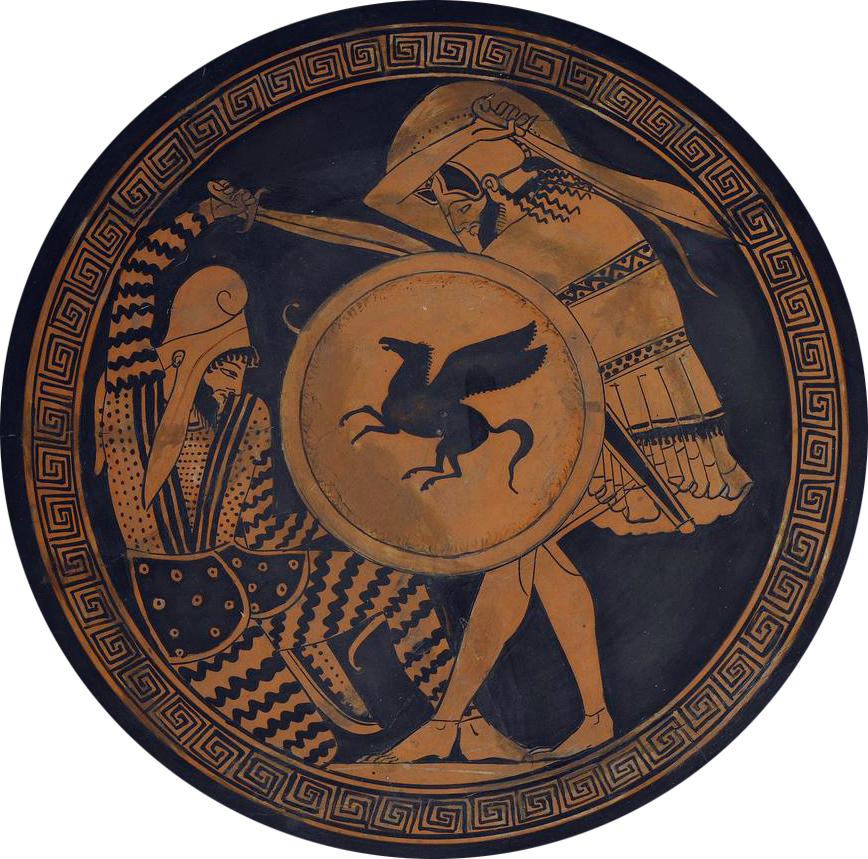
A Greek and a Persian at war
From the Wikipedia
War is inevitable. In a world where there are separate countries with separate interests, and in which there is international commerce and immigration and an exchange of both goods and ideas, of people and of merchandise — and even sometimes people as merchandise — little disagreements are bound to arise. And little disagreements can turn into border skirmishes, pitched battles and even complete chaos involving mass carnage and unspeakable horror.
There are only two ways to arrive at a relative peace: submit or fight to win. Submitting is shameful and expensive. Fighting is dangerous and expensive.
Once we realize that war must be paid for, one way or another, then only one question remains: who should pay for war?
In this day and age, almost everyone agrees that war should be paid for by the taxpayer. In other words, ordinary citizens have to pay Danegeld to their own government in order to get it to protect them from intruders. But then who will protect them from the government?
Once you agree to pay Danegeld to anyone — even your own government — is there any way to put a cap on it? Doesn’t paying Danegeld only encourage more warfare and more taxation to pay for it?
Isn’t there another way that will both minimize the cost of war and also lead to having fewer wars?
1. The Abstract Principles that Govern War and Peace
The basic strategy that governs both war and peace is called Tit for Tat. It means that aggressive and destructive behavior is met with retaliation, but peaceful behavior is met with peace. The most effective version of tit for tat exacts a price for initiating violence above and beyond a return to the status quo. This ensures that another attack is less likely. So, for instance, in border skirmshes, the winner of a skirmish against an aggressor gets to keep any territory gained, discouraging the other side from starting another skirmish.
Tit for tat is a strategy found in nature, and it is employed by many different species, including chimpanzees and humans, to ensure relatively cooperative behavior from conspecifics most of the time.
Some aspects of war are purely destructive: people are killed or buildings are demolished. But in every war there are also spoils, such as property that is claimed from the enemy, territory gained and prisoners taken, who can later be used as slave labor.
Winning a war does not simply mean a cessation of hostilities. Winning means making good any losses incurred during the war at the expense of the enemy and realizing a gain in terms of spoils. Only then can the war be seen as having come out to one party’s advantage. Getting a true and telling advantage over the enemy is not a purely spiteful or venial consideration. It is a way to ensure a prolonged cessation of hostilities.
When wars end without a clear victor, then a resumption of hostilities can be expected fairly soon, as the enemy recovers from any wounds inflicted. But when one party is clearly victorious and another is crushed and surrenders unconditionally, then and only then can a relatively conflict-free interlude of long duration take place. These interludes are called peace.
So the question is, for those who see war as an undesirable state of affairs, how can we get to the peace after the war as quickly as possible and with the least expenditure of life and other valuable commodities?
Many suggest that a strong defense requires a standing army and government expenditure on the implements of war, even in times of peace. But if we reckon with the price of obtaining these goods from unwilling citizens, as well as the disruption of the economy by the creation of entire industries dependent on government subsidies, then in fact the price is very high and the overall value of such an army is reduced in terms of cost/benefit analysis.
2. Taxation Requires an Internal Army to Obtain Funding for Your External Wars
In the United States of today, the armed forces are kept afloat by funding obtained for them by the Internal Revenue Service from the citizenry, instead of relying on the spoils of war derived from other nations. The Internal Revenue Service, in order to make sure that taxes are collected, has its own military arm to deal with those people who will not willingly pay the Danegeld. Even when taxpayers are cooperative, as most are, there is an entire bureaucracy devoted to calculating and collecting the tax, and even many people ostensibly in the private sector have made for themselves careers based entirely on helping people to report their income and calculate the tax. All of this is a drain on the economy.
In addition, defense contractors are known to be highly inefficient in the way that they produce weapons, and they compare poorly to weapons manufacturers who sell weapons to the general public. Vessels built to government specifications under a government bidding system are much more expensive than vessels built on spec in the private sector. Even toilets and nails and other commodities, when ordered by and for the government, become disproportionately expensive.
When the government contracts for war, it tends to forget that the purposes of war is to inflict damage on the enemy with the smallest possible outlay of resources. It forgets that guerrilla warfare is more effective than pitched battles and that commandeering an enemy vessel is more cost efficient than building one of your own.
3. The Early History of War Finance in the United States.
The reason for the American Revolution was the unwillingness of the American Colonists to finance the war expenses of the British Empire in other parts of the globe. The revolution was about taxes, but it was also about quartering of soldiers, about unreasonable search and seizure and most of all about British soldiers treating British colonists as if they were the enemy to be plundered.
The Revolutionary War really was a revolution, rather than simply a war of independence. The revolution was about the relationship of citizens to their government. The colonists refused to be treated as all British subjects were: as mere sources of income for the British government.
Arguably, the revolutionary war was not actually won, so much as fought to a stalemate. The colonists succeeded in making themselves enough of a nuisance so as to drive the British army away. They became independent and self-governing. They did not, however, continue with their war effort and pursue the British to their own home base, to harry them and demand tribute so as to fill the American coffers and to pay the war debt incurred during the revolution. Hence the new nation started out in debt. Their war efforts were not a financial success. They were not Danes. They were not Vikings. War was not their their daily bread. Commerce was.
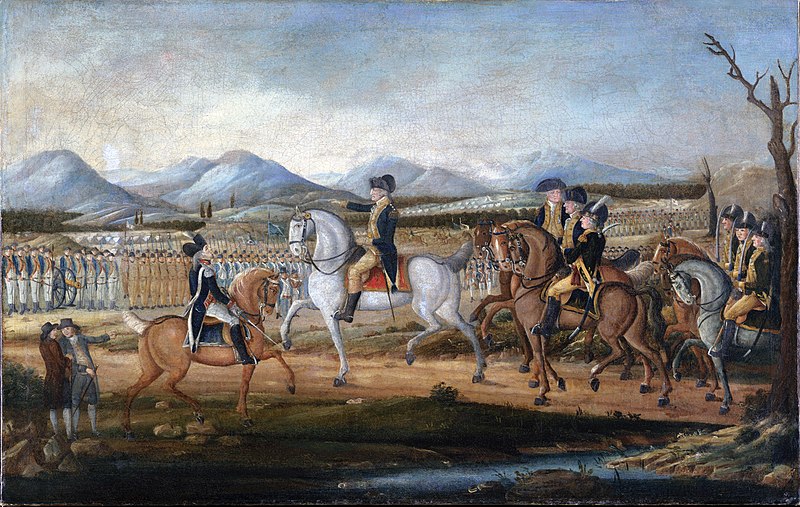
The Whiskey Rebellion: George Washington rides out against the people. From Wikimedia Commons
The American Revolution was about getting rid of that pesky internal British army that collects taxes so the valiant external British army can go to war against other nations. But seeing as the Americans had not paid for the war against the British, they soon felt compelled to start taxing their own citizenry for the protection afforded them by their new government from the British. The Whiskey Rebellion was about that. The disagreements between the Federalists and the Anti-Federalists were about that: it was not about democracy versus monarchy or even about a strong central government over a weak one. It was about this very question: Who should pay for waging war?
4. Alexander Hamilton’s Revenue Service
Alexander Hamilton was unusual among the founding fathers, because he did not see the national debt as a mere problem to be solved: he saw it as an opportunity.
Hamilton saw that those people who go into debt by lending money are more likely to have a credit history that induces others to let them borrow even more. In the same way that a frugal person who has never borrowed money cannot get a loan because of no credit, a country that does not act as a central creditor for its local borrowers cannot expect to borrow money from foreigners. So Hamilton proposed to consolidate the war debts of each of the states, and to seek foreign investors so that the United States could incur even more debt. And he proposed to service the current debt by imposing an import tax on coffee and tea, liquor and spirits and other “pernicious luxuries.”
But to the sum which has been stated for payment of the interest, must be added a provision for the current service. This the Secretary estimates at six hundred thousand dollars; making, with the amount of the interest, two millions, eight hundred and thirty-nine thousand, one hundred and sixty-three dollars, and nine cents.
This sum may, in the opinion of the Secretary, be obtained from the present duties on imports and tonnage, with the additions, which, without any possible disadvantage either to trade, or agriculture, may be made on wines, spirits, including those distilled within the United States, teas and coffee.
The Secretary conceives, that it will be sound policy, to carry the duties upon articles of this kind, as high as will be consistent with the practicability of a safe collection. This will lessen the necessity, both of having recourse to direct taxation, and of accumulating duties where they would be more inconvenient to trade, and upon objects, which are more to be regarded as necessaries of life.
That the articles which have been enumerated, will, better than most others, bear high duties, can hardly be a question. They are all of them, in reality—luxuries—the greatest part of them foreign luxuries; some of them, in the excess in which they are used, pernicious luxuries. And there is, perhaps, none of them, which is not consumed in so great abundance, as may, justly, denominate it, a source of national extravagance and impoverishment. The consumption of ardent spirits particularly, no doubt very much on account of their cheapness, is carried to an extreme, which is truly to be regretted, as well in regard to the health and the morals, as to the œconomy of the community.
And so the new nation that arose because the British colonists in America refused to pay a tax on tea created a revenue service that imposed a tax on tea (and on coffee, and on liquor and spirits, even when distilled in the United States.) Of course, to get some people to agree to pay a tax on what other people think are “pernicious luxuries” one needs an armed military unit to enforce the tax. Every tax is ultimately enforced at gunpoint and is no less an act of piracy than the encroachments by outsiders that it is supposed to help prevent.

Like the Boy Scouts, the Revenue Cutter Service Motto is “Always Prepared”
Among his many other remarkable achievements, Alexander Hamilton is responsible for the creation of the Revenue Cutter Service. Its main mission was to make sure that the tax on pernicious luxuries was always paid. The reason for the tax was to service the debt. And the reason for the debt was the colonial uprising in protest of just such a tax .
5. Isolationism Under Jefferson and the Embargo Act
That was all under the Federalists, who in order to maintain support for their policies also found it necessary to pass legislation to curtail free speech, known as The Alien and Sedition Act, while they pursued an undeclared war against France. But the direction of the country was about to change. In 1800 Thomas Jefferson and Aaron Burr were elected president of the United States. Or, rather, they tied for president.
Burr and Jefferson were on the same side. They were both members of the anti-Federalist camp, and they were running mates on the Democratic-Republican ticket. In those days, the President was the person who received the greatest number of electoral votes. The person who received the second greatest number got to be Vice President. In case of a tie, all hell broke loose.
When all the dust had settled, Thomas Jefferson became the third president of the United States. And Jefferson had completely different ideas from the Federalists about who should pay for war. He was of the opinion that nobody should pay for war, because there should not be any wars. This was an idealistic position, but a little hard to implement.
If Aaron Burr had been chosen the president, instead of Jefferson, he would probably have implemented a policy in consonance with the general principles of tit for tat. Burr was a realist and would have balanced the need for military ascendancy with an understanding of the heavy price of war. He would have avoided war without capitulating. Burr was a war hero who led successful campaigns during the Revolutionary War. He was not afraid of war, but he also understood its cost, and having seen battle close at hand, he knew clearly who paid the ultimate price. Burr was also an able diplomat, and he would likely have used a combination of threat and coalition formation to keep the United States in a strong position vis a vis other nations without actually going to war. If he found war to be necessary, he would have been an able commander-in-chief.
But Thomas Jefferson was not a military man, and his ideas about war and peace were entirely different. During the Revolutionary War, Jefferson’s main contribution was the wording of The Declaration of Independence. He spent the rest of the war waiting for the British to leave. He never saw action. (Kennedy 1999).
Jefferson was not good at war. He did not like it. He wanted to minimize its importance in the grand scheme of things. He was a genius at many things, and his solutions to the war problem were unusually creative, though ultimately doomed to failure.
Jefferson proposed to achieve the positive objectives of war — gaining new territory — without actually engaging in war. His deal with Napoleon for the purchase of Louisiana Territory in 1803 was arguably a stroke of diplomatic and entrepreneurial genius. Though not clearly constitutional, this step did seem at first glance to avoid war by using money — instead of troops — to advance the national objectives of territorial expansion.
While Louisiana was officially bought from France, the financing involved the sale of bonds — a financial obligation — which Napoleon sold at a discount to a British bank. And so it happened that while this was an unsecured loan on the sale of real estate, the creditor financing the transaction had a fleet that could easily treat Louisiana as collateral.
At the same time, Jefferson tried to achieve the negative objectives of war — deterrence against enemy attacks — by refusing to allow Americans to engage in commerce in places where he was not prepared to defend that commerce. Under Jefferson’s sponsorship, Congress passed The Embargo Act.
In short, Jefferson thought that money could buy land, without reckoning with the price of defending that land later down the line. He thought that bullies on the high seas, such as the British fleet, could be kept in check by punishing their victims — the merchants the British were preying on. This is equivalent to preventing rape by requiring all women to stay at home.
Naturally, the American merchants continued to want to sell their wares. Smugglers arose to help with that. Part of the role the smugglers played was that of a defense fleet — and they did this at a fraction of the cost of an official navy. One of the costs of doing business is defending against theft — whether by local brigands or by international governments. The cost is kept down when the person paying it is also the one likely to gain from the commerce. The reason? The zero sum game. If it costs more than you gain, war is just not worth it.
One of the smugglers who was attracted to Louisiana during this period was Jean Laffite. Laffite was a great admirer of Thomas Jefferson, finding that the Jeffersonian ideals prepared the way for his own success. He was an avid reader of The Aurora, a paper associated with the Democratic-Republican ideals of Thomas Jefferson, and sent in letters to the editor to plead his own cause. (Keyes 2008). He was adamant in making the distinctions between pirates and privateers.
It is true that it was Thomas Jefferson’s policy that led to the rise of smugglers and privateers in Louisiana. But was this really what Jefferson had in mind when he thought up the Embargo Act? Did he really want to privatize war? If so, why did he persecute Burr when he set out on a private expedition against Spain and speak out against private individuals engaged in war in his 1803 State of the Union Address?
6. The War of 1812 and Its Financing
Eventually Jefferson stepped down, able to maintain his status as a peacetime president till the very end. His chosen successor was James Madison. Madison was also not a military man, but he inherited a real mess from Jefferson. Strapped for cash because of the Louisiana Purchase, and heavily in debt, the United States Treasury could not pay for a proper navy. At the same time, the encroachments by the British against American ships and American sailors became too difficult to bear. Madison asked for and obtained a declaration of war against Britain. But though he had Congress’s blessing in going to war, he had very little support in actually raising the funds that it would take to successfully fight a conventional war.
Americans have always resisted attempts to tax them in order to pay for war. According to Bank, Stark and Thorndike (2008.xv) “Indeed, resistance and reluctance are recurring themes in the history of American taxation. In the War of 1812, for example, congressional Republicans repeatedly balked at imposing new taxes to fund ‘Mr. Madison’s War’…”
The United States was nearly defeated and annihilated, crushed out of existence in the War of 1812. That this did not happen was in great measure due to the private war contributions of Jean and Pierre Laffite and the Baratarian buccaneers.
What is most interesting to note is that the government entities that were financed with taxpayer money to keep the enemy at bay spent almost as much effort on trying to make war on the Baratarian privateers as they did on the British. My novel, Theodosia and the Pirates dramatizes this point.
One problem with allowing the government to use taxation to achieve military objectives is this: the government often loses sight of its legitimate military objectives when it pursues its other target: people evading taxation. Even when it turned out that Jean Laffite freely gave of his own resources to fight the British on behalf of the United States, his ships were plundered to fill the coffers of government officials. It was not merely that he lost the benefit of the ships for business purposes. Those ships were not used for military purposes at all once confiscated. They were sold for money. Not only that, but the Baratarian efforts to continue to fight against the enemy to secure a true victory were hampered by a premature treaty of peace. Thus the War of 1812 was a war that ended in the red. The budget was not balanced by means of this war, and the people who died defending the territory that was gained in the Louisiana Purchase died in vain. First they paid for the territory with money that went straight to the British. Then they paid with their own blood.
War is a zero sum game. The more you pay, the less you win. Privateers understand this. Governments do not. It is for this reason that using private resources to achieve military objectives has always saved both money and blood.
7. The Efficiency of Privateers: Getting More for Less
When a government commissions the building of a ship, it will usually stint no effort to use the very best materials and have everything up to spec, so the vessel is sea worthy and the workmanship is without reproach. They do this, because they have potentially unlimited resources at their disposal and making a good job of it seems like “the responsible thing to do.”
But a privateer starting out on his first mission will actually choose to take out a less than seaworthy ship, spending the least amount of money on equipping it, in the hopes of capturing a far better vessel from the enemy, using his skill and daring to outwit and outmaneuver a more expensively built craft. Take for example the story of Jean Laffite’s older brother, Alexandre, on his first outing as a privateer (The Journal of Jean Laffite). Being young, poor, inexperienced and not entirely supported in his mission by the family, Alexandre refurbished a ship that was in very poor condition. He spent hardly any money on that ship, making it just barely seaworthy. In his first battle with the enemy, his ship sank, but he captured two fine vessels to replace it and made a great profit. If Alexandre had spent more money on his ship, his profit from the venture would actually have been less!
People spending their own money on warships make wise decisions, in terms of balancing the books. They understand that a good captain can win a battle even with a less than perfect ship. But when a government official spends money extracted from the taxpayer, the books are seldom balanced, so that in the end, no matter how much money is spent on a war, it will never turn a profit. And because there is always more money to finance the next venture, the pattern persists and one unprofitable war is followed by another and another, with no end in sight. In this way, governments spend taxpayer money and are motivated to enter into war as a way to keep the money coming.
We are told that we have to build better ships, better planes and better anti-aircraft and anti-satellite defenses than the enemy, because otherwise the enemy will outgun us. But the wiser course, considering that war is a zero sum game, is to spend far less than our enemies and to capture their ships, their missiles and their spy satellites and use them for our own purposes.
If terrorists armed only with box cutters can turn a civilian airplane into a weapon of mass destruction, imagine what a few intrepid men could do with the enemy’s ships, guns and warheads. Any fool can spend massive amounts of money on the national defense and assume that this kind of spending will automatically buy security. But a real warrior can do more with less.
8. The Zero-Sum Game
Commerce is not a zero sum game. When there is a transaction between two parties, there is no loser or winner. If the the transaction was freely entered into then both parties gain. Advocates of the free market often point this out to those who see commerce as a mere allocation of resources. In the economy, new value is created, and the potential for mutual gain is limited only by the natural resources at our disposal. The question of which natural resources are at our disposal is the province of war. Hence everything that commerce is not, war is.
War is by definition the ultimate zero sum game. It is about the allocation of the limited resources of our planet. When one party is victorious, its enemies lose. It therefore follows that the fewer resources squandered in the pursuit of a particular military objective, the more successful the campaign. In prolonged wars, everybody loses, because resources are destroyed forever that might have served us all in a commercial setting. In the event of a nuclear war, everybody loses irrevocably, and that — and not considerations of human decency — is the real reason that nobody chooses that course of action.
The less we spend on national defense and still achieve our objectives, the more we gain. The more we spend, the more we lose, because war expenses are always a waste when seen from the perspective of a healthy economy. The less money spent on defense, the fewer the resources that are squandered.
Only when the governing class sees itself as separate from the people who pay for the war (with both money and blood) does this obvious, tautological fact about war not seem to apply. The spenders always claim to need more money, because they are not the ones who earned it. In order to avoid this situation, it is important that the people who finance war and the people who profit from war should be the same people.
This is not a pacifist argument against the war machine. It is merely an observation about the way all economic transactions work. If spending is not tied to earning and immediate consequences are not visited directly on the decision makers, then there will be no end to war spending and no end to war. A government entity financed by taxes does not fight to win — it fights to spend and tax again.
There would not be any war unless war paid off. In the interest of wise resource management, it would be best to ensure that war is managed by those who can make it pay. That way, when there is no profit in war, then we can have peace.
References
Bank, Steven A., Kirk J. Stark and Joseph J. Thorndike. 2008. War and Taxes.Washington D.C.: The Urban Institute.
Kennedy, Roger G. 1999. Burr, Hamilton and Jefferson: A Study in Character. Oxford University Press: Oxford.
Keyes, Pam. 2008. Jean Laffite’s Letter to the Editor. http://journals.tdl.org/laffitesc/index.php/laffitesc/article/view/288


 Figure 2 – Male English House Sparrow
 Figure 3 – Female English House Sparrow