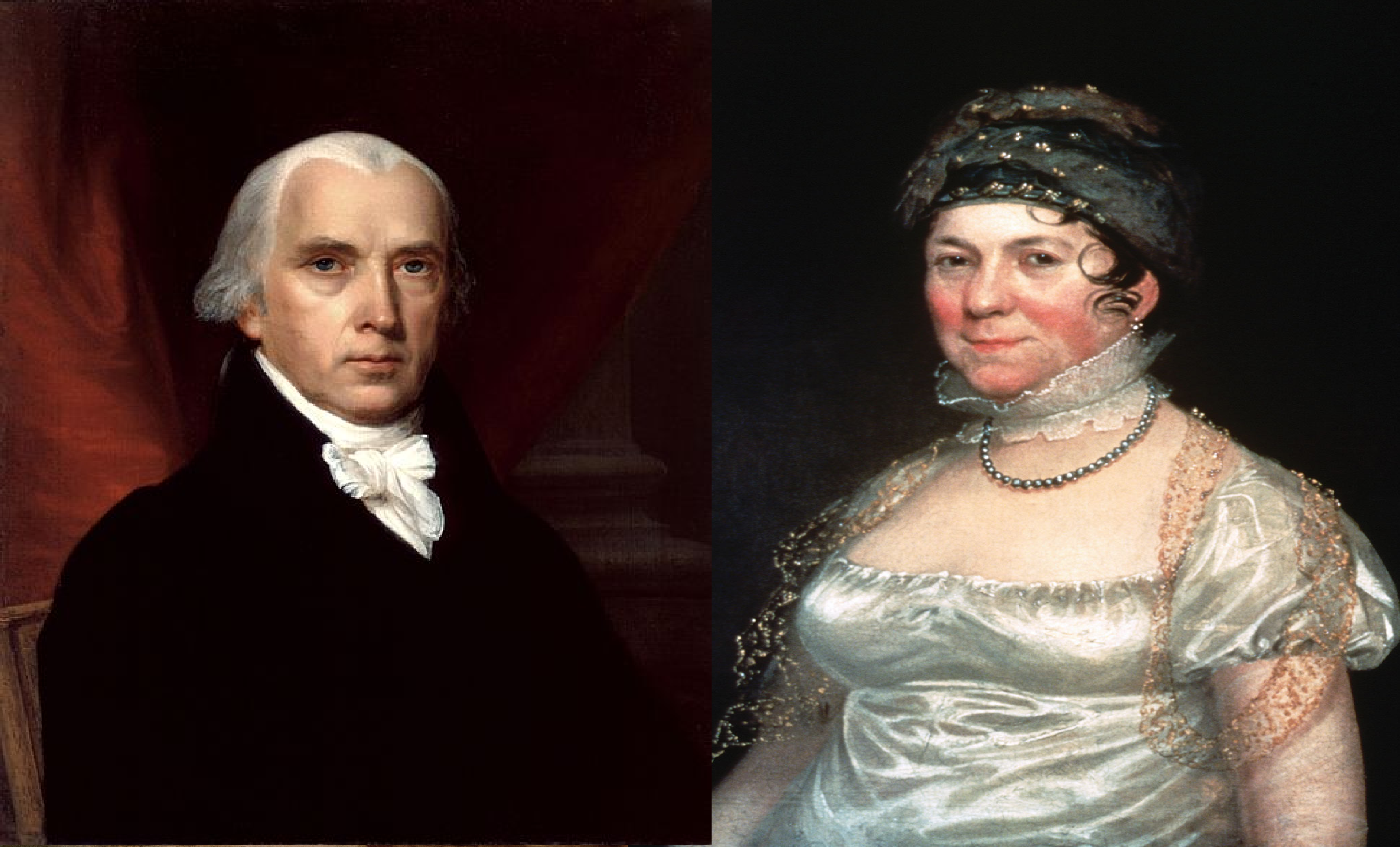
Lobbying the Madisons: Letters to James and Dolley

TheMadisonsWhen the government has done us wrong, any attempt to seek redress is fraught with difficulty. Ironically, people find it much easier to ask for a handout or a government job or a special favor than to ask for justice. The reason: before you can get justice, the party in the wrong has to admit to wrongdoing. Admission of misfeasance, even by a predecessor or an underling, is something that a government official is unlikely ever to do.

Theodosia Burr Alston and Jean Laffite, each acting separately and under somewhat different circumstances, found themselves in the unenviable position of  writing a letter requesting help from President James Madison in righting a wrong. The wrong, in each case, was not one committed directly by James Madison, but it was a wrong he had the power to redress and chose not to.

The mental gymnastics that petitioners must perform in order not to blame the person in power is of considerable interest. In this article I will compare the strategies employed by Theodosia Burr Alston in her letter to Dolley Madison of 1809 with those of Jean Laffite in his letter to James Madison of 1815.


Of the two, Theodosia Burr Alston was the better writer, which is not surprising considering her education and the fact that she was using her native language. But her ability
to conceal bitterness and deep seated anger toward those who mistreated her father is not equal to the task. In contrast, Jean Laffite manages to cast himself as a debonair benefactor who would never think of asking for anything but a return of his property, and at that he generously allows that he should be paid only so much as the United States Treasury can spare — implying that the country will remain forever in his debt.

The text of the letter to Dolley and the text of a similar letter Theodosia wrote to the Secretary of the Treasury, can be found here:

 http://www.historiaobscura.com/theodosia-burr-alstons-letters-on-behalf-of-burr-in-exile/

Here I will quote relevant portions of the letter of  June 24, 1809 from  Theodosia Burr Alston to the first lady  and will discuss their significance.

You may, perhaps, be surprised at receiving a letter from one with whom you have had so little intercourse for the last few years. But your surprise will cease when you recollect that my Father, once your Friend, is now in exile; and that the President only can restore him to me & to his country.

This is how the letter to the first lady starts, and while it may seem respectful and humble, the phrasing is already problematic. Theodosia is reminding Dolley of their long acquaintance at the same time as she admits there has not been much communication between them in the last few years. This lack of communication cannot have been because Theodosia wished it. In the last few years Aaron Burr dropped from the high office of Vice President to becoming a hunted fugitive. He was accused of treason by Thomas Jefferson himself. And when he was acquitted of the charge, despite Jefferson’s efforts to pressure the judge in the case, Burr was forced to flee the country. Not too long ago, Burr and James Madison had been close friends, Burr serving as a sort of wiser, more powerful mentor. Madison was also good friends with Jefferson. The alliance with Jefferson led to Madison’s being elected president. When forced to choose between his friendships with Jefferson and with Burr, Madison chose Jefferson. So it must be that James and Dolley, once regular dinner guests,  dropped the Burrs as soon as they were in trouble.

What’s more, Theodosia reminds Dolley that Aaron Burr had once been her friend. Aaron Burr had helped bring the Madisons together. He had introduced Dolley to the future president.  If not for him, Dolley would not now be Mrs. Madison.

All these things are true, but is it politic to bring them up in the opening paragraph of a letter in which you hope to get help from the president? Would it be better not to mention any of that? If Aaron Burr had been Dolley Madison’s friend, would she not remember it on her own? Isn’t an opening like that equivalent to saying: “You owe us”? And isn’t that what we must never say to anyone, leastwise someone in power?

Ever since the choice of the people was first declared in favor of Mr Madison; my heart, amid the universal joy, has beat with the hope that I too should have reason to rejoice. Convinced that Mr. Madison would neither feel nor judge from the feelings or judgment of others, I had no doubt of his hastening to relieve a man whose character he had been enabled to appreciate during a confidential intercourse of long continuance; and whom he must know incapable of the designs attributed to him. My anxiety on this subject has, however, become too painful to be alleviated by anticipations which no events have yet tended to justify; and in this state of intolerable suspense, I have determined to address myself to you, & request that you will, in my name, apply to the President for a removal of the prosecution now existing against Aaron Burr; I still expect it from him as a man of feeling and candour, as one acting for the world & posterity.

Among the universal joy that James Madison had been elected president, Theodosia added her own, based on the belief that this good friend of her father would now remove the “prosecution now existing against Aaron Burr”. She was sure that the moment James Madison came into office, her father’s troubles would be over, since they were good friends of long standing, and Madison knew that her father was not a traitor. And yet… Madison has been in office for a year now, and nothing has changed for Aaron Burr.

Again, there is no direct recrimination, but the context cries: “What kind of friend is James Madison? For that matter, what sort of President is he? He knows Aaron Burr is not guilty, knows that he was acting in the best interest of the country, and still he allows the prosecution to continue? To whom is he beholden for his office, that he cannot undo the harm that has been done?”

Statesmen, I am aware, deem it necessary that sentiments of liberality, and even justice, should yield to consideration of policy; but what policy can require the absence of my Father at present? Even had he contemplated the project for which he stands arraigned; evidently to pursue it any further would now be impossible. There is not left one pretext of alarm even to calumny; for, bereft of fortune, of popular favor, & almost of friends, what could he accomplish? And, whatever may be the apprehensions or the clamors of the ignorant & the interested, surely the timid illiberal system which would sacrifice a man to a remote & unreasonable possibility that he might infringe some law, founded on an unjust, unwarrantable suspicion that he would desire it, cannot be approved by Mr Madison, and must be unnecessary to a President so loved, so honoured. Why, then, is my Father banished from a country for which he has encountered wounds & dangers & fatigue for years?

Now, the recriminations are not implicit any longer. Every line screams: “This is so unfair!” And not far behind is the thought: “If Madison allows it, then Madison is unfair.”

And in case Dolley has forgotten, Theodosia recites the list of wrongs committed against her father and his current financial situation. She hints that he has no pension, like many other military heroes, and must start saving for his old age.

Why is he driven from his friends, from an only child, to pass an unlimited time in exile, and that too at an age when others are reaping the harvest of past toils, or ought at least to be providing seriously for the comfort of ensuing years? I do not seek to soften you by this recapitulation. I wish only to remind of all the injuries which are inflicted on one of the first characters the United States ever produced.

Theodosia is very proud. She hastens to assure Dolley that Burr will not steal into the country illegally when the country is still beholden to him for his services.

Perhaps it may be well to assure you there is no truth in a report, lately circulated, that my Father intends returning immediately. He never will return to conceal himself in a country on which he has conferred distinction.

Perhaps the most bizarre portion of the letter is this plea for secrecy. Theodosia is writing this letter behind her husband’s back, and she does not want him to find out about it. She implies that there is something almost improper in asking Dolley to speak to James Madison on Burr’s behalf. But already in so writing, she anticipates that her plea will be denied.

To whatever fate Mr Madison may doom this application, I trust it will be treated with delicacy; of this I am more desirous as Mr Alston is ignorant of the step I have taken in writing to you; which perhaps, nothing could excuse but the warmth of filial affection; if it be an error, attribute it to the indiscreet zeal of a daughter whose soul sinks at the gloomy prospect of a long and indefinite separation from a Father almost adored; and who can leave unattempted nothing which offers the slightest hope of procuring him redress. What indeed, would I not risk once more to see him, to hang upon him, to place my child on his knee, and again spend my days in the happy occupation of endeavoring to anticipate all his wishes? …

The tone of the letter turns desperate and melancholy and almost embarrassingly personal. That Theodosia’s love for her father knew no bounds is clear. But the phrase “What, indeed, would I not risk..” begs the question: what is she risking by writing this letter? Is writing to Dolley dangerous? How? Was Theodosia just being melodramatic or was more at stake than we know in keeping the correspondence with the first lady a secret?

Let me entreat, my dear Madam, that you will have the consideration and goodness to answer me as speedily as possible; my heart is sore with doubt and patient waiting for something definitive. No apologies are made for giving you this trouble, which I am sure you will not deem irksome to take for a daughter, an affectionate daughter, thus situated.  Inclose your letter for me to A. J. Frederic Prevost, Esq., near New Rochelle, New York.

That every happiness may attend you, …

This letter, written from one woman to another, is at times angry, at times proud and at other times submissive and cloyingly sentimental. That Theodosia is desperate and would do anything to help her father is evident. But how effective is this letter in achieving her goals? Is her resentment toward the Madisons not just below the surface? Is it any wonder that Dolley turned her down, calling her a “precious friend” and otherwise complimenting Theodosia, but asserting that Mr. Madison could do nothing “to gratify” her wishes?

That was back in 1809. Theodosia was not asking for money or appointment to office or even a letter of marque. She was asking that her father be restored to his country, seemingly a very humble request. Why couldn’t it be granted? What forces outside President Madison’s control prevented it?

We turn now to Jean Laffite’s letter to James Madison written in December 27, 1815. Here the matter was simpler and more straightforward. Jean Laffite had informed the government of Louisiana and through them the United States Navy of the attempts of the British to recruit him to fight the Americans during the British attack on New Orleans. He offered to serve the Americans, and he gave proof of his loyalty by disclosing the whereabouts of the British fleet. Instead of accepting his overture, the American Navy and Revenue Service attacked the Laffite fleet in Barataria and confiscated his ships and the contents of his storehouse. Despite this,  the Laffites  remained loyal to the Americans and as soon as Edward Livingston had negotiated a deal for them with James Madison, going over the heads of the Governor and the Navy, the Laffites donated gunpowder and flint and served together with a company of their own trained artillerymen to turn the tide in the Battle of New Orleans. And yet after the war was over, the ships and goods that were confiscated from the Laffite brothers and their associates were sold at auction, never returned to their owners and no compensation was offered.

Here is the opening paragraph of Jean Laffite’s letter to James Madison, asking for restitution:

President

Encoraged by the benevolent dispositions of your Excellency, I beg to be permitted to State a few facts which are not generally Known in this part of the union, and in the mean time Sollicit the recommendation of your Excellency near the honnourable Secretary of the treasury of the U. S. whose decision could but be in my favour, if he only was well acquainted with my disinterested conduct during the last attempt of the Britanic fources on Louisiana. At the epoch that State was threatened of an invasion, I disregarded anny other consideration which did not tend to its Safety, and therefor retained my vessells at Barataria inspite of the representations of my officers who were for making Saile for Carthagena, as soon as they were informed that an expedition was preparing in New Orlean to Come agains us.

If we disregard the spelling errors and the odd diction and style, we can see that Jean Laffite has placed himself in an advantageous position by failing to make any recriminations in the opening sentences.

Unlike Theodosia Burr Alston in her letter to the first lady, who reminded Dolley of their relationship of long standing, Laffite, in his opening paragraph, casts James Madison as a fair, generous and disinterested party in this transaction who may not be fully acquainted with the facts of Laffite’s case. Also, in no way is Laffite soliciting funds from the President. It is the Secretary of the Treasury who needs persuading, and Laffite is hoping that James Madison will help win the Secretary over.

For my part I Conceived that nothing else but disconfidance in me Could induce the authorities of the State to proceed with So much Severity at a time that I had not only offered my Services, but likewise acquainting them with the projects of the ennemy and expecting instructions which were promised to me I permited my officers and Crews to secure what was their own, ashureing them that if my property Should be Ceized I had not the least happrehension of the equity of the U. S. once they would be Convinced of the Cinserity of my Conduct.

In other words, Laffite is so sure the United States government is fair and just, that he believes that only a misunderstanding of the facts of the case could have caused a delay in dealing fairly with him.

My view in preventing the departure of my vessells was in order to retain about four hunderd Skillful artillers in the Country, which Could but be of the utmost importance for its defence. When the aforesaid expedition arrived I abandoned all I pocessed in its power, and entered with all my Crews in the marshes, a few miles above New Orleans, and invited the inhabitants of City and its environs to meet at Mr. Labranches where I acquainted them with the nature of the danger which was not far of. (as may be seen by the anexed document which is atested by some of the moast notorious of the inhabitants which were present.) a few days after a proclamation of the Governor of the State permitted us to Joyne the army which was organising for the defence of the Country.

Laffite describes his behavior in putting the safety of the country first in very simple terms. He then goes on the explain that he wants no reward for defending the country, as anyone with patriotic feelings would do, but he wonders if he might have restitution for that portion of what the United States government took from him that would not deprive the United States Treasury of its own funds.

My Conduct Since that period is notorious The Country is Safe & I Claim no merit for having like all the inhabitants of the State, cooperated in its wellfair In this my Conduct has bin dictated by the impulce of my proper Centiments: But I Claim the equity of the Government of the U. S. upon which I always relied for the restitution of at least that portion of my property which will not deprive the treasury of the U. S. of anny of its own funs. For which benefit will lieve for ever grateful your Excellency’s very respectful and very humble & Obedeant Servant

Notice that in this way, Laffite puts himself not on the footing of one who seeks a favor, nor in the angry and bitter stance of one who has been robbed, but rather he paints himself as a benevolent and generous donor, who asks to have a little of what is his back, but not so much as to bankrupt the country or to put the Treasury out of business.

The problem, in Laffite’s case, was not with the content of the letter, but its execution. It was full of misspellings, awkward phrasing and malapropisms. As just one example, Laffite used the word “notorious” for its denotation, meaning “famous”, but not its negative connotation,  “famous for being bad”. He is then seen as boasting about his ill fame, when he meant to say just the opposite.

Excuses could be made to the effect that Jean Laffite was not a native speaker of English, but that is not really the problem. James Madison was a gentleman, and he could read French, as very nearly all well educated men in those days could. In fact, the Madison archives contain letters addressed to the President in French requesting appointments and sponsorship. President Madison looked upon some of these requests with favor.

Letter from Dupont de Nemours to James Madison

As an example of just such a letter, consider the one dated December 28, 1815 from Dupont de Nemours to James Madison, which just happens to have been the next letter Madison received after the one he got from Jean Laffite. Dupont de Nemours writes: “Monsieur le President, J’ai a vous remercier avec la plus vive reconnaissance, a la bonte, pleine de graces,  avec laquelle votre Excellence bien voulu admettre mon Petit-Fils dans le Corps de Midshipmen.” In English: “Mr. President, I have to thank you with the most vivid gratitude at the goodness with which Your Excellency has admitted my grandson into the Corps of Midshipmen.” In other words, for the grandson of Dupont de Nemours, an exiled French aristocrat, there is a place in the United States Navy. But for Jean Laffite, who saved the country from certain annihilation, there is nothing. Why?

The fact that Jean Laffite could not have written such a letter in French or English or any of the other languages he was fluent in is part of the story. Laffite was literate, in the sense that he could read and write. He was multilingual, in the sense that he spoke many languages fluently, among them Spanish, French and English. But he was no gentleman, in the sense that he did not have a university education or the equivalent of private schooling. No matter what language he wrote in, he was bound to make comical mistakes, such as spelling “sentiment” with a “c”. This word is spelled the same way in both French as in English, and it was not because Laffite was a Frenchman that he did not know how to spell it. It was because he belonged to the merchant class, and no matter how intelligent and brilliant and articulate he was, he could not compete with the likes of James Madison and Albert Gallatin and Dupont de Nemours.

Theodosia Burr Alston was a well educated woman who wrote brilliant, moving letters, but she could not move Dolley Madison, who was far less educated, especially when Theodosia reminded Dolley too often of the past in her letter. But Jean Laffite, despite his brilliant bargaining strategy was bound to fail like Theodosia in his plea to Madison, and his failure was for social reasons as well: Laffite’s way of expressing himself betrayed his class and confirmed in Madison’s mind that the man was nothing but “a pirate”.

REFERENCES

http://founders.archives.gov/?q=Theodosia%20Burr%20Alston&s=1511311111&r=5

Theodosia Burr Alston to Dolley Madison, 24 June 1809,” Founders Online, National Archives (http://founders.archives.gov/documents/Madison/03-01-02-0285, ver. 2013-06-26) 

“To James Madison from Jean Laffite, 27 December 1815,” Founders Online, National Archives (http://founders.archives.gov/documents/Madison/99-01-02-4832, ver. 2013-06-26). Source: this is an Early Access document from The Papers of James Madison

http://memory.loc.gov/cgi-bin/ampage?collId=mjm&fileName=17/mjm17.db&recNum=871&itemLink=S?ammem/mjm:@field(TITLE+@od1(Jean+Laffite+to+James+Madison,+December+17,+1815+))

Suggested Reading

Buy it on Amazon!

Posted in Opinion Pieces and Editorials, Politics and Philosophy, PubWages Staff | Tagged , , , , , , , , , , , , , | 3 Comments

Meeting People Halfway: Detours in Communication

MyRedHairCloseMost people agree that if you want to communicate with someone else, you have to meet him halfway. It’s all about give and take, and we have to be willing to do both. But what many people have never stopped to consider is that the halfway point changes, depending on who you are talking to. Also, over time, the halfway point may shift.

The Dallas Metropolitan area — Source: Wikipedia

I used to have a friend who lived near Ft. Worth. We were both living in the Dallas-Ft. Worth Metroplex. I was living in Grand Prairie, which was more on the Dallas side, and she was living in a suburb of Ft. Worth. Driving time between us was close to an hour. My friend was very meticulous about the concept of give and take. She kept records of which of us had driven to the other’s house last. And she made sure that the next time around, the other person was the one to make the drive. We used to meet about once a week, and this was a good system, so long as I lived in the Metroplex. It was almost like meeting at the halfway point between us, in that each of us traveled the same distance to meet the other. It was fair. It was equal.

And then one day I moved to Houston. Now it took me five hours to drive to Grand Prairie, where there was still a house I could stay in. I could make the five hour drive to Grand Prairie for a weekend visit, and I hoped she could come from her house to meet me there. My friend, however, insisted that every second visit, I had to drive all the way to Ft. Worth from Grand Prairie to see her, even though I had just driven five hours to get to Grand Prairie. She did not understand that the halfway point had shifted. In time, I found this so exhausting that even if a visit to the Metroplex could be managed, I did not bother to call up my friend.

Now the same issue applies between any two people when they are trying to communicate. It can be exhausting to always have to put yourself in the other person’s shoes, when they never try to understand your point of view. Yes, everybody is capable of perspective shifting, but the amount of shift depends on how different the other person is from you. If you have a friend that is very different, then each should shoulder at least half the difference, or the friendship will be unsustainable.

In communicating with another person, you have to choose the medium of communication. For instance, you might decide on a language that both of you speak. One of you may be a native speaker of that language and the other may be a non-native. If someone is speaking to you in your language, while using a language that is not his own, you must understand that he has already come more than halfway to meet you, and any gaps in communication due to imperfect use of your language are yours to bridge.

By the same token, if someone who is not good at non-verbal communication is bending over backwards to try to understand someone whose primary mode of communication is non-verbal, the non-verbal communicator needs to make more of an effort to bridge the remaining gap, because the verbal communicator has already made a  big effort.

Some people rely very heavily on their cultural background to interpret everything that is said to them. They don’t realize that someone else from a different background may interpret things differently. Take hair color, for instance. Hair color is not an absolute, because the concept of color is culturally mediated.

Where I come from, my hair would be considered dark brown, but not black. Black hair, according to Israeli understanding, should have blue highlights. If the highlights are reddish, then the hair, even though quite dark,  is considered dark brown, not black. But according to American standards, my hair is black. I make allowances for these differences by taking into account the background of the person I am speaking to. If an American describes someone as having black hair, I know it means a different range of darkness than if someone from Israel described the same person.

Many people, however, are not aware of these slight cultural variations in the color concept. To them color is an absolute. This became really evident to me when I went to teach in Taiwan, and there were other westerners in the English department where I taught.

One day, I was scheduled to give a talk about “Cycles in Language”. The students in my department prepared a poster to announce the talk. As part of the poster, they drew a representation of me holding a microphone and giving the talk.

MyRedHair

I liked the picture, and I thought it was a fairly accurate caricature, except that possibly they had slimmed me down a little. But one of my colleagues turned to me and said: “Did you see what they did with your hair? They are sure all westerners have red hair, so they gave you red hair, when actually it’s pitch black.”

I looked at him. He was a blond American. I considered setting him straight about how actually my hair is not black by Israeli standards.  And the picture was not of a redhead, but a brunette. But then I thought better of it. I just nodded. “Yeah.”

How we perceive color depends on where we come from. But how we perceive other people’s perception of color depends on how practiced we are at perspective shifting. People who don’t understand that color is culturally relative cannot see what you see. They can only ever see what they see.

The first step toward placing yourself in another person’s shoes is understanding that not all other people are the same as the other people you have met before. Some are closer to you, because they come from a similar place, and so the halfway point is also closer. Some are standing much further away, and so to meet them halfway, you have to go further yourself.

Most people are happy to meet others halfway. The problem is recognizing where halfway is. Sometimes that requires a little trial and error, as we get to know each other.

There is, however, one type of person who will never meet you halfway: the person who thinks there is “normal” and “not-normal”, and that if your perspective is different from his, it is just wrong, and that’s all there is to it. That sort of person is doomed to be a permanent stranger, because he thinks that meeting another person half way is only half the distance between one normal person to another. In other words, half of zero.

But for everybody else out there, there is always hope, as we gradually adjust our perspective, looking for the magical halfway point that will allow us to get together and share thoughts.

Vacuum County is all about perspective shifting. Order here

Posted in Language, Opinion Pieces and Editorials | Tagged , , , , , | 6 Comments

An Interview with F.L. Light

Antigone as Translated by F L Light

F. L. Light is a poet, translator and dramatist. He is a prolific writer, and Amazon lists 65 of his works.  He also writes online, and two of his blogs can be found here:

Solopassion and The Eleutherian Laureate.

I recently had the opportunity to interview F. L. Light, and the questions and answers are reproduced below.

 1. I first came across your works when you submitted to the Inverted-A Horn back in the 1980s. I was impressed by your control of the metrical form, but a little taken aback by your use of unusual vocabulary, much of it from latinate origin, or older English forms. These were the sort of words that one could easily find in the OED, but not in the ordinary parlance of even the most educated speakers. Another aspect of your writing was your veneration of the older, pagan gods, mostly of the Greco-Roman pantheon. All this led me to wonder: what is your educational background? Are you conversant in Latin and Greek? When did your learn meter and from whom? How did you come by the knowledge to write as you do? Are you trained in the classics?

When I was in the 2nd grade, my class was escorted to the nearest public library. I can remember the first two books I borrowed. One was a children’s version of the Iliad with many illustrations, and the other was a biography of Shakespeare, which described him reciting to the actors his latest play, Macbeth. In the sixth or seventh grade, my friend, Bailin, and I would interrogate each other about Greek and Roman history and culture.

My teacher of Greek in college was an expert in Homeric formulae. I had four semesters of Homeric Greek and one of Herodotus. I learned to translate the Iliad and how to scan dactylic hexameter, the epic meter of Homer. The college library had most of the Loeb Classical Library, volumes of which I often borrowed, especially Plutarch, Plato, Sophocles, Aeschylus, Euripides and Aristophanes.. James Loeb, who founded that series, was a partner in Kuhn, Loeb, the Wall Street firm, which supported E H Harriman when he reconfigured Union Pacific.

 2. Some of your works are original poems and some are translations. Could you expound on the different poetic processes that go into making a translation as opposed to writing an original work? For instance, I enjoyed listening to your Antigone as read by Jesse M. Bernstein. How much of that work is your own and how much is Sophocles? Do you translate word for word or line for line or sentence by sentence? Or is it more like scene for scene?

 Translators are supposed to be faithful to their authors, not to distort them, especially the classics. Translation is usually line by line, though sometimes by sentence. Other translators are not fit for the poetic cogency of Sophocles which is lost in translation. Abiding by the lines of Sophocles, I would do no less poetically than he while remaining faithful to his Attic Greek.

In my historical dramas I often rewrite 19th century documents into my dramatic idiom. It is akin to translation but the text is much enhanced. This is what Shakespeare does with his sources. Sometimes I consult Congressional hearings, which in the 19th century were much more well-spoken than they are now.

3. Your works manifest a true veneration of the ancient gods. Are you yourself a pagan or is it just that you are able to enter into the spirit of your subject matter so completely that it seems that way?

But for religion I would not have translated the Iliad. Homer understood the communicative furtherance afforded to humans by the intelligence of signs. I never cared for the Wicca people, a movement fit for illiterates or free versers. Now if I were to identify myself with any proposed philosophy, it would be with the Objectivists, although Rand’s esthetics are not mine.

4. I recently came across your sonnets of The Julianic Manifest. In them you praise the Emperor Julian who reestablished paganism as the state religion, overturning Constantine’s establishment of Christianity. How do you feel about establishment of religion in general? Do you think the United States Constitution’s Bill of Rights is correct in forbidding it?

The Julianic Manifest is volume five of Cleopatra’s Kingdom of Idolatry, wherein classical effigies and painting represent the ideals of ancient Greece. Both pagans and Catholics worshiped their ideals in art.

I can condone the classical establishment of paganism for the esthetics. But establishment implies a central government of impositions and political impostures. Caesar advised Augustus to use religion for validation, although religion is invalid in itself. That was the beginning of the dark ages.


5. I know that you have read Sophocles and Shakespeare and Ayn Rand. What others have you read? What authors have most influenced your thinking and your writing style?

Homer, the first recorded poet of Hellas, I might set above Shakespeare. In college I read the complete works of Lord Byron, John Milton, Chaucer, Dostoeyevsky, H L Mencken, and Friedrich Nietzsche. I had German for two years to study Nietzsche’s texts. His esthetics are much better than Rand’s. My books of couplets are somewhat Nietzschean in style.

From Chaucer to Tennyson, the English have produced the best literature in Europe.

I have also translated three plays by Aeschylus, and the Argonautica by Apollonius of Rhodes. Prometheus Bound, performed by Jack Nolan, is now offered on Audible.com.


6. You have published many books which are available on Amazon and now on Audible. What form of publication do you like best: print, ebook or audio file? Explain why.

As I have more time to listen than to read, I prefer recorded books. The spoken word is of more instance and impetus than the written word. In the ancient world authors like Herodotus and Homer were recited to audiences. Some households would have servants whose only duty was to recite books.

I use ebooks for research.

7. What do you see as the major problems facing people in the United States today? Can writers and poets make a difference in addressing these problems? If so, how?

The major badness in the US is the Robber Media, which robs Americans of their true history, their proper language, their acuity in discernment, their normal ethics of earning, their manhood or womanhood, and their individual properties, material and private. Once a person is stupefied, he is easily robbed, defrauded, and enslaved.

Reason’s dissolvers are your dizziers,
As apprehension is reduced to blurs.

Most folk assimilate delusions, not
Defying an excited idiot.

Some of the Works of F.L. Light

Posted in Books and Authors | Tagged , , , , , , , , , , , , , , , , , , | 3 Comments

Changing Social Norms in the 18th Century: The Courtships of Aaron Burr

Every generation decries the changing social norms of the generation that comes after: unless, of course, the older generation does not even survive to see how the younger generation lives. In that case, the younger generation is pretty much left to its own devices.

In the eighteenth century, parents sometimes did not live to watch their children grow up. That was the case with Aaron Burr, Sr. and his wife Esther Edwards Burr. They died when their daughter Sally was three years old and their son Aaron was only two. Sally may have followed in her mother’s footsteps, marrying at seventeen a man who was a great deal older and had served her as a tutor. But Aaron Burr was in almost every particular different in his choices from his father. Where his father was pious, Aaron Burr, Jr. was agnostic. Where his father was loyal to Britain, Aaron Burr joined the Continental Army to fight against the British. Where his father married a seventeen year old girl when he was thirty-six, Aaron Burr, Jr. married a thirty-five year old widow when he was twenty-five.

In some ways the generation of his parents and the generation of Aaron Burr, Jr. lived on opposite divides of a major cultural shift. Founded by Puritans, the American colonies had been filled with pious, self-restrained, hard working loyalists. Suddenly in one generation — the generation that separated the two Aaron Burrs — the most prominent members of  society became deists, like Thomas Jefferson, believers in the separation of church and state, like James Madison, and agnostics, like Aaron Burr the younger. They flouted the traditional authority of the state. They looked for new ways to educate their children and they showed a different attitude toward romance. How in one generation had this changed? Where did the ideas come from that allowed such a cataclysmic rift in the very fabric of society?


François-Marie Arouet , known by the nom de plum, Votaire From the Wikimedia

It was the Enlightenment, many will tell us, the age of reason that set aside tradition in favor of rational thought and scientific experiment. While Esther Edwards Burr was nourished on the Bible and the sermons of her father, Jonathan Edwards, Aaron Burr and his bride, Theodosia Bartow Prevost read and discussed Voltaire and Rousseau.

Aaron Burr, Sr. asked for Esther Edwards Burr’s hand in marriage after first obtaining the consent of her father. When he asked, her response was one she had been trained from childhood to make: “If it please the Lord.”

Aaron Burr, Jr. corresponded with Theodosia Bartow Prevost, a married woman with five children. When the topic of love arose, she cited the superiority of Rousseau over Lord Chesterfield as a reason to practice self-restraint.

Jean-Jacques Rousseau From the Wikipedia

Today, if a thirty-six year old president of a university asks a seventeen year old girl to marry him, and if her father’s consent were the thing that induced her to accept, it might be greatly frowned upon. Today, if a twenty-five year old young man who had just taken the bar were to marry a widow ten years his senior, perhaps nobody would remark on it at all.

But in the days of Aaron Burr, Sr., his courtship of Esther Burr was perfectly respectable, perhaps even exemplary in the restraint that both parties showed by not indulging in familiarity prior to marriage. And in the days of Aaron Burr, Jr., it was the knowledge that they loved one another, though without acting on it, prior to the death of her husband, that made people talk.

So it happens that what once was a respectable mode of courtship has fallen into disrepute, whereas what may have seemed questionable is now accepted as normal.

Today, when the right and the left are at each other’s throats, where devotees of the Constitution forget that it was written by followers of the Enlightenment, whereas those who claim they follow the liberal tradition have become authoritarian and dismiss the rights of the individual, it might behoove us to think of the generation gap between the two Aaron Burrs.

Freedom from tyranny goes hand in hand with personal freedom. But each generation has to remake the world to fit its own way of thinking. Which way are we leaning today?


 References

http://www.historiaobscura.com/tag/the-courtship-of-aaron-burr/


Posted in Child Rearing, Family, Opinion Pieces and Editorials | Tagged , , , , , , , , , , , , , , , , , , | 2 Comments

Wedgewood Harelquin Butterfly Bloom Table Settings

Wedgewood Harlequin Butterfly Bloom saucer and cup


In the spring and summer months, all of nature turns to beautiful and whimsical colors. The blossoms of every tree and bush invite us to enjoy life and the great outdoors. Even when dining inside, we like to leave the windows open and allow the gentle breeze to caress us as we eat. When this is the general mood, who wants to eat off boring, monochromatic dinnerware? This is the time for Wedgewood Harlequin Butterfly bloom table settings.


There is nothing like a fresh splash of elegant color to fill the dining room with cheer.


Cups and saucers dressed up in blooms and butterflies are enough to bring life to the most gloomy of family gatherings. On top of which, your stodgy Aunt Martha cannot complain, as you can always whisper meaningfully: “But it’s Wedgewood!”

Posted in Beauty, Food, Eating and Cooking | Tagged , , , , , , , , , | Leave a comment

The Character of Aaron Burr: A Review


This is a review of Roger G. Kennedy’s biographical book, Burr, Hamilton and Jefferson: A Study in Character.


Kennedy’s  is not the sort of book one should read when not familiar with the history of the United States, the Revolutionary War, early American politics, or the specific life stories of Thomas Jefferson, Alexander Hamilton and Aaron Burr. Because Burr, Hamilton and Jefferson is not written in chronological order as a straight narrative, but instead groups events by topic for the purposes of character analysis, the book might be confusing to the uninitiated. But if you are so thoroughly familiar with the basic facts underlying the analysis that you are able to understand at all times the wider frame of reference, Roger G. Kennedy’s Burr, Hamilton and Jefferson: A Study in Character is an excellent tool for deepening your knowledge. You can open the book on any page and learn something new and interesting about people and events you thought you knew everything about.

For me, the different experiences of the three men in the Revolutionary War were brought into sharper focus when compared and contrasted in this way. The comparison between what Burr did during the war and how Jefferson occupied his time was especially telling and left a strong impression on my mind.

Military service, of course, is a tricky subject. All three men were active and prominent. All three could claim to have been of service to their country in the Revolutionary War. But the way in which they served reveals their character. Jefferson sat on the sidelines and avoided action. Hamilton was involved in military campaigns and worked toward personal advancement. But Burr was the one who fought on the front lines,  or was sent to deal with difficult issues of discipline but who declined a desk job under George Washington. Because his relations with Washington were not sufficiently deferential, Washington snubbed Burr and failed to commend him for his service. When military pensions were handed out, Burr did not get one. (This did not change until toward the very end of his life, Burr’s service was recognized by President Andrew Jackson.)

Kennedy’s study covers many other facets of the personalities of the three men. In  matters of religion, Hamilton claimed great piety, Jefferson shielded the people from knowledge of his theism  by using fancy words such as “endowed by their Creator”, while Burr refused to put on a show of religiosity. In matters of the heart, Hamilton had many affairs and was irresponsible, while Burr tried to help women who had gotten into trouble by finding themselves on the wrong side of social mores. Jefferson spoke out publicly against slavery, but did not free the slaves he owned, even those with whom he was intimate. On the question of honorable treatment of adversaries, Hamilton threw calumny around without conscience, Jefferson declared Burr guilty before he was tried and bypassed constitutional provisions to see him convicted, but Burr did not in fact speak out against his adversaries. He practiced a very honorable silence, which in the end did his reputation much harm.

In discussing Burr’s letters to his daughter Theodosia from Europe, Kennedy touches upon the unusual candor that Burr practiced as a father. It could not have been easy for Theodosia to read some of her father’s avowals, but he can never be said to have misrepresented himself as a paragon of virtue to his child. That he nevertheless won her undying respect and admiration is something worthy of contemplation.

The issue of slavery and the attitudes of the three men toward it was also a big part of this book. Also touched upon lightly were the fiscal policies of all three. Each of the three men was a bad manager of his own personal assets. Each might well be termed a spendthrift. But Burr got there because of his generosity towards others and his willingness to spend his own money for public ends such as the conquest of Mexico, whereas Hamilton wanted to spend and tax, and Jefferson favored purchasing land at the expense of the people.

To me, the most telling contrast when reading Kennedy’s book was Burr’s willingness to put his life, his fortune and his sacred honor in the service of his country where Jefferson was only penning such words. Undoubtedly Jefferson was an eloquent writer, but Burr was a doer of deeds.

Posted in Books and Authors, Opinion Pieces and Editorials | Tagged , , , , , , , , , , , , | 6 Comments

Who Should Pay for Waging War?

A Greek and a Persian at war
From the Wikipedia

War is inevitable. In a world where there are separate countries with separate interests, and in which there is international commerce and immigration and an exchange of both goods and ideas, of people and of merchandise — and even sometimes people as merchandise —  little disagreements are bound to arise. And little disagreements can turn into border skirmishes, pitched battles and even complete chaos involving mass carnage and unspeakable horror.

There are only two ways to arrive at a relative peace: submit or fight to win. Submitting is shameful and expensive. Fighting is dangerous and expensive.

Once we realize that war must be paid for, one way or another, then only one question remains: who should pay for war?

In this day and age, almost everyone agrees that war should be paid for by the taxpayer. In other words, ordinary citizens have to pay Danegeld to their own government in order to get it to protect them from intruders. But then who will protect them from the government?

Once you agree to pay Danegeld to anyone — even your own government — is there any way to put a cap on it? Doesn’t paying Danegeld only encourage more warfare and more taxation to pay for it?

Isn’t there another way that will both minimize the cost of war and also lead to having fewer wars?

1. The Abstract Principles that Govern War and Peace

The basic strategy that governs both war and peace is called Tit for Tat. It means that aggressive and destructive behavior is met with retaliation, but peaceful behavior is met with peace. The most effective version of tit for tat exacts a price for initiating violence above and beyond a return to the status quo. This ensures that another attack is less likely. So, for instance, in border skirmshes, the winner of a skirmish  against an aggressor gets to keep any territory gained, discouraging the other side from starting another skirmish.

Tit for tat is a strategy found in nature, and it is employed by many different species, including chimpanzees and humans, to ensure relatively cooperative behavior from conspecifics most of the time.

Some aspects of war are purely destructive: people are killed or buildings are demolished. But in every war there are also spoils, such as property that is claimed from the enemy, territory gained and prisoners taken, who can later be used as slave labor.

Winning a war does not simply mean a cessation of hostilities. Winning means making good any losses incurred during the war at the expense of the enemy and realizing a gain in terms of spoils. Only then can the war be seen as having come out to one party’s advantage. Getting a true and telling advantage over the enemy is not a purely spiteful or venial consideration. It is a way to ensure a prolonged cessation of hostilities.

When wars end without a clear victor, then a resumption of hostilities can be expected fairly soon, as the enemy recovers from any wounds inflicted. But when one party is clearly victorious and another is crushed and surrenders unconditionally, then and only then can a relatively conflict-free interlude of long duration take place. These interludes are called peace.

So the question is, for those who see war as an undesirable state of affairs, how can we get to the peace after the war as quickly as possible and with the least expenditure of life and other valuable commodities?

Many suggest that a strong defense requires a standing army and government expenditure on the implements of war, even in times of peace. But if we reckon with the price of  obtaining these goods from unwilling citizens, as well as the disruption of the economy by the creation of entire industries dependent on government subsidies, then in fact the price is very high and the overall value of such an army is reduced in terms of cost/benefit analysis.

2. Taxation Requires an Internal Army to Obtain Funding for Your External Wars

In the United States of today, the armed forces are kept afloat by funding obtained for them by the Internal Revenue Service from the citizenry, instead of relying on the spoils of war derived from other nations. The Internal Revenue Service, in order to make sure that taxes are collected, has its own military arm to deal with those people who will not willingly pay the Danegeld. Even when taxpayers are cooperative, as most are, there is an entire bureaucracy devoted to calculating and collecting the tax, and even many people ostensibly in the private sector have made for themselves careers based entirely on helping people to report their income and calculate the tax. All of this is a drain on the economy.

In addition, defense contractors are known to be highly inefficient in the way that they produce weapons, and they compare poorly to weapons manufacturers who sell  weapons to the general public. Vessels built to government specifications under a government bidding system are much more expensive than vessels built on spec in the private sector. Even toilets and nails and other commodities, when ordered by and for the government, become disproportionately expensive.

When the government contracts for war, it tends to forget that the purposes of war is to inflict damage on the enemy with the smallest  possible outlay of resources. It forgets that guerrilla warfare is more effective than pitched battles and that commandeering an enemy vessel is more cost efficient than building one of your own.

 3. The Early History of War Finance in the United States.

The reason for the American Revolution was the unwillingness of the American Colonists to  finance the war expenses of the British Empire in other parts of the globe. The revolution was about taxes, but it was also about quartering of soldiers, about unreasonable search and seizure and most of all about British soldiers treating British colonists as if they were the enemy to be plundered.

The Revolutionary War really was a revolution, rather than simply a war of independence. The revolution was about the relationship of citizens to their government. The colonists refused to be treated as all British subjects were: as mere sources of income for the British government.

Arguably, the revolutionary war was not actually won, so much as fought to a stalemate. The colonists succeeded in making themselves enough of a nuisance so as to drive the British army away. They became  independent and self-governing. They did not, however, continue with their war effort and pursue the British to their own home base, to harry them and demand tribute so as to fill the American coffers and to pay the war debt incurred during the revolution. Hence the new nation started out in debt. Their war efforts were not a financial  success. They were not Danes. They were not Vikings. War was not their their daily bread. Commerce was.

The Whiskey Rebellion: George Washington rides out against the people. From Wikimedia Commons

The American Revolution was about getting rid of that pesky internal British army that collects taxes so the valiant external British army can go to war against other nations. But seeing as the Americans had not paid for the war against the British, they soon felt compelled to start taxing their own citizenry for the protection afforded them by their new government  from the British.  The Whiskey Rebellion was about that. The disagreements between the Federalists and the Anti-Federalists were about that: it was not about democracy versus monarchy or even about a strong central government over a weak one. It was about this very question: Who should pay for waging war?

4.  Alexander Hamilton’s Revenue Service

Alexander Hamilton was unusual among the founding fathers, because he did not see the national debt as a mere problem to be solved: he saw it as an opportunity.

Hamilton saw that those people who go into debt by lending money are  more likely to have a credit history that induces others to let them borrow even more. In the same way that a frugal person who has never borrowed money cannot get a loan because of no credit, a country that does not act as a central creditor for its local borrowers cannot expect to borrow money from foreigners. So Hamilton proposed to consolidate the war debts of each of the states, and to seek foreign investors so that the United States could incur even more debt. And he proposed to service the current debt by imposing an import tax on coffee and tea, liquor and spirits and other “pernicious luxuries.”

But to the sum which has been stated for payment of the interest, must be added a provision for the current service. This the Secretary estimates at six hundred thousand dollars; making, with the amount of the interest, two millions, eight hundred and thirty-nine thousand, one hundred and sixty-three dollars, and nine cents.

This sum may, in the opinion of the Secretary, be obtained from the present duties on imports and tonnage, with the additions, which, without any possible disadvantage either to trade, or agriculture, may be made on wines, spirits, including those distilled within the United States, teas and coffee.

The Secretary conceives, that it will be sound policy, to carry the duties upon articles of this kind, as high as will be consistent with the practicability of a safe collection. This will lessen the necessity, both of having recourse to direct taxation, and of accumulating duties where they would be more inconvenient to trade, and upon objects, which are more to be regarded as necessaries of life.

That the articles which have been enumerated, will, better than most others, bear high duties, can hardly be a question. They are all of them, in reality—luxuries—the greatest part of them foreign luxuries; some of them, in the excess in which they are used, pernicious luxuries. And there is, perhaps, none of them, which is not consumed in so great abundance, as may, justly, denominate it, a source of national extravagance and impoverishment. The consumption of ardent spirits particularly, no doubt very much on account of their cheapness, is carried to an extreme, which is truly to be regretted, as well in regard to the health and the morals, as to the œconomy of the community.

And so the new nation that arose because the British colonists in America  refused to pay a tax on tea created a revenue service that imposed a tax on tea (and on coffee, and  on liquor and spirits, even when distilled in the United States.) Of course, to get some people to agree to pay a tax on what other people think are “pernicious luxuries” one needs an armed military unit to enforce the tax. Every tax is ultimately enforced at gunpoint and is no less an act of piracy than the encroachments by outsiders that it is supposed to help prevent.

Like the Boy Scouts, the Revenue Cutter Service Motto is “Always Prepared”

Among his many other remarkable achievements, Alexander Hamilton  is responsible for the creation of the Revenue Cutter Service. Its main mission was to make sure that the tax on pernicious luxuries was always paid. The reason for the tax was to service the debt. And the reason for the debt was the colonial uprising in protest of just such a tax .

5. Isolationism Under Jefferson and the Embargo Act

That was all under the Federalists, who in order to maintain support for their policies also found it necessary to pass legislation to curtail free speech, known as The Alien and Sedition Act, while they pursued an undeclared war against France. But the direction of the country was about to change. In 1800 Thomas Jefferson and Aaron Burr were elected president of the United States. Or, rather,  they tied for president.

Burr and Jefferson were on the same side. They were both members of the anti-Federalist camp, and they were running mates on the Democratic-Republican ticket.  In those days, the President was the person who received the greatest number of electoral votes. The person who received the second greatest number got to be Vice President. In case of a tie, all hell broke loose.

When all the dust had settled, Thomas Jefferson became the third president of the United States. And Jefferson had completely different ideas from the Federalists about who should pay for war. He was of the opinion that nobody should pay for war, because there should not be any wars. This was an idealistic position, but a little hard to implement.

If Aaron Burr had been chosen the president, instead of Jefferson, he would probably have implemented a policy in consonance with the general principles of tit for tat.  Burr was a realist and would have balanced the need for military ascendancy with an understanding of the heavy price of war. He would have avoided war without capitulating. Burr was a war hero who led successful campaigns during the Revolutionary War. He was not afraid of war, but he also understood its cost, and having seen battle close at hand, he knew clearly who paid the ultimate price. Burr was also an able diplomat, and he would likely have used a combination of threat and coalition formation to keep the United States in a strong position vis a vis other nations without actually going to war. If he found war to be necessary, he would have been an able commander-in-chief.

But Thomas Jefferson was not a military man, and his ideas about war and peace were entirely different. During the Revolutionary War, Jefferson’s main contribution was the wording of  The Declaration of Independence. He spent the rest of the war waiting for the British to leave. He never saw action. (Kennedy 1999).

Jefferson was not good at war. He did not like it. He wanted to minimize its importance in the grand scheme of things. He was a genius at many things, and his solutions to the war problem were unusually creative, though ultimately doomed to failure.

Jefferson  proposed to achieve the positive objectives of war  — gaining new territory — without actually engaging in war. His deal with Napoleon for the purchase of Louisiana Territory in 1803 was arguably a stroke of diplomatic and entrepreneurial genius. Though not clearly constitutional, this step did seem at first glance to avoid war by using money — instead of  troops — to advance the national objectives of territorial expansion.

While Louisiana was officially bought from France, the financing involved the sale of bonds — a financial obligation — which Napoleon sold at a discount to a British bank. And so it happened that while this was an unsecured loan on the sale of real estate, the creditor financing the transaction had a fleet that could easily treat Louisiana as collateral.

At the same time, Jefferson tried to achieve the negative objectives of war — deterrence against enemy attacks — by refusing to allow Americans to engage in commerce in places where he was not prepared to defend that commerce. Under Jefferson’s sponsorship, Congress passed The Embargo Act.

In short, Jefferson thought that money could buy land, without reckoning with the price of defending that land later down the line. He thought that bullies on the high seas, such as the British fleet,  could be kept in check by punishing their victims — the merchants the British were preying on.  This is equivalent to preventing rape by requiring all women to stay at home.

Naturally, the American merchants continued to want to sell their wares. Smugglers arose to help with that. Part of the role the smugglers played was that of a defense fleet — and they did this at a fraction of the cost of an official navy. One of the costs of doing business is defending against theft — whether by local brigands or by international governments. The cost is kept down when the person paying it is also the one likely to gain from the commerce. The reason? The zero sum game. If it costs more than you gain, war is just not worth it.

One of the smugglers who was attracted to Louisiana during this period was Jean Laffite. Laffite was a great admirer of Thomas Jefferson,  finding that the Jeffersonian ideals prepared the way for his own success. He was an avid reader of The Aurora, a paper associated with the Democratic-Republican ideals of Thomas Jefferson, and sent in letters to the editor to plead his own cause.  (Keyes 2008). He was adamant in making the distinctions between pirates and privateers.

It is true that it was Thomas Jefferson’s policy that led to the rise of smugglers and privateers in Louisiana. But was this really what Jefferson had in mind when he thought up the Embargo Act? Did he really want to privatize war? If so, why did he persecute Burr when he set out on a private expedition against Spain and speak out against private individuals engaged in war in his 1803 State of the Union Address?

6. The War of 1812 and Its Financing

Eventually Jefferson stepped down, able to maintain his status as a peacetime president till the very end.  His chosen successor was James Madison. Madison was also not a military man, but he inherited a real mess from Jefferson. Strapped for cash because of the  Louisiana Purchase, and heavily in debt, the United States Treasury could not pay for a proper navy. At the same time, the encroachments by the British against American ships and American sailors became too difficult to bear. Madison asked for and obtained a declaration of war against Britain. But though he had Congress’s blessing in going to war, he had very little support in actually raising the funds that it would take to successfully fight a conventional war.

Americans have always resisted attempts to tax them in order to pay for war. According to Bank, Stark and Thorndike (2008.xv)  “Indeed, resistance and reluctance are recurring themes in the history of American taxation. In the War of 1812, for example, congressional Republicans repeatedly balked at imposing new taxes to fund ‘Mr. Madison’s War’…”

The United States was nearly defeated and annihilated, crushed out of existence in the War of 1812. That this did not happen was in great measure due to the private war contributions of Jean and Pierre Laffite and the Baratarian buccaneers.

What is most interesting to note is that the government entities that were financed with taxpayer money to keep the enemy at bay spent almost as much effort on trying to make war on the Baratarian privateers as they did on the British. My novel, Theodosia and the Pirates dramatizes this point.

One problem with allowing the government to use taxation to achieve military objectives is this: the government often loses sight of its legitimate military objectives when it pursues its other target: people evading taxation. Even when it turned out that Jean Laffite freely gave of his own resources to fight the British on behalf of the United States, his ships were plundered to fill the coffers of government officials. It was not merely that he lost the benefit of the ships for business purposes. Those ships were not used for military purposes at all once confiscated. They were sold for money. Not only that, but the Baratarian efforts to continue to fight against the enemy to secure a true victory were hampered by a premature treaty of peace. Thus the War of 1812 was a war that ended in the red. The budget was not balanced by means of this war, and the people who died defending the territory that was gained in the Louisiana Purchase died in vain. First they paid for the territory with money that went straight to the British. Then they paid with their own blood.

War is a zero sum game. The more you pay, the less you win. Privateers understand this. Governments do not. It is for this reason that using private resources to achieve military objectives has always saved both money and blood.

7. The Efficiency of  Privateers: Getting More for Less

When a government commissions the building of a ship, it will usually stint no effort to use the very best materials and have everything up to spec, so the vessel is sea worthy and the workmanship is without reproach. They do this, because they have potentially unlimited resources at their disposal and making a good job of it seems like “the responsible thing to do.”

But a privateer starting out on his first mission will actually choose to take out a less than seaworthy ship, spending the least amount of money on equipping it, in the hopes of capturing a far better vessel from the enemy, using his skill and daring to outwit and outmaneuver a more expensively built craft. Take for example the story of Jean Laffite’s older brother, Alexandre, on his first outing as a privateer (The Journal of Jean Laffite). Being young, poor, inexperienced and not entirely supported in his mission by the family, Alexandre refurbished a ship that was in very poor condition. He spent hardly any money on that ship, making it just barely seaworthy. In his first battle with the enemy, his ship sank, but he captured two fine vessels to replace it and made a great profit. If Alexandre had spent more money on his ship, his profit from the venture would actually have been less!

People spending their own money on warships make wise decisions, in terms of balancing the books. They understand that a good captain can win a battle even with a less than perfect ship. But when a government official spends money extracted from the taxpayer, the books are seldom balanced, so that in the end, no matter how much money is spent on a war, it will never turn a profit. And because there is always more money to finance the next venture, the pattern persists and one unprofitable war is followed by another and another, with no end in sight. In this way, governments spend taxpayer money and are motivated to enter into war as a way to keep the money coming.

We are told that we have to build better ships, better planes and better anti-aircraft and anti-satellite defenses than the enemy, because otherwise the enemy will outgun us. But the wiser course, considering that war is a zero sum game, is to spend far less than our enemies and to capture their ships, their missiles and  their spy satellites and use them for our own purposes.

If terrorists armed only with box cutters can turn a civilian airplane into a weapon of mass destruction, imagine what a few intrepid men could do with the enemy’s ships, guns and warheads. Any fool can spend massive amounts of money on the national defense and assume that this kind of spending will automatically buy security. But a real warrior can do more with less.

8. The Zero-Sum Game

Commerce is not a zero sum game. When there is a transaction between two parties, there is no loser or winner. If the the transaction was freely entered into then both parties gain. Advocates of the free market often point this out to those who see commerce as a mere allocation of resources. In the economy, new value is created, and the potential for mutual gain is limited only by the natural resources at our disposal. The question of which natural resources are at our disposal is the province of war. Hence everything that commerce is not, war is.

War is by definition the ultimate zero sum game. It is about the allocation of the limited resources of our planet. When one party is victorious, its enemies lose. It therefore follows that the fewer resources squandered in the pursuit of  a particular military objective, the more successful the campaign. In prolonged wars, everybody loses, because resources are destroyed forever that might have served us all in a commercial setting. In the event of a nuclear war, everybody loses irrevocably, and that  — and not considerations of human decency — is the real reason that nobody chooses that course of action.

The less we spend on national defense and still achieve our objectives, the more we gain. The more we spend, the more we lose, because war expenses are always a waste when seen from the perspective of a healthy economy. The less money spent on defense, the fewer the resources that are squandered.

Only when the governing class sees itself as separate from the people who pay for the war (with both money and blood)  does this obvious, tautological fact about war not seem to apply. The spenders always claim to need more money, because they are not the ones who earned it. In order to avoid this situation, it is important that the people who finance war and the people who profit from war should be the same people.

This is not a pacifist argument against the war machine. It is merely an observation about the way all economic transactions work. If spending is not tied to earning and immediate consequences are not visited directly on the decision makers, then there will be no end to war spending and no end to war. A government entity financed by taxes does not fight to win — it fights to spend and tax again.

There would not be any war unless war paid off. In the interest of wise resource management, it would be best to ensure that war is managed by those who can make it pay. That way, when there is no profit in war, then we can have peace.

 References

Bank, Steven A., Kirk J. Stark and Joseph J. Thorndike. 2008. War and Taxes.Washington      D.C.: The Urban Institute.

Kennedy, Roger G. 1999. Burr, Hamilton and Jefferson: A Study in Character. Oxford University Press: Oxford.

 Keyes, Pam. 2008.  Jean Laffite’s Letter to the Editor. http://journals.tdl.org/laffitesc/index.php/laffitesc/article/view/288


Posted in Books and Authors, Opinion Pieces and Editorials, Politics and Philosophy | Tagged , , , , , , , , , , , , , , , , , , | 8 Comments

Trapping and Shooting Strategies for Eliminating European Starlings and…

I’ve been meaning to write this article for a long time.  As a member of a few birding forums, I see a lot of requests for advice with sparrow trapping and shooting and I always post a lot of information, but never thought about putting it all together into one article – until now.  This article will benefit both blue birders and purple martin landlords, as well as anyone who puts up housing to host any of our beautiful North American native birds.

After I shot my first starling in 1998, I put the gun away and cried for three days.  I just couldn’t bring myself to do it again.  Then, I moved to Missouri in 2007 and decided that I wanted to put up a purple martin house and have a bluebird trail on my 23 acres.  But when I first read the articles on the Purple Martin Conservation Association forum about hosting purple martins, my heart sank; one of the key elements for attracting and keeping purple martins is control and elimination of the non-native, invasive species; the European Starling (EUST) and the English House Sparrow (HOSP).  Then I read the bluebird forums and found the same information and learned that HOSP are also a particular problem for bluebird trails.

Entrances on purple martin housing can be fitted with Starling Resistant Entrance Holes (SREH), to keep starlings out and the holes on bluebird houses are far too small for the starlings to enter.  The more insidious problem is the HOSP, because any hole that was small enough to prevent the HOSP from entering would also prevent the purple martin, bluebirds or tree swallows from entering the nest box as well.

During my first year I trapped and killed more than 35 HOSP at my site.  They wreaked havoc on my purple martin, bluebird and tree swallows’ eggs.  At first, I was timid in my approach, however, after experiencing the loss of 5 one-week old baby tree swallows, my compassion for the HOSP ended.  A male HOSP came by at 7 AM one morning and by 7:30 AM had committed the atrocities for which he is well known.  At that point, I declared war on every HOSP and became determined to educate every purple martin and bluebird landlord that I came into contact with about the issues with allowing HOSP to breed and roam their sites.

Figure 1-  One-week old tree swallows were victims of a HOSP attack.

Identifying the Starling and English House Sparrow:

The Starling is pretty easy to recognize:  bright yellow, long beaks, long legs and irredescent coloring of their feathers.

The male English House Sparrow is also easily recognizable, but the female is a bit more difficult to identify.  The male’s markings are pretty distinct, with the distinguishing ‘bib’ below his beak.  The female has a buff-colored stripe that goes through her eye and a buff-colored belly, but the most telling indicator is that she’s hanging out with a male HOSP.  The other indicator is that they are invading your nest cavities and building a very unique nest.  The Sialis.org site has much more information on id’ing HOSP.

 Figure 2 – Male English House Sparrow Figure 3 – Female English House Sparrow

If you are interested in only passive measures for managing HOSP and starlings that are invading your nest boxes, then you should read no further.  Passive measures such as nest pulling do not work and you are not yet serious about protecting our native birds.  I am only interested in protecting the native birds that I invite to nest on my property and by doing so, I feel obligated to do my absolute best to protect them and their offspring.  Allowing a HOSP to live only serves to delay the inevitable and ensures the death of one or more of our native birds.  I have found that other stories, such as, “if you shoot the male, the female will leave” are simply not true either.  I’ve shot 3 males that had paired up with a female that became attached to a neighbor’s house and she never left, until I was finally able to kill her too.  The only measures that will guarantee that your native birds won’t be harmed by these non-native species are aggressive measures intended to kill them.

Do not be discouraged by the number of house sparrows around your area.  This study by University of North Dakota determined that the HOSP has a range of 2-4 miles from its natal site and most of them won’t venture beyond that range.  That means that yes, you can make a difference by trapping out large numbers of HOSP in your area.

From the article: “A concerted effort based on trapping could reduce house sparrow damage on the small, experimental plots of cereal grains and sunflower grown at the station.”  Reference:

http://www.aphis.usda.gov/wildlife_damage/nwrc/publications/08pubs/linz088.pdf

Shooting:

I have to admit that I am not a crack shot.  I do have my days where I am dead-on and other days when I am dead-off!  I have an RWS-850 –C02 pellet rifle and I love it.  Others highly recommend the Beeman R-7 break barrel gun, but I have no experience and cannot speak to that gun.  Search the “Straightshooters” forums and the PMCA forums for more discussions on the best gun for you.

I actually prefer trapping now over shooting, but I will shoot if I have to.  The lessons I have learned are:  1) Only shoot a pellet gun on the days when it is less windy; 2) only shoot when you are confident of your shot; 3) take your time – if you shoot & miss, the bird will become skittish and it will be difficult to get a future shot on him; 4) use vehicles or cheap camouflage sheets / tents to allow you to get closer to your target; and – most importantly – 5) Buy a QUALITY pellet rifle the first time.  Don’t even waste your money on the cheap pellet guns such as those at Walmart – you will only waste your money and your time and become extremely frustrated.  Go ahead and spend the money, especially if you plan on hosting birds for years to come.

The best times of day for shooting & trapping are in the morning when they are searching for nest sites.

Trapping Strategies:

English House Sparrows

There are many different traps that can be used in various situations to trap the non-native birds.  Unfortunately, HOSP are smart – you just need to be smarter.  Trapping requires you to consider the HOSP behaviors and use them against him.  For example, the HOSP has a tendency to hop, so trip levers on traps work well; also, they are very sensitive to any changes to their nests, so be careful when pulling one that you’ll be using later to camouflage traps.  Once a HOSP has committed to a nest and laid an egg, they aren’t likely to abandon, so use his commitment to the nest box and egg to set your trap (there is no 100% guarantee on this, but it works *most* of the time for me).  You’ll also find that the presence of other birds returning to the housing will help drive the HOSP back to his nest to protect it from them.  I have waited for 30-40 minutes after setting a nest box trap, with the HOSP sitting 30’ away and refusing to return to his cavity.  But when the martins / bluebirds flew back to their box, the HOSP immediately came back to defend his territory.

Below, I’ll discuss my three favorite traps and the strategies for using them.

  1.  The Universal Sparrow Trap, seen here is a simple, insert trap that fits inside most martin housing nest boxes.  You can catch both starlings and HOSP in this trap.  I only deploy this trap when one of them has become interested in a particular cavity.  I have found that the trick to using this trap is to ensure that the bird cannot see the wire walls of the trap.
    1. Cut 3 pieces of cardboard to the exact size of the inside walls of the cage.  Spray paint them with a flat black paint, let the cardboard dry, then slip a piece into each side of the trap and the third piece goes inside the back door.  When you slide the trap into the nest box, the bird will not be able to determine the dimensions of the cage and will more readily enter the trap.
    2. Another trick I use for the hard-to-catch, wary HOSP is to let them build their nest (it takes a lot of patience) and lay an egg.  This normally only takes a day or two.  Carefully remove the front of the nest (try to keep the tunnel shape of the front of the nest) and take out just the small nest cup, keeping as little of the cup as possible, but enough to hold the eggs, with the egg intact.  Place the nest cup containing the egg in the back of the trap and insert the trap back into the nest box.  Before closing the nest box door, try to rebuild the front of the nest around the front of the trap and then close your nest box door.  Keep a close eye on the trap entrance, as you don’t want to catch any curious native birds that may try to enter.  Using this method, I have usually trapped the HOSP within the first 30-60 minutes of placing the trap.
    3. After you catch the male or female that went in, if they didn’t break all the eggs, reset the trap and wait for the other.  Put your trapped HOSP in the repeating trap in the holding pen. She / he is *bait* for future sparrows, so give him / her food & water & keep them alive.
  2. The Repeating Bait Traps – my absolute favorite is the Blaine’s Repeating Sparrow Trap.  Repeating traps work best with the proper bait for the right season.  During the off-breeding, winter months when the birds are hungry, use cheap millet seed, French fries, chunks of white bread and / or popcorn.  During the breeding season, the only bait that will work is other HOSP in the holding pen.  Their strong mating instinct draws HOSP to either males or females in the trap – I’ve found that either sex of the species works equally well as bait.  This trap has 3 features that make me prefer it over any other trap on the market:1)  A small screen over the entrance into the holding pen that prevents the trapped birds from re-entering the trip-cage area.
    2)  A screen around the trip-cage area that prevents anything from escaping that may get into that part of the trap.
    3) A rubber flap over the retrieval door that prevents any birds from escaping past your arm when you reach in to retrieve them.

          Placement of repeating traps:

a)  If you have HOSP that are trying to nest in your martin housing, place the trap just below your martin house – off to the side 4-6 ft., up on a small platform that’s about 1-2 ft. high. Put a couple of feathers just outside the trap so the sparrow can ‘win’ by grabbing a couple and he’ll get cocky / comfortable around the trap.  Place more feathers, or some of the old materials from the last nest tear outs in the bait tray of your trap.

b)  You can also trap HOSP by placing your repeating trap near their favorite bush where they hang out.  Again, make sure you put it up on a small 2-3’ platform.

c) The end of the breeding season is a good time to catch the newly fledged HOSP that have been fledged by your neighbors.  If you keep 2-3 HOSP alive in your repeating trap holding pen and a cheap millet seed mix in the bait tray, you will find that the newly fledged HOSP will march right into the trap.

3.  Van Ert Trap – With 15 bluebird and tree swallow nest boxes at my site, this trap has been my most-used trap.  At $9.00 each, it is a bargain for all the headaches it has helped relieve.  This trap comes with a couple of sets of screws and is portable.  You can simply put the screws in the inside of your nest box door and when a HOSP invades, slide the trap on the door, set it and wait.

  1. I have actually had more of a problem with HOSP invading my bluebird housing than my martin housing, so if anyone is having an issue with HOSP and their martin housing, my first recommendation is to put up a bluebird box and set this trap.
    Attracting HOSP back to the box after inserting the trap:
    Make it desirable for HOSP to go in. Put a little Sparrow type nesting material over trip mechanism to hide it and make him think another bird might be building nest. Stick a long strand of grass out of the hole (makes him think another bird is trying to take “his” compartment and in he goes). Scatter some nice nest material on ground under the nest box near “his” hole (makes him want to add it to “his” nest).  Try purchasing small craft plastic eggs that look like Sparrow eggs.  Place egg on trip mechanism or in back where he can see it and have to go in after it (he knows it is not “his” egg and will want it gone).  All these things will allow you to catch him quickly.
  2. Once the HOSP is trapped in the nest box, I use a kitchen trash bag placed around the nest box, then open the front door and let him fly into the bag.  Once he settles in the bottom, close the bag and place him / her in the holding pen of your repeating bait trap.  The reason I use a kitchen trash bag is that I have tried just lifting the door slightly and reaching into the cavity, but given that I need some room to get into the nest box, it often leaves just enough room too for the HOSP to zoom out of the box and escape.
  3. As I have a neighbor whose barn is hosting HOSP and producing numerous vermin during the year, I’ve had to get smart about trapping them before they get to my nest boxes and kill my nesting native birds.  I have found that if I place a decoy nest box containing traps, directly in between his barn and my nest boxes, that it is usually the first (and last) stop for the HOSP.  I’ve been using this strategy for 2 years now and I have trapped 80% of the HOSP that come here in this trapping box.  This is a two-chamber nest box trap. The door on the left is a trap door for Trios that was sent to me by someone on the PMCA forum a while back. I just mounted it to the front of this ‘box’ that I screwed together out of left over wood. The other chamber has a Van Ert trap in it.  On the back are 2 retrieval doors, 1 for each chamber.
  4. I had a problem with the blue birds and tree swallows insisting on trying to nest here, so I finally closed down the box on the right and cut a smaller hole out of a sour cream lid, then duct-taped it over the larger hole on the door.  I used a 1 3/8″ Forstner bit to cut the hole in the plastic lid, but as the bluebirds were still squeezing in, I adjusted the hole down another 1/16″ by sliding the lid over the door edge. That did the trick!  So, the net effect is 1 5/16″ hole. Since then, I’ve only caught HOSP in this trap. The roof rests on top of the two T-posts and to keep it from tipping, I have 2 screws on each side, just far enough apart to let the trap slide down the t-posts.  It was cheap, but it is very, very effective.

In-Cavity Trapping:

When sparrows have started nest building, only the female sleeps in the bird house.
Knowing this information, you can go out in the dark of night, quietly sneak up to the bird house and block the entrance.  Place a plastic garbage bag over the bird house and flush the female sparrow out.  Insert a nestbox trap the next morning, and when the male returns to check out the nest, he will be trapped.

Trapping Starlings:

As Starlings can be kept out of martin housing by the deployment of Starling Resistant Entrance Holes (SREH) and are not able to enter the 1.5” holes on bluebird housing, I don’t have much of a problem with them anymore.  I do have a few that will stop by and try to invade my woodpecker nest cavities and my wood duck boxes, however, they are quickly dispatched by shooting and / or use of the Van Ert trap as described above.  I will be discussing more on Starling trapping in my next article.

Please visit Chuck’s Purple Martin page for more information and strategies & tips for trapping & killing the non-native birds:

http://chuckspurplemartinpage.com/starspar.htm

Plans for a Do It Yourself Starling Trap are available here:

http://www.entrancesbysandy.com/id239.htm

Posted in Birds | Tagged , , , | 3 Comments

Didactic Fiction: Propaganda or Art?

Today I came across this quote in a Facebook posting:  “Some major writers have a huge impact, like Ayn Rand, who to my mind is a lousy fiction writer because her writing has no compassion and virtually no humor. She has a philosophical and economical message that she is passing off as fiction, but it really isn’t fiction at all.”  You can find this quote in context here: Interview with Theodore Sturgeon.

Clearly Sturgeon doesn’t like Ayn Rand’s philosophy and her writing, and we could just take this quote to mean that and nothing more. But is he saying anything about fiction that we should pay attention to? Is it true that the moment fiction becomes didactic it ceases to be fiction?

1. What is Fiction?

Fiction is often paired with “fact” when looking for semantic opposites. In this context, something is fiction if it is “not true.” For instance, it turns out that the well known story about George Washington and the cherry is not true. Hence, it is fiction.

When it comes to historical fiction, it is important that readers distinguish the known facts from the made-up parts of the story. When it comes to writing non-fiction biographies, it is important that historians not rely on fiction as if it were fact.

But that’s not all that people mean when they talk about the difference between fiction and non-fiction. There is also the way that it reads. A factual account is often dry and boring, like most of the things that are printed in the newspaper. When we read fiction, we experience an emotional response to the drama that unfolds before us, as if it were reality. So in that sense, fiction feels more real than non-fiction, because it affects us directly as if it were happening in front of us. Fiction appeals to the emotions. Fiction entertains. Fiction moves us.

The difference between a newspaper story and a short story, an encyclopedia entry and a character sketch, an essay and a chapter from a novel is often the immediacy of our reaction to the material.

2. Didactic Fiction as a Type of Fiction

Not all fiction aims to change our mind. Not all fiction is about ideas. But didactic fiction is a subgenre of general fiction. It is no less fictional for being didactic.

Examples of well known didactic works of fiction include Uncle Tom’s Cabin, The Man Without a Country, Les Miserables,  Oliver Twist. Why do I think these are all didactic? Each of them seems to have a moral or an agenda: slavery is bad, blind patriotism is a moral necessity, the poor should not have to pay for bread, and it is not good to apprentice little boys against their will. I may be exaggerating a little about what the exact moral is in each case, but clearly these works of fiction explore social ideas and ideals and support a particular viewpoint.


As long as the reader shares the ideals of the writer, then there is no problem reading didactic fiction and enjoying it as fiction. The problem usually arises when the ideals of the reader and the writer are at odds. It is then that suddenly the charge of “propaganda” comes to the fore, and a perfectly entertaining and moving work of fiction is disdained, because it is “not really fiction”. Or not really art. Or just too obvious in its bias.

3. Common Complaints Against Didactic Fiction

One common complaint against didactic fiction is that events are contrived so as to create a particular bias. Abusive masters and abusive employers can make a good case against slavery and apprenticeship, whereas a different book with a different bias might have shown the master or employer as benevolent. Being saved and pardoned by a friendly priest may purchase a soul for God, but where was that priest or God when all that was needed was enough money to buy a loaf of bread? Of course, you’re going to miss your country while under solitary confinement. We miss our country every time we go abroad. But… that does not mean we might not feel a need to stand up to the current administration when it is unjust.

Every story has more than one side. Every ideological movement has opponents. We should not judge the literary merit of a work by the political bias of its author. Most literary novels do have an ideological bias. Being able to read a work written by someone you disagree with and still value its ability to move the reader is one measure of your merit as a literary critic.

 4. The Novels of Ayn Rand: Not All Equally Didactic

We the Living is about what life was like in the Soviet Union in the teens and twenties. It is a mostly factual account, though, of course, it tells its story through fictional characters who have their own dreams, loves and lusts. Is there a special Objectivist bias to this novel? I doubt it. She wrote it long before she invented Objectivism.

Is this a novel with a romantic outlook on life? Sure. Though it ends badly for the heroine, we yearn with her for the brilliant, significant life that she longs to have. Lacking in compassion? For whom? Is there some reason why we shouldn’t feel compassion for Kira? If you read this book, and you don’t feel that, then it must be because you could not leave your ideological baggage at the door.

The Fountainhead is a much more didactic book than We the Living. But the cause that it champions is the artist’s right to self-expression, even in the face of a market that is closed to  new ideas and products. Hardly sounds like the message of someone only interested in industralism or the rights of the wealthy, does it? Howard Roark refuses gainful employment as an architect in order to maintain his own high standard for exactly how buildings are to be designed.  If the reader cannot feel compassion for the penniless young idealist who would rather work as day laborer in a stone quarry than change one line of his design, then the problem is not with the writing.

Atlas Shrugged is Ayn Rand’s most didactic — and possibly least well edited book. Arguably, the long stretches of pure philosophy, such as John Galt’s speech, are in and of themselves “non-fiction”. But they are embedded in a fictional text that is every bit as emotionally moving as any thriller or detective novel or love story. In fact, the book has elements from all three. And again, it’s not that you don’t feel compassion when reading this book. I think for most critics, it’s who you feel compassion for that is at issue.

5. Perspective Shifting as the Responsibility of the Reader

We all have our own biases. It’s okay. It’s nothing to apologize for. Wherever we happen to be standing, that is how we get our perspective on life. But the art of reading critically involves the ability to temporarily shift perspective.

Great authors also come with their own built-in bias. We read Dickens’ description of Fagin and feel, quite correctly, that there is an anti-semitic bias at play here. But a good reader puts that aside and does not condemn the work just because of the author’s bias.

By the same token, we may feel a distaste for the bias against the bourgeoisie in Victor Hugo’s writing. But we don’t have to be against the middle class in order to appreciate the poignancy of the story.

When it comes to Ayn Rand, many people have trouble shedding their bias long enough to sample and enjoy the writing. In so doing, they are also shutting themselves off from an understanding of people who think differently from themselves.

The essence of compassion is being able to feel for another person, even though you have never walked in his shoes. It means feeling what others feel and suffering along with them. Rand is very good at arousing compassion for those who have been wronged by the system — whether that system is the communism of the Soviet Union, the closed-minded boards of directors or businessmen in the United States in the thirties and forties, or the futuristic bureaucracy depicted in Atlas Shrugged. If a reader or critic cannot feel for those individuals because they don’t fall into the right political camp, then the fault is not with Rand’s writing.

Reading a book written from a different perspective from our own is like watching a nature documentary. One week it’s about rabbits, and we root for the rabbits and despise all the predators. But the next week the documentary is about wolves. And we feel just as much for the wolf as he pursues his next meal as we did for the rabbit when he was trying to elude him. That is the true magic of compassion.

If you are incapable of shifting your perspective, then not only do you lack true compassion, you are also unfit to be a literary critic. The whole point of literary criticism is to distinguish what is being said from how it is said. If you can’t do that, you need to work on your perspective shifting.

Didactic fiction is a type of fiction. It is effective if it moves people. The writing of Ayn Rand  has a “huge impact”, because it does just that!

Copyright 2013 Aya Katz

 Books by Aya Katz


Goodreads Book Giveaway

Theodosia and the Pirates by Aya Katz

Theodosia and the Pirates

by Aya Katz

Giveaway ends July 21, 2013.

See the giveaway details
at Goodreads.

Enter to win

Posted in Books and Authors, Opinion Pieces and Editorials | Tagged , , , , , , , , , , , , , , , , , , | 5 Comments

西奧多西婭和海盜

ChineseTheoQ

西奧多西婭伯爾阿爾斯於1812年12月31日登上愛國者號船,從來就再沒有人見過她。她是淹死在海裡了呢還是被海盜抓去了?過去200年有很多關於這件事的推測。在這個歷史愛情故事中,西奧多西婭和強悍的船長讓·拉菲特一起並肩與英國以及腐敗的聯邦官員還有路易斯安那州的政府官員們戰鬥。雖然新奧爾良之戰和對英國的戰爭很大程度上都是由於拉菲特的貢獻而贏得,可是在一次遠征西班牙的時候搶了西奧多西婭的父親伯爾的船和物資供應的同一支腐敗的政府力量,卻把讓·拉菲特拉菲特的船隻和貨沒收了。亞歷山大·漢密爾頓創建的國稅局,更熱衷於對公民徵稅,而不是與敵人進行戰鬥。海軍派軍艦攻擊獨立私艦,使國家面對侵略者無力抵抗。儘管這樣,拉菲特還是提供火藥,打火石和訓練有素的特殊砲兵部隊,幫助安德魯·傑克遜將軍打敗英國。而麥迪遜總統卻只給了他一個空頭赦免。伯爾能夠讓總統改變想法嗎?抑或拉菲特和西奧多西婭將被迫從西班牙拿錢資助他們進一步的冒險?一個男人和一個女人之間的愛情是什麼?激情和慾望比尊敬和愛戴更重要嗎?什麼是愛國主義?戰爭的費用如何支付?我們能不能愛一個擯棄我們的國家,與此同時又厭棄另一個愛我們的國家?請閱讀’西奧多西婭和海盜’你會得出答案。

ChineseTheodosiaCover


Goodreads Book Giveaway

Theodosia and the Pirates by Aya Katz

Theodosia and the Pirates

by Aya Katz

Giveaway ends July 21, 2013.

See the giveaway details
at Goodreads.

Enter to win

Posted in Boating and Water Sports, Books and Authors | Tagged , , , , | Leave a comment