
Oh Beautiful for Pilgrim Feet: Public Transportation and the Road Less Traveled
One of my favorite stanzas from America the Beautiful goes like this:
OH, BEAUTIFUL FOR PILGRIM FEET
WHOSE STERN, IMPASSIONED STRESS
A THOROUGHFARE FOR FREEDOM BEAT
ACROSS THE WILDERNESS.
When people say that the government should provide us with roads, I like to remind them that if there isn’t a road that goes where they want to go, it’s up to them to make it. The first roads were paths beaten by the feet that decided to tread that way. The first houses were shelters built by people who stopped there. The first mode of transportation was walking. Other ways of getting around are available, but whether you ride a horse or a bicycle or sit in a buggy like the Amish, you have to pay your own way. Whether it is your own car that you drive, or you choose to take a stagecoach, a train, a bus or a plane, somebody has to have offered you that ride, and it’s the people who made it possible who get to decide on the fare they will charge. Nobody gets a free ride, unless the person offering the ride decides to waive the fare. And if you really want to go somewhere, but you can’t afford the fare, you can always walk.
The Benefits of Public Transportation
“But it’s so convenient to ride the bus!” Well, sometimes it is convenient to ride the bus. Throughout my life, I’ve lived in three different countries and traveled through many others. I have taken the bus, ridden a train, used the MRT in Taiwan, and the Metro in Paris, and I’ve taken airline flights, as well as riding in small private planes. I’ve driven to the airport, I’ve taken the shuttle to the airport, and I have even rented a car from the airport. I’ve crossed the Ocean in a ship, and I’ve made that same crossing in a plane. Ive taken ferries, with and without a car. I’ve taken taxis, and I’ve walked the kind of distances that the average American doesn’t. In Taiwan, I walked every morning quite a distance just to get to the bus that would take me to the University where I worked.
Sometimes it is nice to drive your own car, and talk to yourself, or sing, or declaim poetry, or play the radio full blast with your favorite song and not have to worry about inconveniencing other people. Sometimes, though, it’s nice to ride the bus, and meet new people, and experience things you never would have if you’d shut yourself off in your car. The good thing about it is that we have a choice. We don’t have to stick to a single pattern all the time.
I do not have a prejudice against public transportation, if by public transportation we mean that many people ride together in the same vehicle to get to their destination. But sometimes that’s not all that people mean by public transportation. Sometimes they mean that the people who choose not to ride the bus, the subway, or the mass transit system should be forced to pay for the people who do use those services. I’m dead set against that.
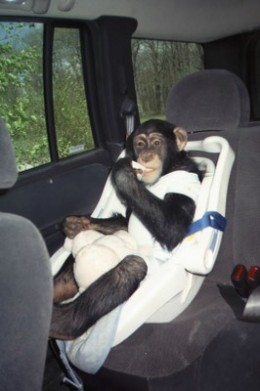
Bow in my Car
Public Transportation and the Right to Privacy
When you board a vehicle that is not your own, the person who owns the vehicle has the right to limit the things and the beings that you bring with you on the ride. If they don’t want you to bring a gun, they have a right to tell you so, and you have to respect their wishes. If they don’t want you to smoke or chew gum or drink alcoholic beverages, they have the right to enforce their wishes. If they don’t want you to play loud music, it’s their choice. If they say no chimpanzees on board, it’s their call.
This is okay only because we can make our own rules in our own vehicle. Someone who can’t bear to be parted from his weapons will have to drive his own car, fly his own plane, ride his own horse or find some other way to get there. It’s not that people don’t have the right to bear arms. It’s just that they have to do it at their own expense.
Someone who can’t do without smoking on a long ride might have to charter a jet or bus or train or boat. Someone who has a chimpanzee will have to do the same.
There was many a time when Bow was small when I had a linguistics conference to attend. The airlines would have demanded that I ship him in a cargo box. Can you imagine how frightening that would be? Would you do that to your baby? Naturally, we drove.
Public Transportation and Eminent Domain
Some people complain against too many of us driving our own cars as a source of pollution. They suggest that if everyone traveled by train, it would be more efficient, and so we should allow eminent domain to take land away from its owners so that many more tracks can be laid, so that the great mass of humanity can be transported back and forth to well frequented spots, while pioneers, recluses, and rural people get no benefit from any of that.
Complaints against tiny cars with a single occupant speeding up and down the motorways are a little ironic, when they come from people who support the government’s paving roads at public expense and taking the land for those roads without the consent of its owners and without just compensation. Eminent domain and taxation are responsible for the public roads that make all those speedy little cars possible!
The next time you hear one of these arguments, ask yourself what the real motivation is: to cut down on pollution, or to make going your own way down a less beaten path more difficult?
Public Transporation and the Road Less Traveled
I live in a rural location, and public transportation does not run here. There is a shuttle from the St. Louis Airport that you can take straight to my house, but the price of the ride is about the same, and in some cases more, than an airline ticket.
Many people who are interested in Project Bow come from urban environments, and they are used to having public transportation available. Some of them don’t drive at all. That is of no concern to me. I don’t require that they drive, but I do warn them that they will need a car to get around. Or barring a car, they will have to ride a horse, a bicycle or walk very long distances. The distance from Orchard House, where my interns stay, and my own house is two miles.
Once, I had two volunteers who informed me they would not need a car. I tried to be helpful, and I bought two pairs of bicycles for them to use. They tried to use the bicycles to get here, but it was tough going. The road is not paved. It was the beginning of summer, and the weather was hot, and they were out of shape. They would arrive here winded, and in a great deal of pain, and after two days they quit. They called their parents to pick them up. And the bicycles remain unused.
Those girls were from California. I did have a better experience with another volunteer from Canada who had no car. She was used to walking, and she was able to make it through the entire summer walking the two miles back and forth each day. Of course, she needed a ride to the Wal*Mart to go grocery shopping, and I was happy to provide that. But even this volunteer, who was in good shape and did a great job, did not choose to use the bikes. Bikes work pretty well on paved roads, but they require a lot more of us on a gravel path.
The Less Beaten Path
I support all people’s right to use whatever mode of transportation works to achieve whatever goal they have set for themselves. I support their right to do so at their own expense. I am entirely opposed to subsidized transportation of whatever sort, because not only does that violate our property rights, it ultimately affects our ability to take the less beaten path.
(c) 2010 Aya Katz

Thanks, ReuVera. It was really nice of the flight attendants to look the other way and let your dog sleep peacefully on the seat next to you. I think many people would rather behave humanely, when they can, but they can’t always do what they want when their employers and government regulations prohibit it.
When traveling with Bow, we often stopped for something to eat on the way, and I found that employees of the big chains were very rude and told me I could not bring Bow inside the restaurant. I’m sure they did not want to treat us like second class citizens, but health regulations and their concern about losing their jobs trumped their humanity.
On the other hand, if the restaurant was not a chain, but a private mom and pop joint, we were treated like royalty, and everyone catered to Bow’s needs. I remember one place where they were so kind, and brought Bow orange juice to drink through a straw specially.

Aya, this is wonderful that we still meet people who are not afraid to overwrite regulations for certain cases. On the plane (it was ElAl air company) a flight attendant even brought a water cup for my dog.

beautiful picture and lovely story, including Reuvera’s one in the comments!
Charlotte

Hi Aya – How do you feel about the Emergency Services such as fire engines and ambulances using the roads? If you are one of those who chooses not to pay for the roads, should you receive a large retrospective bill for the road’s construction if an ambulance has to come for you?
Thanks, ReuVera. People who work for El Al have always been kind to me, too, but I’m never sure if it’s because they are kind to everyone, or because they somehow see me as one of theirs.
Charkamman, thanks! I, too, feel that this hub has been enriched by ReuVera’s comments.
Paraglider, yes, but your question is worded in a weird way. When I say that people shouldn’t have to pay for other people’s roads without being asked, I don’t mean that they shouldn’t pay for their own roads. And I don’t mean that a road should be built, but nobody will pay for it. I’m trying to bring about the simpler life that you have expressed so much longing for: the convivial life where if a group of people want a road built, they voluntarily pitch in and build it at their own expense on their own land.
For instance, on my land there is a very long drive made of gravel. If it needs to be repaired, I and I alone get to decide when and how much. It’s up to me. It’s not anybody else’s responsibility.
Now, in your emergency scenario, are you thinking that a road will have to be constructed the moment my house is set on fire or I get sick and need an ambulance? Or are you thinking that somebody already built the road a long time ago, and then that’s when I’ll be required to pay my share?
We have a volunteer fire department in our small community. The people who work for it do not receive a salary. The people who want to enjoy its services pay an annual fee. The fee is not a tax. It is a membership fee and it is voluntary. If we don’t pay it, we are not entitled to the services. (I own two houses, so I pay twice as much as most people.)
If there were no road, and I called in for help, and somebody wanted to help, they’d have to come by helicopter. Of course, if I asked for the services, I would have to pay for them. But if the services cost too much, I might also decide to do without.
Do you know how many people call for an ambulance when it’s just a false alarm? Don’t you think that would happen less often, if they really had to pay for it?
BTW, how do you think the pioneers who settled this land handled medical emergencies? Do you think they called for an ambulance? How do you think the native Americans who owned the land before the pioneers took it away from them handled medical emergencies? Do you think they called for an ambulance?
If you hope to simplify life, you have to stop thinking like an urban dweller with entitlements.
I think you might have misread me on Conviviality. It has to do with how people interact more than about what infrastructure they have. Amsterdam is a good example of a transport network of roads, rails and canals all carrying public transport, together with walkways and cycleways used by more or less everyone.
Maybe you’d like to allow individual Amsterdammers to opt out of taxation, provided they promise always to hover ten feet above the ground?
I don’t think it matters much how the pioneers lived, way back then. Their choices were limited, after all.
Paraglider, I probably still do misunderstand “conviviality” as you use that term. To me, it would mean knowing how to live together, and the first commandment would be: “Don’t force yourself on others. Respect their right of choice.”
I would never tell people in Amsterdam (or anyplace else) how to live. I respect their right to make their own rules. By the same token, I recognize that the only way a person living in Amsterdam can opt out of their system is to move away from Amsterdam. There just aren’t any other choices, are there?
To me, choice is the key to freedom. Many people moved away from Europe, despite the safety, and the culture, and the way of life that it offered, because everything was too crowded, and they had few choices. They took their lives in their hands, and they braved the elements, and they went into the wilderness to build a new life.
And when that wilderness became New York City, or Philadelphia or Chicago, their descendants had to do the same thing again, to get away from forced conviviality.
I don’t want to tell people in the city how to live. I just don’t want them to come here and tell me how to live. Let them tax each other, and pave all the ground up if they want, but let there be someplace for people to go if they don’t like it!
This all goes back to my father’s article:
http://hubpages.com/politics/Liberty-and-Justice-W…
You can’t have liberty when the population density is too high.
I’d say that people in Amsterdam are pretty free. E.g. to get from A to B they can choose to walk, cycle, bus, tram, train, taxi, drive, water-taxi, all of which facilities are provided by the city’s social organisation and infrastructure.
Whereas in many less well organised conurbations there is no option but to drive a private car (or walk)

Aya, that’s a great pic of Bow in his baby seat.
As to roads, in my mind, roads equate to the beginnings of civilisation. When the Romans came to Britain they immediately built roads, and the foundations of those same early routes still exist under the modern day network. Efficient road building ensured the success of the Roman invasion. Roads are like the veins and capillaries along which our lives flow, and we must all contribute to their maintenance and upkeep if we wish to be an integral part of the world we live in.
Paraglider, freedom does not mean having material goods and being provided for. The ONLY freedom that people in Amsterdam have is to choose “which facilities provided by the city’s social organisation and infrastructure” they will use. You made my point for me when you pointed out that they could not opt out of those social services without leaving Amsterdam far behind them. That is not freedom. That is being boxed in.
Can people take a chimpanzee along with them on these public roads, waterways, buses, walks, or taxis? Can they bring their shotguns and rifles? Can they sing at the top of their voices? Can they smoke? What about flatulence? When they have gas, are they expected to hold it in? Are they expected to suffer stomach aches and ulcers out of consideration for other people? That is not freedom! That is hell on earth.
It may be that there is a process of natural selection that has created people who can live this way and no longer want to be able to do anything else but conform. The people who could not stand it left. The people who could not bear to leave, stayed. But if this happens everywhere, there will be no more pioneer spirit, no more freedom,and many of us will have to simply kill ourselves, leaving only those who see nothing wrong with that kind of life.
Is that really the world you would like to live in?
Thanks, Amanda. Bow used to sit there in his car seat clutching his stuffed bunny, and most of the time he behaved so well! It’s really tough right now when I can’t take him anywhere anymore. I can’t wait till I’m able to build him an island on five of my acres.
The Romans were conquerors in Britain. They built those roads the better to subjugate the Britons. I’m surprised you can’t see that public roads always mean a well policed populace and not freedom.
Aya – I could just as well say that you appear to be confusing freedom with solitude, or perhaps wilderness. City living and country living are different, but both offer options. I’d find it hard to visit a public library in the desert or to catch rabbits in Trafalgar Square. My freedoms in London are merely different from my freedoms in Sahara. They are no less real.
Paraglider, thanks for continuing the discussion. I do appreciate being able have these exchanges.
I am actually not confusing freedom with solitude. I think freedom means being able to choose solitude when we want it and sociability when we want it. As I mentioned in my hub, I have lived in many places, including cities in more than one country. When in Rome, we do as the Romans. I have used public transportation, rather than insisting on having my own car, like some foreign workers I know, when living in Taiwan.
I would be the last person to try to tell people in Taiwan or Amsterdam how to live. I recognize that I have no right. If I don’t like it somewhere, all I can do is leave. But that’s why it’s so important to always have a place to go that is not already overrun with other people.
Freedom isn’t any particular lifestyle. Freedom is the right to choose your own lifestyle, and to change it whenever it suits you.
The problem is that people in the city are taxing people in the country to support their lifestyle. Whether you want that super highway or not, or the public services that Federal money contributes to, you are in fact paying for it with your taxes, if you live anywhere in the US. That is not okay.
It’s very important that anyone who wants to live in a commune live in a private one where only members of the commune contribute to the communal coffers.
I’m going to pick you up on the word ‘overrun’ (by other people). The word suggests that you would like unspoilt places to exist for you, when you want them, but not for others, if it means they get there first and spoil it for you. Fact – we have a lot of people and limited land. We can’t all be pioneers. If you want to be a pioneer, shouldn’t you first give all of your money and resources back to the society from which you inherited/earned them, and then be a true pioneer, relying only on your wit, strength and skill, and not on your ability to call in a bulldozer to flatten your land? Oh, and what is ‘your’ land, if not the land you bought from society with your portion of society’s money?
The problem is that the world is finite. The pioneer model really only works on an infinite flat Earth. Good luck in finding one of these.
Paraglider,
Did you read my father’s article, Liberty and Justice: Why, How and For Whom? If you did read it, did you understand his point that liberty is a limited commodity and that it commands a price and that it diminishes naturally with population growth?
The earth is indeed finite. This is why we can’t have a growth economy and a growing population to support it ad infinitum. That is a pyramid scheme that will collapse sooner or later. I’d rather stop it sooner, rather than later, if for no other reason than to limit human suffering. But yes, I want freedom, too!
Many people speak of the native Americans. Well, they were not native to America. They came here as immigrants across the Bering strait, and they didn’t use a bulldozer, but they were definitely escaping the same pressures that all humans try to escape when they migrate. The pressure is always other humans! Other humans who want to live where you live and hunt where you hunt! No group of hominids has ever been able to avoid territoriality, and whoever loses always is assimilated, is decimated or leaves for greener pastures.
They built a life in the wilderness, too, these immigrants from across the Bering Strait. And their way of life was crushed out of existence by the appearance of other immigrants seeking freedom and space. This time in ships from across the Atlantic.
The pressure of human population growth continues. There is perhaps no way to stop it, but in that case we are all doomed. If there is a way to stop it, it must be by embracing technology to keep the hordes at bay. That is the only hope for chimpanzees in Africa and abroad. It is the only hope for aboriginal peoples the world over embracing a hunter gatherer lifestyle, and it is the only hope for rural farmers who are growing food locally in small quantities rather than yield to agribusiness. They will not win by rolling over and playing dead. They have to fight using whatever weapon is at hand.
It’s all very well for city people to embrace an urban lifestyle, but they have no right to turn the entire world into one big city!
I’m not using a bulldozer to keep people from encroaching on my land yet, but I will if I have to. I’m hoping that others who have similar interests will stand beside me in this fight. Local people have to band together to protect their interests against those who would rule them from afar. The American revolution was all about that.
And no, it was not society’s money, but my father’s earnings that bought this land. Earnings that he saved, while other people were spending theirs!
By society’s money, I simply meant that there can be no money without society, while by definition, money is worthless on an uninhabited island. A true solo pioneer would have no use for money, while anyone who uses money to enhance or protect his settlement is not a pioneer but an outpost of society, demonstrating his dependence or at least interdependence with every purchase he makes.
I agree that a growth based economy (or more specifically, a debt-interest based economy) is unsustainable and bound to collapse.
I also agree that – all else being equal – there’s an inverse relationship between freedom and population. But all else is not equal. Some societies are far more restrictive than others. I’m currently living in a country with a population of less than two million where the freedoms are far fewer than in the extremely densely populated Netherlands.
Paraglider, without trade between individuals, money is without value. It is the desires expressed by individuals when they use money as a means of exchange that give money its value. I recognize that there is such a thing as society. It is an abstract concept based on the existence of individuals. Do you recognize also that without individuals there could be no society?
As for pioneers, they come in many stripes and colors, but very few come all alone, like Robinson Crusoe. I think you may be confusing pioneers with people who are shipwrecked alone on a desert island. Most pioneers use whatever technology is available to them to achieve their goals. The people crossing the Bering Strait did not abandon fire, just because some individual, Prometheus-like in the prehistoric past, thought of using it before they did. The pioneers who tamed the American West did not abandon the wheel, or gunpowder, just because others thought of those things before they did.
Admitting that you owe an intellectual debt to your predecessors is not the same as admitting you owe a money debt to your contemporaries. Anybody is allowed to use whatever technology he has mastered and all the help others are willing to give him of their own free will. Nobody has the right to demand that others serve him without their consent.
I’m glad we are agreed on the impossibility of maintaining infinite growth. Good to know you see the inverse relationship between freedom and population density, all things being equal. Of course, there can be special cases where tyranny is maintained in an area that is sparsely populated, and it is also possible to maintain an unusual degree of freedom in a crowded area, if strict adherence to individual rights and free exchange is somehow maintained. It’s how we behave toward one another that determines how free everyone is. But all things being equal, the higher the population density, the harder freedom is to maintain.
One thing to keep in mind is that there is more than one way to be a pioneer, but that every pioneer is more anxious to be able to make a lasting contribution to society than he is to indulge hedonistic pleasures. (Hedonists usually stay sheltered in the safety of society’s infrastructure.) When we fight to protect our resources, it is because we need them in order to make our contribution. A contribution can be as ordinary as raising a child and as extraordinary as creating an artistic masterpiece or a scientific breakthrough. To every person, his own contribution is of paramount importance. In order to be fair to all, we must let each make his own contribution at his own expense. It isn’t right to take one person’s resources to fund another person’s pet project. Which contribution will be of more value to future generations? Only time will tell.
Wow, isn’t it interesting how a discussion can take an unexpected turn when different individuals see it from a different angle?
Back to the roads: I have two stories from different countries.
In my old country, Soviet Union, there was a huge camp “Artek” (on the Black Sea shore) for “young pioneers” (“young pioneers” was a kind of scouts movement for kids aged 10 to 14, but of socialistic type. Now this camp also exists). So, the founders of the camp let first campers run free on the premises and where their small feet made paths (apparently, convenient for kids) later landscapers made blacktop sidewalks.
Another story is from my recent experience. We usually fly to Israel from Chicago, IL. We drive to O’Hare airport form Wisconsin. Roads in WI are toll free, but in IL you have to pay a toll fee pretty often. This road tax was established years ago as a temporary matter to raise money for building the roads in IL. Now it became mandatory and over 10 years that we drive to and from Chicago it grew from 10 cents to 40 cents in most of the booths and in some booths to $1.50 and even $3! 24/7 millions of vehicles pass those toll stations. Can you imagine HOW MUCH money they collect every day? I can’t say the roads in IL are so much better than in my toll free WI.
Two examples of temporary matter that became permanent, from different angles.
P.S. ElAl personnel is nice to all the passengers. In 2005 two of my sisters-in-law and my son’s friend traveled with us to Israel and they confessed that their experience flying ElAl was the best one, comparing to other companies.
Clearly without individuals there could be no society. But a few individuals can trade quite happily without money. Money becomes necessary when the number of transactions is too great to track and the need arises for a common standard of exchange.
I’m coming back to your ‘all else being equal’ prerequisite for the inverse relation between freedom and population. I don’t really accept it, except for a definition of freedom that is quite different from mine.
For example, while Mr Log-Cabin may be ‘free’ to compose any music he wants to, Mr Metropolitan has access to far more influences, sources, instruments, musicians, etc., yet still is free to lock himself in a room when he wants to.
More people equates to more complexity, not less. And complexity can translate to opportunity, or freedom.
And to back this up with simple Mechanics: Within a Cartesian frame of reference, a body’s position and orientation in space is completely defined by six coordinates. Add a second body and the number of possible arrangements of the system of two is the square of the number of arrangements of the single body. Add a few more and the permutations become incalculable. So incalculable that we have to look to macro descriptions, like the gas laws.
Societies work much the same way – at the macro level, you see trends and societal characteristics, but at the micro or individual level, the diversity is almost infinite.
ReuVera, thanks for coming back and joining in the discussion. The idea that eventually paths that form naturally by being trod upon by many feet may later get paved is not new to me. It makes sense to pave over naturally occurring paths, rather than to centrally plan everything and not understand what local conditions are and what may be most convenient on the spot.
I’ve been to Illinois and I’ve driven through some of those toll roads. In fact I was chided by family members that I took the long way around to get from Brookfield to Gurnee just to avoid the toll. I think the level of corruption in the Chicago area is higher than normal for the U.S. I don’t think it’s a question of toll versus no toll. The police are corrupt there, too, and I’ve been subject to what amounted to highway robbery by a police officer in Chicago, who would not return my license to me until I paid him money in cash.
I have not lived in Wisconsin, but I hear people are nicer there, and I think it has something to do with population density.
Paraglider, you really touched on a subject that hurts right now. So if I get a little emotional, please try to understand. The portion of your comment that really got to me is this one:
“For example, while Mr Log-Cabin may be ‘free’ to compose any music he wants to, Mr Metropolitan has access to far more influences, sources, instruments, musicians, etc., yet still is free to lock himself in a room when he wants to.”
This is not a theoretical question for me. While I personally do not compose music, I wrote the book and lyrics for a musical way back in 1985. I was looking for collaborators. I needed a composer. I wanted someone to produce it. At the time, I was living in the Dallas-Ft. Worth Metroplex, a metropolitan area with more than one opera company, more than one theatre, lots of public money funding the arts. Not one person looked at it. Not one person thought it worthy of considering. Like my novels, and my poems, and my essays and everything else that I did to make a lasting contribution, it was completely rejected.
Twenty-five years went by. I left the law. I got a Ph.D. in linguistics. I taught at a university in Taiwan, in the Taipei area, and again I tried to interest people in the play, and nothing! So I left Taiwan, and I went to live out in the country, and I taught a chimpanzee how to read and write, and we had a great breakthrough, and of course no acknowledgement of same, but, Ms. Log Cabin that I am, still haven’t forgotten my play, THE DEBT COLLECTOR.
So one day, Daniel Carter, a wonderful composer who also does not live in New York or Paris or London, was looking for a play to write music for, and I sent him the manuscript, and we’ve been collaborating, and we now have a full three act play with nineteen songs, sheet music and all!
And do you think anyone on Broadway is going to be interested? No. If we get it produced, it will first have to happen way out in the countryside. So, no, I am not in favor of publicly funding the arts! They take money away from everyone and then they give it to some people and not others. I’d be much better off if everybody got to keep their own money and pay for the kind of art that they like. So would society! I think the arts are in terrible shape because they have been publicly funded. And in case you are interested, I have two related hubs to share:

Great hub and thoughts on the subject of transportation. When weighing the odds of taking different modes of transportation it is also important to remember how extremely expensive owning a car can be. I have heard figures like 20% of the average person’s income goes into their car. I wish I could go carless for environmental and financial reasons, but like you I live out in the country where public transit is unfortunately non-existant!
CompellingCarl, thanks! How soon you have to replace your car, refuel it, or service it also has something to do with how much you use it, and how far you drive. My car remains idle five days out of the week, because I don’t go anywhere. Two days a week, I drive it to get groceries and check the mail. It’s true that if I lived in the city, the grocery store and the post office would be closer. But if I lived in the city, I would probably have to leave my property every single day, in order to earn the property taxes and other expenses that city living would require. Many people just work in order to keep paying for the right to keep working. It’s a crazy way to live.
On the other hand, if you really want to ditch the car, a horse and buggy is one possibility. The Amish do it, and it seems to work for them.
Yes with my primary work being on the farm right now, my driving is definitely much less than if I had to drive 30 min to work everyday
CompellingCarl, right! Having your work right there where you live makes everyday transportation of any sort much less necessary when living in the country.

I can relate to your hub because I tend to walk a lot, and I even have a blog about pedestrianism that I do not update very often. Public transit is a good option, but I only take it when I am running late. I prefer to leave early and walk to my location. I purposely live close to work and where I need to go.
Sweetie Pie, thanks for dropping by. I love walking, too, and when I lived in an urban area, it was one of my favorite ways to get around.

Well, I love public transportation! When I lived in CA, I took the bus everywhere, didn’t have to pay for all the outrageous expenses of a car, and had time to read and watch the scenery instead of fighting the traffic. I would love to have a bus that would take me from my small town to the next larger town so I could go do my shopping once a week. If we had that, I would get rid of my car.
However, I HATE trains! All trains, and especially the 29 trains that roar past my house everyday without a passenger train among them. Down with trains, I say!
Here comes one now…
Suzanne, thanks for dropping by! You bring up a good point about trains: it might be fun to be a passenger on a train, but it’s no fun for the people who live close enough to the track that they have to put up with the noise pollution!
It would be convenient to have a bus from small town to small town, if there were enough people who wanted to use that service and were willing to pay what it cost to run the service. They used to have stagecoaches that ran from town to town. But I don’t think they were subsidized by people who didn’t ride on them. And when it was no longer profitable to run the stagecoach, the service was discontinued.
Of course, it’s always possible to charter your own bus and see how many of your neighbors will pay you for a ride! But… what really gets to me about buses is how the seatbelt laws don’t apply! Is it really safer to be standing up holding onto a little cord during a crash than sitting in your own car without a seatbelt? Or is it just a special dispensation for the public sector?

I can see your point and must say I agree. I do not intend to take away the comfort of others for my own benefit and do not want it done to me.
TaylorsLaw, thanks! It’s always refreshing to meet someone who feels the same way.
Hey Aya – I lived in Fenton for a long time as a child…we walked everywhere! 2 miles would have been nothing! My school bus stop was 1/2 a mile from my front door – uphill. I enjoyed the 1/2 mile walk down the hill after school much better!
Property near train tracks lose a lot in value as well…nobody wants to live next to them.
RealHousewife, thanks for sharing your experiences and your thoughts.
Isn’t it strange how weak we have become, so that what was once an acceptable walk for a child is too hard now for an adult?
Not only did property next to train tracks lose value, but can you imagine the loss to the people whose property was taken by force under eminent domain laws? I bet they were not compensated for their real loss, which may not have been merely monetary but in many cases sentimental as well.

Yeah Aya – I worked for an attorney who practiced Emininet Domain and Condemnation – best in the state! We often fought hard for higher comissioners awards…yeah…you can’t put a price on someone’s land like that!
RealHousewife, I see that you are aware of all of that and are experienced in this area of the law.
The older I get, the more I see that things we take for granted as infrastructure are not free and that only some people are expected to pay for the equal access to “public resources”.

![IMG_1143[1]](https://www.pubwages.com/wp-content/uploads/2015/11/IMG_11431.jpg)
![IMG_1140[1]](https://www.pubwages.com/wp-content/uploads/2015/11/IMG_11401.jpg)








![IMG_7683[1]](https://www.pubwages.com/wp-content/uploads/2015/09/IMG_76831.jpg)






ReuVera 5 years ago from USA
I love Bow’s picture in a baby seat. He IS a baby and of course, you wouldn’t ship him as a “cargo”. When we had to fly with our small dog overseas, she had to be in a carrier, but under my feet in a plane cabin. She was sleeping all way, but on another flight she was restless in a carrier, so I took her out and put on an unoccupied seat right next to me, between me and my son. The flight attendants first demanded me to put her back into the carrier, but we were high in the air and my dog was so peacefully sleeping and we covered her with a towel, so they pretended not to see it. It is nice when sometimes people who are responsible for a ride can think out of the box and be human.
I agree with you on the choice of transportation part too.