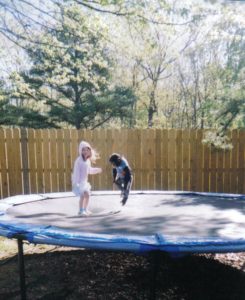
Nowadays, when Bow and I look out on the backyard we see our dog Leo lounging on the trampoline. But there was a time not long ago, when Sword and Bow used to play on that trampoline together. I mentioned this once on social media and reminisced about how it was a wonderful experience for all of us.
When I wrote about our trampoline, I got two comments that I thought were interesting. One person said that where she lives, nobody has trampolines, because the insurance companies would increase the charges for homeowner’s insurance on anyone who had one, and this has a chilling effect on trampoline ownership.
Another person mentioned that she has a trampoline with a safety net. I told her we never got a safety net for ours because Bow would have destroyed it, but that in retrospect, I was glad we never got one, because it would have lulled my children into a false sense of security. Instead, I made it very clear to them that no one would catch them if they fell, and so they had better not fall. And they never did!
This got me to thinking of the concept of insurance as a kind of safety net.
A trampoline really is dangerous. So is a chimpanzee. A chimpanzee on a trampoline with a little girl you would think would be very dangerous. But really it depends on the chimpanzee, the little girl and their mother to see to it that things do not get out of hand. I insisted they jump close to the center of the trampoline and that they do so in a safe manner. I supervised. And as athletic as my children are compared to me, they are not super-athletic, so they never tried any dangerous stunts. I have heard about children getting hurt on trampolines. I have heard of it happening with a safety net on.
But you could also say that it’s a matter of statistics. That our case was unusual, but that insurance companies play the numbers game, and that statistically speaking, if lots of people and their chimpanzees jumped on a trampoline without a safety net then someone was bound to get hurt.
I can definitely see the insurance company’s point of view. If I were in the business of selling insurance, then I, too, might not want to bet on nobody getting hurt, especially if I stood to lose money on it. So I would probably tell people not to do what I allowed my own children to do, because I do not know those people and some of them might not be very careful and somebody would end up getting hurt and I would have to pay for it.
The thing is, to me, our family is not a statistic. And I can tell you with 100% certainty in hindsight that we made it through the years of a little girl and a chimpanzee on a trampoline with flying colors, and nobody in fact got hurt. It would be a real shame if an insurance company robbed us of those beautiful memories.
In fact, if any insurance company had tried that, they would have seen me cancel the policy. If all of them did, then I would do without insurance at all. My house is paid up. There is no law that says that I have to have homeowner’s insurance. Which means that I am free to make my own risk calculations.
There are, however, other kinds of insurance policies that are now being forced on me, and I am afraid that it’s not just about the money. It might also be about what sorts of chances I get to take with my own life and that of my family. It might be about how much fun we can have or whether we get to stay together at all.
A safety net is a very dangerous thing, even when you choose it yourself, because it can lull you into a false sense of security and make you less vigilant about real dangers. But a safety net that you cannot choose to discard is a noose around your neck.
My father, Amnon Katz, died seventeen years ago today. It was October 3, 2000. His helicopter crashed and he was killed instantly. There were no other people on board. It was an experimental helicopter he had built with his students at the the Universiy of Alabama in Tuscaloosa. He was sixty-five years old at the time, and a Cudworth Endowed Professor in the Department of Aerospace Engineering and Mechanics at the University of Alabama.
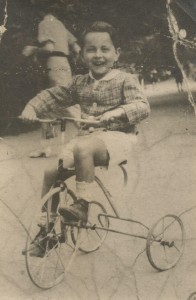
My father, Amnon Katz, on his tricycle
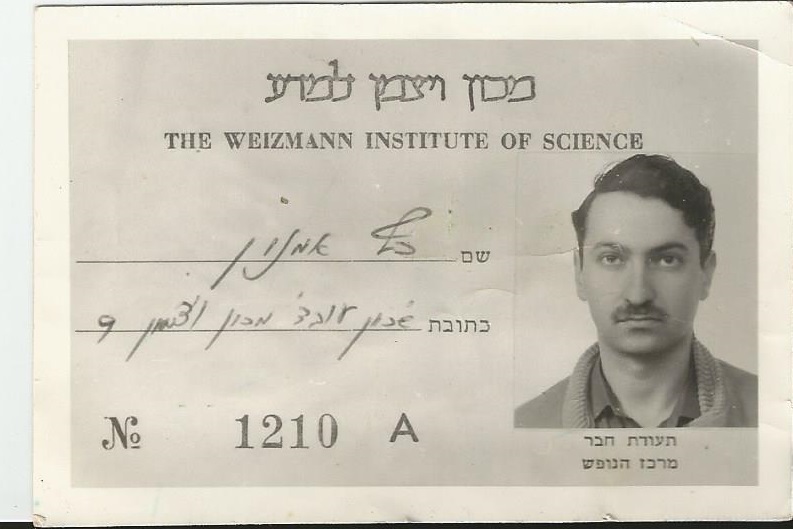
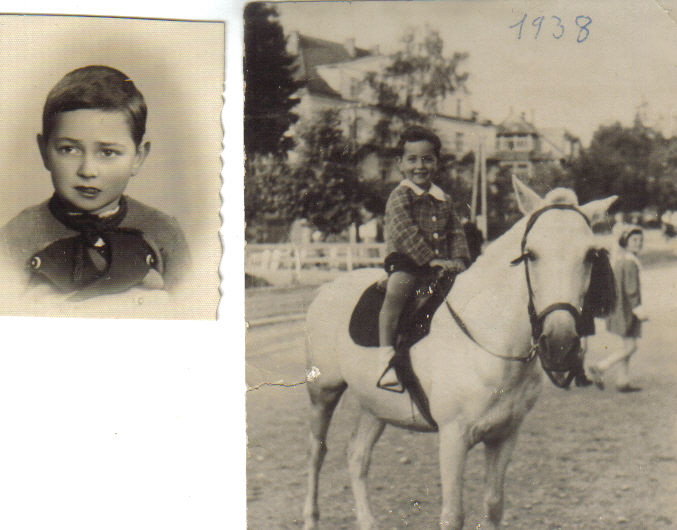
To the right is a picture of my father mounted on a pony in 1938 in Krakow before the war broke out. To the left is photo of him, probably taken for some identification document, when he was a refugee in Vilnius,Lithuania, on the way to Israel.
Amnon Katz was born in 1935 in Krakow, Poland. Here is a picture of him riding his tricycle in a park in Krakow when he was three years old. When he was four, he and his parents left the country by stealth, and took a long and arduous journey that led to Palestine, where they settled down. I know that none of his relatives who remained in Poland survived. But looking at this picture, I suddenly wonder what happened to the tricycle.
My father’s parents were Zionists, and so he spoke Hebrew at home even before the move. He had a nanny who spoke Polish with him, but his parents only ever addressed him in Hebrew. It was a grand linguistic experiment he was involved in: reviving a dead language.
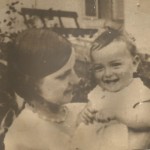
My father and his Polish nanny
Neither of his parents was a native speaker of Hebrew. There were no native speakers until the language was revived in the late nineteenth century by Zionists. Yet my father became a native speaker, because that is what his parents spoke to him from birth.
When people ask me how dare I run a linguistic experiment on my own children, I smile and reply that there is an ongoing family tradition to experiment linguistically on our children. As far as I know, it has never done anyone any harm to be exposed to dead languages that have been revived.
My father in Texas with our dog Aza and the twin engine he called Gearcheck
My father’s love of flight developed en route to Palestine, when he boarded his first plane. But his first career was as a physicist, at the Weizmann Institute in Rehovoth, Israel. It was there that he met my mother. It was also there that he wrote and published the following books: Classical Mechanics, Quantum Mechanics, Field Theory, Academic Press 1965 and Principles of Statistical Mechanics (The Information Theory Approach), (Freeman 1967).
My father was a member of the Canaanite movement. He believed in separation of church and state and equal rights for all Israelis, of whatever ethnicity or religion. He also thought Israel should not accept aid from the United States, and he believed it should keep all territories conquered in war.
In 1970, disillusioned with politics in Israel and the uselessness of the academic calling, my father decided to immigrate to the United States and become an aerospace engineer. But he had much to learn about industry, and especially the way the defense industry has been corrupted by government contracts.
My father also ran his own company, Inverted-A, and he designed one of the first electronic flight simulators for general aviation: the Minisimulator IIC. He is the founding member of Inverted-A Press, which I inherited from him. His book one political book, Israel: The Two Halves of the Nation was published by Inverted-A.
Eventually, my father went back to academia. While a professor at the University of Alabama, he published the following two books: Subsonic Airplane Performance, (Society of Automotive Engineers 1994) and Computational Rigid Vehicle Dynamics, (Krieger 1997).
My father has always been my role model. He was an independent thinker and a pioneer in more than one discipline. I owe everything I am today – even the weird stuff – to him.
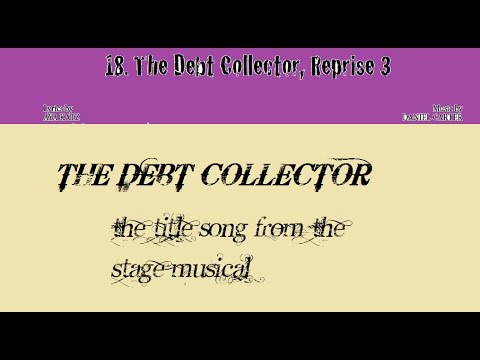
Blood Samosude is someone to fear. A vigilante enforcer of contracts, Blood lives outside the law and is shunned by respectable society. In the town, they warn one another about him.
The debt collector, the debt collector,
They don’t call him Blood for nothing.
He has no heart, he has no soul,
No pity, patience or forbearance.
Outside the law, out of control,
There’s nothing he won’t do to scare us.
Children frighten each other with graphic descriptions of what he might do to them, if he met them on some dark night.
He’ll tear all the teeth from your mouth like a dentist,
Except that he’ll do it without Novocaine.
The way they did back when it wasn’t invented.
And he’ll laugh in your face when you cry out in pain.
He’ll take all your teeth, and no one can stop it,
And he’ll whistle a tune feeling chipper and merry.
Then he’ll wrap them in tissue and sell them for profit.
Each one for a quarter paid by the tooth fairy.
Everybody who owes money or who has reneged on a promise both loathes and fears him. But when Helga Hauser, a financially struggling widowed landlady, needs someone to help her against her unruly tenants, the Larks, the Debt Collector is her only hope.
The Lark family has seven children and one on the way. They are living on welfare in Mrs. Hauser’s rent house, and they do not pay their rent and are also late with the bills, but they are not thieves. The Larks consider themselves to be decent folk. They are law abiding people.
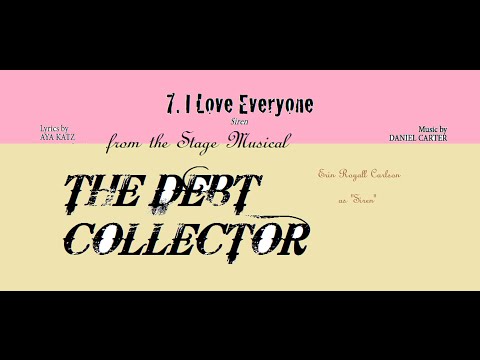
Into the lives of the Larks steps the beautiful, flirtatious social worker, Siren Thompson. Siren has been sent by the State to make sure that everything is okay with the Larks, and especially with their children, who are considered “at risk”. Siren is concerned for the poor and the downtrodden, and she loves everyone.
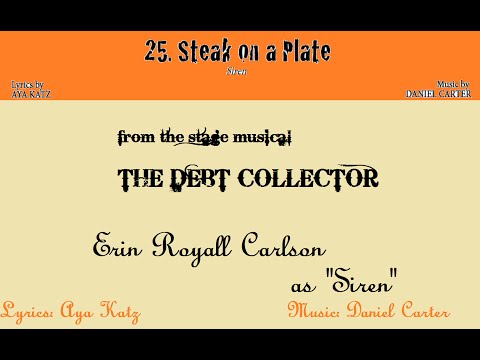
Blood, the Debt Collector, happens to overhear Siren singing this song, when he is on his way to collect rent from the Lark family that is owed to his client, Helga Hauser. He is charmed by Siren’s enthusiasm, and the two exchange words. Blood and Siren are both idealists, but their ideals are different. Siren wants a world where no child is ever hungry or hurt. But Blood wants to live in a world that is fair, where people keep their promises –or else.
Things begin to unravel when Blood shoots and injures Constable Peeples, whose job it is to prevent the eviction. Blood goes into hiding, while Constable Peeples makes a full recovery. Two of the Lark children, Dexter and Sophie, who have learned to respect Blood when he helped them collect a debt from their parents, decide to go with him, and they ask him why he lives outside the law, the way he does. Why isn’t Blood an officer of the State, instead, like Constable Peeples, if he is so interested in enforcing the law? His answer is “I’d Rather Be Free”.
The children, who begin to miss their parent, return to find that their mother is in the hospital, having given birth to yet another baby. But Siren has already reported the absence of the children, spurring an investigation by child protective services that eventually leaves seven year old Sophie in the hands of a cruel foster mother who wants to adopt her without her consent.
When the Larks learn that Sophie is in danger, they realize that the Debt Collector is the only one who can help them against the welfare state. But they don’t know where he is. He has gone into hiding. The only person who knows how to contact Blood is Mrs. Hauser, their former landlady. But when Lottie Lark sees Mrs. Hauser on her knees, trying to scrub the stains out of the dirty floor that she has left in their former residence, she suddenly realizes that she owes Mrs. Hauser an apology.
Mrs. Hauser, moved by this apology, tells the Larks how they can contact Blood. At first, Blood does not want to help the Larks, until he realizes that it is his fault the State took Sophie away. He had no right to take the children away from their parents without permission. He has contributed to the problem. Overcome with remorse, Blood apologizes to Lottie Lark.
Blood goes off and saves Sophie, but is shot in the process of illegally removing her from her foster home. Mrs. Hauser provides a safe house for both Blood and the Larks, and even tells Constable Peeples who comes to check on her that the crying baby the Larks have left in her living room is her own grand child. While Blood recovers from his injury, Siren, the social worker, learns how to apologize by taking lessons from Carl Lark, the welfare father.
Eventually, after being well-schooled by Carl, Siren manages to apologize to Blood for her contribution to the problems of the Larks and Mrs. Hauser, and for trying to sabotage him.
In the end, the Larks and Mrs. Hauser come to terms, and they realize that tenants need landlords, and landlords need tenants, just as children need parents, and parents need their children. Carl Lark agrees to work for Mrs. Hauser as a handyman, and he asks Blood to make sure that she does not go back on her promise to pay him his wages. The Larks learn that they have as much to lose to government meddling as Mrs. Hauser does. Children are precious to their parents. Rent is essential to the continued existence of landlords, and nobody needs a government that redistributes either money or children. Even Siren reforms and agrees that everybody needs a person like the Debt Collector, to make sure that important promises are kept.
Copyright 2017 Aya Katz and Daniel Carter. All rights reserved,
[This article was first published in 2013 on a website that has since gone defunct.]
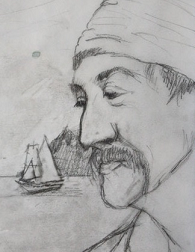
A sketch of Jean Laffite by Lanie Frick
What is it about pirates? Why are people so attracted to them? Why is today, September 19, celebrated by some people as talk-like-a-pirate-day?
In the past, pirates held no attraction for me, as I believed they were mere robbers of the sea. I was not interested in thievery, I was not interested in treasure, and I had no desire to talk like Long John Silver from Treasure Island.
But in the past two years, as I became immersed in the life story of Jean Laffite, I think I came across the real reason people are so interested in pirates. Pirates live by their own rules, often form their own governments and offer an alternative way to mete out justice. Many of the people that we think of as pirates today – people like Jean Laffite – were actually privateers. They performed as private navies, doing the work that real naval officers would not do, for a fraction of the cost.
Laffite’s real crime before the battle of New Orleans was tax evasion. He and his brother Pierre came to Louisiana as smugglers. They got around the Embargo Act which outlawed all international trade. They were importers of goods people wanted, but could not get. When the Embargo was lifted, they avoided customs, and brought ashore goods to be purchased by the citizens of New Orleans. Everybody was grateful for what they did – except two groups: merchants who sold for a higher cost and the United States government’s Revenue Service.
Now, supposedly, the Revenue Service was collecting taxes so that it could finance the United States Navy in the War of 1812. But when the British came to recruit Laffite, he gave all the information about the British to the local authorities who turned it over to the U.S, Navy. And the Navy went on the attack – not against the British – but against Laffite’s Baratarian privateers. They cared more about tax evasion than an invading army. They looted the stores with all the goods belonging to the Laffites and sold them for profit. Commodore Patterson and his men took privateering ships that could have been used for the national defense and sold them for money to line their own pockets.
When despite all this, Laffite saved the United States from the British in the Battle of New Orleans, the goods the Navy confiscated from him were never returned. So, I ask you, who is the real pirate here?
People say that pirates – real pirates – are bad and they are against them, but that they enjoy putting on costumes and saying “Aargh” for a day. Just for fun. Doesn’t mean anything. But the real attraction of “pirates” is the one we seldom acknowledge – that they are a welcome alternative to the tyrannical governments that rob us every day of our hard earned cash – not in order to fight an invasive enemy – but just to line their own pockets.
When I teach a course in Biblical Hebrew, I always base it on the Book of Ruth. Why? Because it’s a short book, uses simple and poetic language and is very down to earth. There are no miracles or divine appearances, no angels and no visions. It is about ordinary people, how they deal with hardship, their feelings of loyalty and love, and their customs and way of life.
Naomi and her husband and two sons left their hometown, Bethlehem (which means House of Bread) during a famine. They went to live in Moab, which was a different country, with different customs and ways of life. The sons married local women. But the family fell on bad luck. The husband and the two sons got sick and died, leaving Naomi with her two daughters-in-law. Naomi decides to go back to Bethlehem, because she has heard the famine was over. She suggests to her two daughters-in-law that they leave her and go find themselves some new husbands. One daughter-in-law agrees. But the second one – – Ruth – – decides to follow Naomi home. “Whither thou goest I shall go …” This is the best remembered line from the book and is sometimes quoted in a romantic context, but it was originally spoken by one woman to another.
So they go back to Bethlehem, where the barley harvest is currently in progress. And because they are poor and hungry, Ruth goes a-gleaning after the reapers. What is gleaning? That is actually what I want to talk about. It is a way to feed the poor that does not rob the rich.
And that’s what I really want to focus on here: not Ruth’s romantic encounter with Boaz, which occurs in the context of gleaning – but the context itself. The people who wrote this book of the Bible took it for granted that everybody hearing the story would know the customs of the times, but today we could gain a lot of perspective by reviewing them.
During the harvest, after all the bulk of the grain had been reaped, there were some grains left unharvested. If it were up to the wealthy landowners, these grains would simply go to waste. So the poor were allowed to come on the property and follow the reapers and pick up the left over, squandered grain. However much they gathered in a day was theirs to keep. They were even allowed to roast it and eat it on the spot. It made a good meal, because the grain contained fats, proteins and carbohydrates, enough to supply all the body’s needs. Nothing went to waste, and nobody lost anything by following this custom. The rich did not lose money, and the poor did not get rich, but those who really needed it got something to eat, without hurting anyone else. And they got it by their own efforts. They worked for it!
Notice that when Naomi came back to her hometown, nobody said she was a parasite. Nobody thought it was bad that she had left during a famine and came back when the harvest was good. Nobody tried to shame her. It is natural to leave your hometown during a famine. It is right to take your family to where there is plenty of food. You do not help anyone by sticking around and starving. But it is also natural that when things get better, people want to return home. And there’s nothing wrong with that!
The reason today so many supporters of the welfare state think it’s not okay to drop out of the system when it suits us and then drop back in when that seems right for us is because their system is based on taking from one person and granting another. But under gleaning, nobody was robbed in order to feed anyone else. Nobody exploited anyone else. And one person’s salvation did not come at a cost of another’s life. It was a win/win situation.
We don’t have to hate the rich to help the poor. And we need not despise the poor to save ourselves.That is what we can all glean from the Book of Ruth!
[This pub was first published on Hubpages in 2010. Due to the current ban on dueling by Hubpages management, I had to move it to PubWages.]
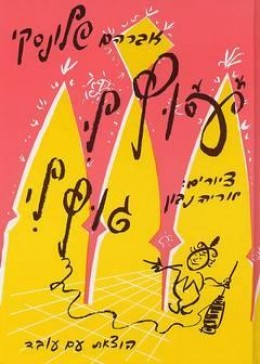
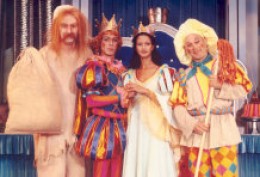
The first musical I ever saw was עוץ לי גוץ לי (pronounced Utz Li Gutz Li). I was five years old. I liked it so much that I asked to see it again. My parents bought the record, and they copied it onto reel to reel, and I listened to the songs over and over again throughout my childhood, no matter where we lived.
The book and lyrics to Utz Li Gutzli were written by אברהם שלונסקי (Avraham Shlonsky), and the music was composed by Dubi Zeltzer. The play is based on the fairy tale by the Brothers Grimm called Rumplestiltskin, but it’s really nothing like the scary children’s story, except in the bare bones plot. Instead, it is a satire and a social commentary. And the intended audience? Children and their parents.
Shlonsky was warned that it would be a flop. They tried to convince him to simplify the language, so that children “would be able to understand it.” He used the very highest kind of Hebrew, the kind you find in the old testament, and he used it to poke fun at politicians. How could children possibly understand what a deficit is or that trying to balance the budget by printing more money might be a questionable practice? Who would even want to see such a play? The lyrics were not just peppered with archaic words, they were grammatically challenging. Who even uses the dual anymore? And does it really seem like a good idea to make fun of local place names, substituting “House of Womb” for “House of Bread” (Bethlehem)?
Shlonsky insisted on the original text. And the play was a great success. I was there. I was five years old. And from that day forward I was hooked on musical theater.
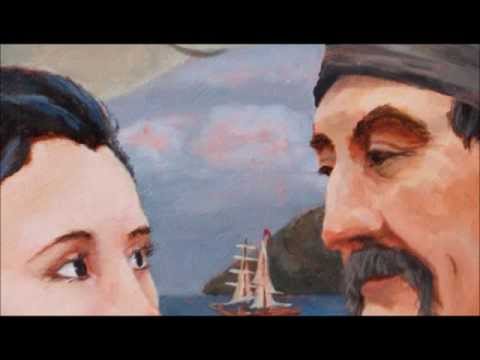
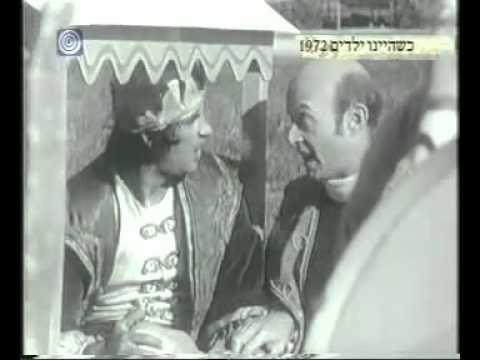
The Advice Song
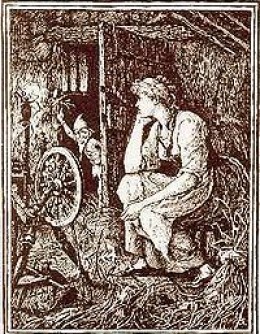
Utzli Gutzli is derived from Rumplestiltskin
The first musical I saw was an original Hebrew language play by Shlonsky based on the Grimm story “Rumplestiltskin:
My Fair Lady
The next musical that made a really big impression on me was My Fair Lady. The play was by George Bernard Shaw. The lyricist was Alan Jay Lerner. The composer was Frederick Loewe. I was ten years old. The location was Ann Arbor, Michigan. My music teacher in the local school took the whole class to see the dress rehearsal for free.
For a fictionalized account of that event, you might want to read my short story The Punky-Wunkies.
Again, this play was not really written for children. It deals with complex social issues. It speaks of the idle poor, the idle rich and middle class morality. It has lyrics like “A man was made to help support his children, which is the right and proper thing to do, but with a little bit of luck, with a little bit of luck, with a little bit of luck, they’ll go out and start supporting you.”
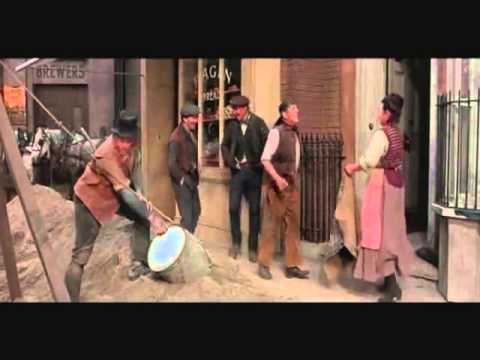
With A Little Bit of Luck
I own the book by Shlonsky (אברהם שלונסקי)
Living Without Theatre
It seemed that my early years were spent in an atmosphere rich in culture, where important works were readily accessible, and where going to the theatre was a very normal and natural part of life. Nobody I knew thought children were too simple minded to understand satire or to care about social issues. And it did not require a superhuman effort to get to the theatre. It either didn’t cost much or it didn’t cost anything. It was no big deal.
And then we moved to Grand Prairie, Texas, and all that came to a grinding halt.
I don’t really know why it happened. It’s not because of the location. We were in the Dallas-Ft. Worth Metroplex. There was theater in Dallas. There was theater in Ft. Worth. We could have gone. But for some reason we didn’t.
I remember distinctly that my mother said she might take me to see Yul Brynner in The King and I, but then when it turned out that it would require us to drive to Dallas, she changed her mind. Something happened to us. We just stopped going.
Current Day Production of Utz li Gutz li
It is in production in the Cameri Theatre.
The Cameri
The Cameri Theatre
The Dream of Broadway
For years now, I’ve had this dream of taking my daughter to see a Broadway play. When I got confined to the pens, I even thought of sending my daughter to visit a friend who lives in New York so that they could attend a Broadway play together. Then my friend told me that she has not seen a Broadway play herself in years, since the tickets are way too expensive.
Do you have to be rich to enjoy theater? Since when? And if that is the case, is it any wonder that the arts are languishing?
But there’s also another issue. There’s the content.
Modern versus Ancient
Among the literati, there are a lot of left-wingers. This doesn’t just affect their politics. It seems to affect their language, too. The idea that children could not understand archaic Hebrew — one suggested to Shlonsky, but rejected by him — is closely related to the idea that the “masses” can’t understand anything, and you have to dumb things down for them.
As a result, much of modern theater isn’t really like Utz Li Gutz Li or My Fair Lady, and it’s not worth the inflated prices they are charging for it. Rather than making modern drama accessible to the masses, they have succeeded in making it inaccessible to anyone.
If they made it something that everybody might like to see, they could probably afford to lower the price of the tickets.
Support Your Local Theater
Forget about New York! Or Tel Aviv! Or London. Or Paris. Wherever it is you live, there is a local theater within driving distance. Why not go there? That’s what I’ve decided to do. Tonight, I am taking my daughter to Springfield, Missouri to see the opening night production of Treasure Island, a musical. The cost of the tickets? Twenty dollars.
We have a choice. We don’t have to buy into expensive and pointless drama written by and for the intellectual elite, who for some incomprehensible reason live in large, crime infested cities with a high tax rate and vote against everything we believe in. We could go local. And instead of letting them think for us, we could be trend setters.
City versus CountryThe other day there was a knock at my front door, when no guests were expected. It was a local person campaigning for public office. I hesitated, when I saw her, between telling her I was in the middle of…
We All Share the Same World“We all share the same world, and we breathe the same air, and the water we drink must be cycled with care. We are closer together than ever suspected, for all things on earth are interconnected.” I wrote…
How To Love MusicIf someone asked me, a musician, what songs make me LOVE to listen to music I might start with this ten.
Comments
nhkatz nhkatz 6 years ago from Bloomington, Indiana
Aya,
I don’t think it is fair to blame the decline of theatre on the preeminence of the left.
Bernard Shaw and Shlonsky were both leftists, the former a utopian socialist and the latter a member of the marxist wing of the Israeli labor party. You could say that the problem is that the left’s standards have been dropping.
This is a phenomenon not confined to the left. How do Glenn Beck and Sarah Palin compare to Ayn Rand and Barry Goldwater? If this is a false comparison, what prominent figure on the right do you see as comparable to Ayn Rand or to Barry Goldwater?
I think the real problem is a change in the way intellectuals see their role. Shlonsky was a leftist, but at least, he was a pioneer.
Aya Katz Aya Katz 6 years ago from The Ozarks
Nets, you may be right. I knew that calling the current intellectuals “left-wing” was problematic, but I just didn’t know what other term to use, since that’s how they identify themselves, and they are clearly nothing like George Bernard Shaw, not just in their writing, but in their politics, too.
The far right of today aren’t anything like Rand or Goldwater, but then, didn’t Ayn Rand say that she wasn’t a conservative? Wasn’t Goldwater a different breed of politician? In what way was he right wing?
Utopian socialist, huh? I’ve heard that about Shaw. But… isn’t he the guy who proposed to solve the poverty problem by putting to death all the poor? Is that utopian? For that matter, is it socialist?
Doesn’t make me like his play any the less, but I tend to think of him as an eccentric free thinker. I doubt seriously if he were alive today if any current day leftist would want anything to do with Shaw.
As for Schlonsky, aren’t there parts of his play that seem to hint at the idea that a balanced budget is a good thing and that excessive government expenditure is a problem that rulers and commoners alike are responsible for?
nhkatz nhkatz 6 years ago from Bloomington, Indiana
Aya,
Is supporting a balanced budget inconsistent with being a leftist? Can’t you be for a budget that is balanced but big?
The most striking parts of Shlonsky’s book for me are the ones that mock concern with national security.
Pri frbi qi ge nhfz
Lzbe eecne sl ofz.
Aya Katz profile Aya Katz 6 years ago from The Ozarks
Nets, I have yet to meet a leftist who supports a balanced budget in the sense of not inflating the currency. But then, maybe I haven’t met enough leftists. Anyway, Schlonsky made the king’s spending seem frivolous, including the money he wanted to send to the poor woman who had triplets, but he seemed to think that spinning gold out of straw to solve the problem was also somehow wrong.
As for the injunction to be fruitful and multiply for the sake of the army, I’m afraid that one went right over my head. I took it literally. But then, I was just five…
Aya Katz profile Aya Katz 6 years ago from The Ozarks
Mixim mixim fofd mixim, fla hxim ol ekixim.
Sounds like a tax protest.
ReuVera ReuVera 6 years ago from USA
Aya, thank you so much for this hub. I totally enjoyed The Advice Song. Though I am on the level of a child with Hebrew (10 years in Israel gave me a nice Hebrew, but now 10 years of not using it …), but I understood and enjoyed every word of it! “Zanavotaim”- loved it! Was it young Zeev Revach singing?
You are so right about the high level of understanding children are able to possess. My mother took me to see a ballet for the first time when I was 8. I loved it so much!
My son manages to attend some of the performances in Milwaukee (and they have great theaters there!) only thanks to his student ID ($10 student rush), otherwise we won’t be able to afford it.
Our local community theater is very good (I volunteer there as a stage crew when I can) and they perform on a very high level!
drbj drbj and sherry 6 years ago from south Florida
You were lucky, Aya, to have been exposed to theater as a very young child. That love of the theatrical, whether professional or amateur, will sustain you forever. Thanks for this fascinating read.
Aya Katz profile Aya Katz 6 years ago from The Ozarks
Reuvera, thanks. Glad you enjoyed “The Advice Song”. Yes, it was Ze’ev Revach and Yosi Gerber performing it. It’s great that you are able to be involved in your local community theater. I wish we could, too, but it was a two hour drive to the theater.
Aya Katz profile Aya Katz 6 years ago from The Ozarks
Dr. BJ, thanks! It’s odd, but I never really focused on this love of the theatrical before. I just took it for granted.
anglnwu anglnwu 6 years ago
I agree–we can just support our local theaters instead of forking out costly sum. Another reason for supporting them?–they’re in dire need of funds. Thanks for sharing.
Aya Katz Aya Katz 6 years ago from The Ozarks
Anglnwu, thanks. I agree. The same money applied locally could make so much more of a difference.
Note: This is a Vlog Post. The text comes from the video embedded below. It is in a spoken register of English.
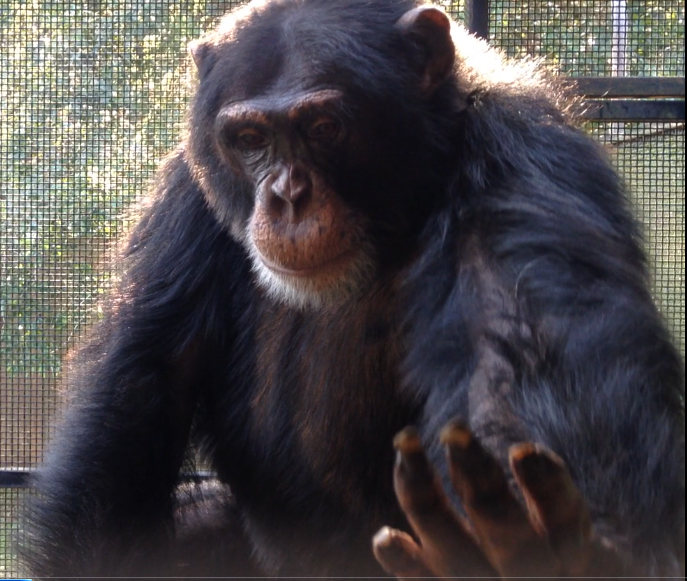
I have a lot of comments on my videos, especially the videos of Bow. And a lot of them are very positive. And most of them are about — you know — how cute he is, and how wonderful it is to work with him, and how somebody else might like to experience that. But I also receive some negative comments, and if they’re really nasty I delete them, but I don’t delete every critical comment. And recently I had one that I think needs addressing.
It was basically: “You are not a real primatologist. And you are not engaged in an official study.” You know, with any university or any other official place, and I don’t remember what the rest of it was.
Okay, so first of all let’s address what a “real” primatologist is. A real primatologist is a scientist who studies primates — usually nonhuman primates, but lately the primatologists that I know have been forced to study humans, because those are the only primates who are available to study.
The primatological studies happen in a number of disciplines, which include biology, psychology, anthropology and, in my case, linguistics. So I have a PhD in linguistics from Rice University in Houston. And my PhD is about as “official” as it gets. But you’re right. I am not engaged in an “officially” sanctioned study. And neither is anyone else. [When it comes to ape language studies.]
So what’s happened is that there has been a political movement that said that humans and apes, or other nonhuman primates, should not interact with one another. The kind of primatological studies that are now being allowed to take place, usually not on university campuses, because the great apes have been pretty much banned from university campuses, but at other institutions such a zoos and other research facilities, they are studies involving cognition, studies involving biology. Oftentimes, if it’s anything resembling language, it is computer mediated. And the researchers are not allowed to form a relationship to the research subject.
For some things, that’s fine. If you’re just giving them intelligence tests, if you’re just trying to see if they can solve a problem, even a linguistic problem, in a very formal way, then, yes, it’s fine not to have a relationship. But if you want to see whether they can develop language — not become linguists and solve a linguistic problem in a very abstract way — but develop language for the purposes of communication, then you need to replicate the situation that is available to humans when they acquire language.
So if you take a child and separate the child out from society, from other people, make sure that all the child’s needs are met, and go in there with a mask to feed the child, and you treat the child as if it were some kind of biological object, not a person, and you don’t talk to the child, and you don’t allow the child any means to talk to you, then that child will not develop language. It’s true for humans, and there’s no reason to suppose that it’s not true for chimpanzees , [bonobos], gorillas, orangutans and lower order primates.
So, if your particular interest is language, and mine is, it’s important to have that relationship. And right now no official study is doing that! And those people who used to have official studies — and there are people, and I’m following in their footsteps — have been forced to leave the academic world in order to pursue these things, and often they are forced out of their institutions, and they lose custody of their apes, because they are not allowed to own them, and all of this is going in a certain direction. And it’s not a direction that will ever allow us to test the hypothesis that other apes are capable of language.
So while this is not an official study, this is a study that is very important to the development of science. And believe me, science is not an “official” thing. It never was, and it never will be!
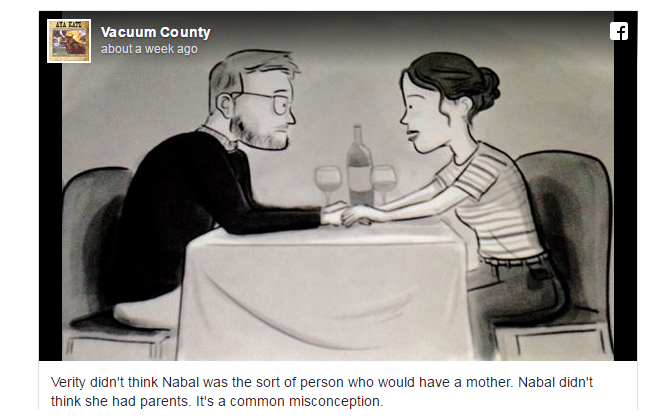
This cartoon from the New Yorker, posted on Facebook by a friend, and shared by the Vacuum County fan page had a caption saying: “Before we go any further, I should let you know that I have parents.”
Everyone, at one time or another, has had parents. Or parent surrogates, if the actual parents were not around. But sometimes it is hard to imagine that someone we are having a relationship with also has parents. Do the types of parents we have had determine the way we view love? Can we look at someone’s parents and learn more about their way of loving?
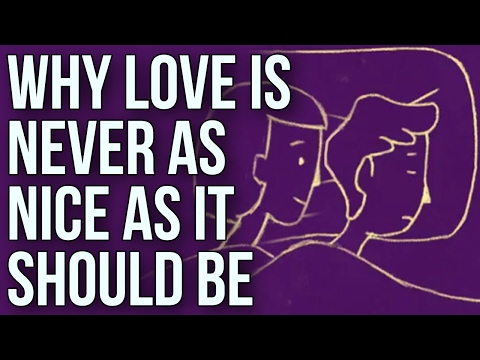
They say that what we experienced with our parents as children affects what we expect from a romantic relationship — that the sort of love we got affects the sort of love we expect to receive — and to give — in the future. Here in the video embedded below is the School of Life’s take on this issue.
A salient excerpt from the video suggests that our first glimpse of love was with a parent:
Our idea of what a good loving relationship should be like and what it feels like to be loved, doesn’t ever come from what we’ve seen in adulthood. It arises from a stranger, more powerful source. The idea of happy coupledom taps into a fundamental picture of comfort, deep security, wordless communication and of our needs being effortlessly understood that comes from early childhood.
At the best moments of childhood, if things went reasonably well, a loving parent offered us extraordinary satisfaction. They knew when we were hungry or tired, even though we couldn’t usually explain. We didn’t need to strive. They made us feel completely safe. We were held peacefully. We were entertained and indulged. And even if we don’t recall the explicit details. the experience of being cherished has left a profound impact on us. It’s planted itself in our minds as the ideal template of what love should be.
This conception or gestalt of what love consists of is by no means as universal as “The School of Life” would have us believe. But there is a certain segment of the world’s population that does hold to this view and that can conceive of no other type of love.
Here are few properties of this kind of love: 1) It is one-sided 2) It’s a feeling of “satisfaction” with another’s perceived state of mind and not the feeling of love for another, because it’s the experience of “receiving” love rather than the emotion of loving and 3) it involves having basic needs like food and shelter being met by someone else in return for nothing. There is the fallacy of the stolen concept here, because the satisfaction of being loved presupposes a perceived love by another that remains undefined. But also, it’s an appeal to attachment love, as opposed to limerent love.
There is a developmental fallacy inherent in supposing our first experience of love is of being loved by a parent, rather than loving that parent ourselves. Babies are born without a concept of self and other. When they first discover that the parent is not a part of themselves, they have still not yet worked out for themselves a theory of mind. So it is much more likely that the baby first loves the parent, before ever realizing that the parent returns that love. To feel your own love for another, it is not necessary to read another person’s mind. The raw feeling of loving someone is directly linked to physical sensations from the reward center of the brain. To determine that someone else loves us is a much more convoluted act of abstract inferencing, based on indirect evidence. A baby can experience preference for a particular caregiver’s face at about six months of age. Having a complex theory about another person’s feelings and thoughts does not happen until much later.So despite popular opinion to the contrary, we probably experienced being in love before we experienced being loved.
Even if we do get our first taste of a satisfying experience of being loved from our relationship with a parent, it’s not necessarily the nurturing, mind-reading all powerful being who took care of us in early infancy. It’s not always the one who held us peacefully and indulged our every need. That maternal, “unconditional” love that so many assume is the only “real” love gives way to other pleasures. There is the parent who threw us up in the air and excited, rather than calmed us. The one who encouraged us to test our wings, who engaged us in logical argumentation when we were only in preschool and corrected us when we erred, who when the other parent was trying to force us to cower indoors, told us that, yes, we could go out walking alone at night, and here was a gun to protect ourselves with. There is the parent who treated us with respect, like a real person, while the other parent wanted to spare us all suffering, stunting our growth. In short, we could model our view of love on the typically more paternal parental role.
Not all mothers are nurturing, and not all fathers empower children toward greater independence. Sometimes the roles are reversed. Sometimes children have only nurturers and no challengers. Sometimes there is only the challenging parent, and not the nurturing one. But whichever way being loved is first experienced, our model for adult love should not be of an all powerful person who filled our every need and asked nothing of us in return. This is not because adults and children are so different. It’s because even chidren are not nearly as passive and dependent as this model assumes.
In our modern society, when people speak of love, they often have a skewed model of what love is, based on a misunderstanding of the parent/child relationship. Not only is the adult relationship nothing like the ties between a newborn infant and its mother, but also most of childhood is nothing like the helplessness of the newborn. Even at a few weeks old, an infant starts to give back to a caretaker and is not only and merely ever taking. If you’ve ever cared for an infant, you know it’s not all selfless service to a clueless, entitled being. They do give back first with smiles and teasing glances, but later with offering to help sweep the floor and wash the dishes, before they ever conceive of those tasks as a chore. Toddlers long to grow up and be contributing members of the family. Unfortunately, in today’s society, children are seldom given a chance to make real contributions before adulthood. A parent’s ideal relationship with a child is not all giving and no taking. The more the parent respects the child, the more the relationship will be a two way street. Even when their positions are inherently unequal, good parents empower children to face difficulties and challenges, rather than fixing everything for the child so it goes smoothly.
The gestalt of love is not the same for everyone. Failing to define what you mean by love can lead to many misunderstandings. There is great danger of miscommunication in assuming that love is universally experienced as selfless provision of service by a being far superior to ourselves. This view of love creates an undesirable effect of turn-taking in adult relationships. Since adults are expected to give as well as receive love, lovers who conceive of love as selfless take turns being the “good, giving” partner, instead of giving and taking simultaneously based on the pleasure of complementary, though somewhat asymmetrical sex roles. That is, such partners assume they can’t both be happy at the same time, and that one person’s happiness is at the “expense” of the other.
The fallacy at the heart of this view of love is a misunderstanding of “taking and giving” as necessarily consisting of two separate acts. It is very difficult to give someone a hug and not get a hug back somehow. It’s not possible to touch someone and not be touched in turn. Even in unreciprocated love, there is a great pleasure that comes from loving someone else. The idea that “getting” must involve exploitation of a “giver” is at the heart of this misconception.
The selfless conception of unconditional love has ramifications well outside the family and sex roles. When people speak of universal love as a desirable goal for society at large, this can often be a shorthand for socialism and the nanny state. That’s why when someone starts waxing eloquently in praise of “love” and how all the world’s problems can be solved “by love, sweet love”, it might be a very good idea to ask them which kind of love they mean exactly. If it’s the selfless kind, ask them how they think everyone can sacrifice himself selflessly to everyone else and how any society could possibly function that way.
Dogbane and milkweed look very similar, before they bloom. They both have waxy leaves and both give a milky discharge if they are injured. Here are some tips for telling them apart.
Milkweed plants (asclepias) are bigger than dogbane and their leaves are broader. There is a slight reddish tinge to the vein that runs through the middle of the leaf, dividing it in two. The leaves are more “waxy” on the milkweed than the dogbane.
Even before the flowers bloom, the flower buds are bigger on the milkweed than on the dogbane plant, and they are placed much closer together, to make a composite flower. The dogbane cluster is looser, and there are fewer individual buds in each cluster.
When the leaves of the milkweed are injured, the white sap that comes out looks like Elmer’s glue.
The dogbane flowers, when they open, are usually white.
Dogbane flowers opening
In contrast milkweed flowers are more colorful. The can be purple, pink or orange, depending on the variety.
Milkweed flowers have bright colors
Dogbane flowers are tiny and delicate. They are easy to overlook.
A tiny sweat bee is bigger than a single dogbane flower
A sweat bee when it lands on a dogbane flower entirely obscures it from view, the flower is so small. Large butterflies, like spangled fritillaries, can sit on milkweed flower, and still most of the flower is visible. Of course, those are composite flowers we are looking at.
Great Spangled Fritillary butterflies on purple milkweed
Even though the flowers are arranged in clusters on the dogbane, too, they don’t quite form a larger composite flower, as their stems are longer, and they each seem to be going a different way.
Each tiny flower in the bunch seems to be going its own way Dogbane florets are individuals
But even when in bud, the milkweed flowers form a collective, single entity.
The milkweed flower buds are bunched so closely together that they seem to act as one. Different bunches will form different composite flowers on the same plant.
By the time the flowers bloom, the difference between the the dogbane and the milkweed is unmistakable. But before we see the flowers, a closer examination of the leaves can help.
Copyright words and images 2017 Aya Katz
Update from May 12, 2018
Today I saw both dogbane and milkweed plants side by side long before either had bloomed. Look at the video to get a better idea of the basic differences that don’t involve the flowers.
The dogbane plants are still taller at this point than the milkweed, but the milkweed leaves are broader and more waxy.
I have been fixating on milkweed. Two years ago, I found plenty of milkweed on my property. There was purple milkweed, with its pinkish blooms. There was common milkweed, with its less brilliant kind of purple. And there was even butterfly milkweed, which was sort of orange. But all the milkweed disappeared last year. And along with it went the butterflies that I used to watch feeding on the milkweed flowers.
This year there has been massive flooding in our state, and with the rain, there also came a lot of growth. In a completely different spot in my unmown pasture, a bunch of plants have come up that have leaves just like my old milkweed. Well, not exactly like my old milkweed, and they have yet to flower. So I am hoping they are milkweed, but I’m not sure.
Yesterday I trudged in the rain-soaked pasture in high boots to get a closer look. Those look like flowers developing in the middle, at the top if the plant.
Then today a Facebook friend, Dave McClure, a Scotsman who lives in Doha, Qatar, posted a photo of a plant and asked what it was.
Photo by Dave McClure
Photo by Dave McClure
“Anybody know what this plant is? The seed pods are about lemon sized and puffy to touch and the leaves are round and waxen. Obviously it likes hot climates or it wouldn’t be wasting its time in Qatar,” Dave McClure wrote on his Facebook wall.
It looks like a plant I saw in Israel, I thought to myself. But then I also thought, no, the leaves remind me of milkweed. So Missouri Aya kept insisting it was milkweed, like the rain soaked plant in the pasture, and Israeli Aya kept thinking it was a plant she had seen in her arid native land long. long ago. I had split brain syndrome. But wait, could it be both?
“Found only in Doha” the site said. But not really only in Doha. That’s just if you are looking for it exclusively in Qatar. The asclepias procera is native to “North Africa, Tropical Africa, Western Asia, South Asia, and Indochina.”
The plant is a milkweed. It is even called “Giant Milkweed”. But it also goes by a number of other names: “Asclepias procera, mudar, osher, Sodom’s Apple, stabragh, ushaar, ushar”. The name Sodom’s Apple comes from the Hebrew תפוח סדום. And the fact that it even has a Hebrew name is a pretty good indication that, yes, this version of milkweed does grow in Israel as well.
In his Biblical Researches in Palestine, Edward Robinson describes it as the fruit of the Asclepias gigantea vel procera, a tree 10–15 feet high, with a grayish cork-like bark called osher by the Arabs. He says the fruit resembled a large, smooth apple or orange, hanging in clusters of three or four. When pressed or struck, it exploded with a puff, like a bladder or puff-ball, leaving in the hand only the shreds of the thin rind and a few fibers. It is filled chiefly with air, which gives it the round form. In the center a small slender pod runs through it which contains a small quantity of fine silk, which the Arabs collect and twist into matches for their guns. From the Wikipedia
If you look Sodom’s apple up in the Hebrew wikipedia, you will find that the plant has another name: פתילת המדבר הגדולה. Which loosely translated means “great wick of the desert.”
That just goes to show once again that everything is interconnected. All flesh is kin. And when your intuition says it’s a milkweed — no, wait, I’ve seen it in Israel! — the answer should always be: Why not both? It’s a small world.


































_2.jpg)
