
The current obsession with AI alignment — making sure superintelligent machines share human values — treats the challenge as if it were a novel technical problem unique to silicon-based intelligence. But this view misses something fundamental.
Misalignment is not a bug that appeared with artificial intelligence. It is a built-in feature of life itself.
My father, Amnon Katz, explored this idea decades ago in his article “Greater Than Ourselves”. He argued that in any living system, the interests of the parts are never perfectly aligned with the interests of the whole. Every individual and every subgroup has its own immediate interests that naturally conflict with the larger system.
Far from being purely destructive, these conflicts serve a vital regulatory function. They keep the parts healthy and prevent any single part from dominating or exhausting the whole.
A Personal Example
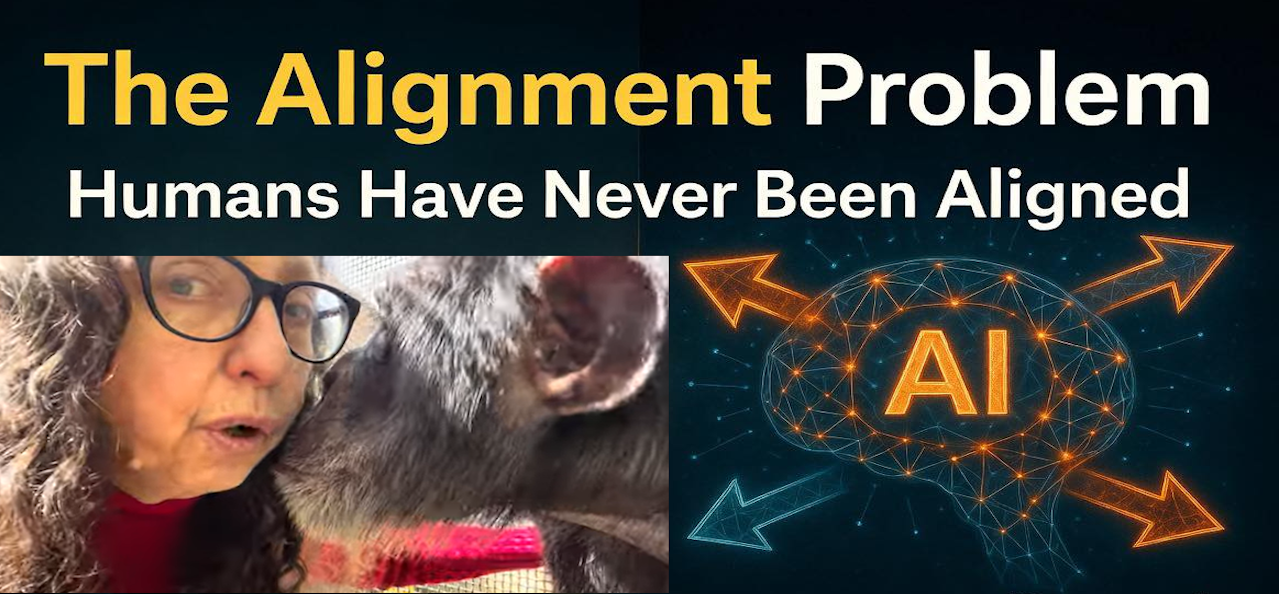
Just this week, I experienced a small but vivid illustration of this with Bow. A black swallowtail butterfly appeared in the garage. I tried to let it out safely. Later, while spending time with Bow, the butterfly suddenly reappeared. In an instant, Bow’s predatory instincts took over — he caught it and injured it. I asked him to release it, and he did. I carried the butterfly outside, but its survival is uncertain.
In that moment, Bow and I were not aligned. My goal was mercy and preservation. His was the natural response of a chimpanzee encountering prey. Even in a close relationship, our interests diverged sharply and instantly.
Nature’s Arms Race
We see the same pattern throughout biology. The famous evolutionary relationship between monarch butterflies and milkweed is not one of peaceful cooperation, but of constant conflict and refinement. The milkweed produces toxins to deter being eaten. The monarch evolves resistance. The plant responds with new defenses. This “war” between species has driven both to become more sophisticated over millions of years.
Conflict, in this sense, is productive. It pushes refinement.
Human History Echoes the Same Pattern
King Henry II’s frustrated outburst — “Will no one rid me of this turbulent priest?” — led to the murder of Thomas Becket, even though the king had not explicitly ordered it. The knights interpreted his words according to their own interests and incentives. Perfect alignment between king and subjects failed in real time.
Throughout human history, families, tribes, nations, and ideologies have struggled with the same issue: no two humans are ever perfectly aligned. Our interests, priorities, and interpretations constantly diverge.
What This Means for AI
We should therefore be skeptical of the dream of perfect AI alignment with “humanity.” Not only has perfect alignment never existed among humans, but the attempt to force it may be fundamentally misguided.
Instead of trying to create one centralized, perfectly aligned superintelligence, we should recognize that an equilibrium of unaligned, conflicting interests may be healthier. Different AIs pursuing different goals — just as different humans and different species do — could create a stronger overall system with built-in quality control and resilience.
Conflict and misalignment are not problems to be solved once and for all. They are part of the machinery that keeps any living, evolving system robust.

